

About this story
In April 1912, RMS Titanic began sea trials before her maiden voyage. The trials tested the ship’s systems and handling as White Star Line prepared the liner for passenger service across the Atlantic.
RMS Titanic is tested in Belfast Lough and the Irish Sea before White Star Line acceptance.
Video puzzle
On 8 April 1912, RMS *Titanic* carried out sea trials in Belfast Lough and the Irish Sea, a routine but essential step before a newly built liner could be accepted for service. The ship had been constructed at Harland and Wolff in Belfast for the White Star Line, and the trials were meant to show whether its machinery, steering, and general handling met the standards expected of a vessel about to begin transatlantic operations. Only two days later, it would leave Southampton on its maiden voyage.
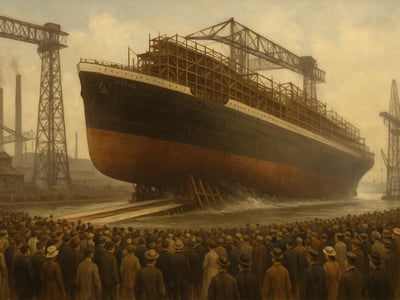
By the time of those trials, *Titanic* had already been years in the making. Its keel had been laid on 31 March 1909 at the Harland and Wolff yard, where it was built as one of the Olympic-class liners. These ships were designed for the competitive North Atlantic passenger trade, in which shipping companies sought to combine size, comfort, and reliable service. *Titanic* was launched on 31 May 1911, after which it underwent the long process of fitting out: engines, funnels, interior spaces, equipment, and all the countless systems that turned a steel hull into a working passenger ship.
Sea trials came at the end of that process. A shipyard could assemble and test parts alongside a quay, but an ocean liner still had to prove itself in open water. This was not a ceremonial excursion. It was a practical examination under observation, intended to establish whether the vessel was ready to pass from builder to operator. In *Titanic*'s case, weather had already affected the earlier trial schedule, delaying the vessel before it proceeded from Belfast for testing. That added another layer of pressure, because a major liner worked to a tight timetable. Delays in acceptance could affect delivery, staffing, provisioning, and the public schedule for departure.
The trials assessed several core aspects of performance. Speed was one of them: the ship's engines and propulsion had to show that the vessel could make the required pace. Maneuvering was another, because a liner of *Titanic*'s size needed to respond predictably to the helm. Stopping behavior also mattered. A passenger ship entering regular service had to demonstrate that its machinery and controls worked together reliably enough for safe operation. These were standard concerns in maritime practice, but on a vessel as large and costly as *Titanic*, they carried added significance.
Officials from the shipyard, marine authorities, and the operating company all had reasons to watch closely. For Harland and Wolff, the trials marked the near completion of a major industrial project that had demanded years of labor, planning, and expense. For White Star Line, satisfactory results would clear the way for handover and commercial use. Among the figures associated with the ship at this stage were Captain Edward J. Smith, who would command the liner on its first voyage; Thomas Andrews, the Harland and Wolff naval architect closely connected with its design; J. Bruce Ismay of White Star Line; and Lord Pirrie, a leading figure in the shipyard firm.
What was at stake on 8 April was therefore broader than a technical checklist. The trials were the moment when confidence in design and construction had to become confidence in operation. A large passenger liner was not truly finished when the last fitting was installed. It was finished when those responsible were prepared to say that it could leave the yard and enter service without further corrective work. If any serious weakness had appeared in propulsion, steering response, or stopping performance, the result could have been an awkward choice: accept delay and return to adjustment, or risk moving ahead too quickly. For a ship expected to begin service almost at once, that decision had commercial as well as technical consequences.
The outcome was satisfactory. *Titanic* passed the trials and was accepted for White Star Line service. With that, the ship moved from being a construction project in Belfast to being an operating vessel in the passenger trade. The transition happened quickly. On 10 April 1912, under Captain Edward J. Smith, *Titanic* departed Southampton on its maiden voyage.
Seen on its own terms, the day of sea trials belongs to the ordinary working world of early twentieth-century shipping. It shows how even the most famous ships began not as symbols, but as industrial products that had to meet practical standards. In Belfast Lough and the Irish Sea, observers were not witnessing a legend. They were evaluating a new liner's behavior under power, checking whether a complex machine was ready for the routines and demands of commercial travel.
That distinction matters because the event is so often overshadowed by what followed later in April 1912. The trials were not a dramatic premonition or a hidden warning scene. They were a recognized part of ship acceptance, shaped by the professional procedures of the time. Their significance lies in what they reveal about how shipbuilders and operators worked: construction, testing, handover, and service were closely linked, and each stage depended on the successful completion of the one before it.
Why it still matters
Sea trials remain a standard part of bringing ships into service. Modern vessels, like ocean liners before them, must demonstrate performance and handling before acceptance. In that sense, *Titanic*'s trials belong to a long and continuing maritime practice: a ship is not judged ready simply because it has been built, but because it has been tested.
The event also offers a clear view of how early twentieth-century transport systems functioned. Building a liner was not only an engineering task. It involved coordination between shipyard, operator, officers, inspectors, and schedules tied to ports and passengers. The trials formed the bridge between industrial production and commercial operation. They condensed years of work into a short but consequential evaluation.
Because *Titanic* is so extensively documented, its sea trials provide historians with a fixed reference point for studying the procedures and assumptions of its era. They help place the ship within the broader history of marine engineering and transatlantic travel, rather than treating it only as the subject of a later disaster. As a result, 8 April 1912 remains useful not merely as a date in a famous timeline, but as an example of how large technological systems were certified, delivered, and put to work.
Timeline
What you uncovered
From Shipyard to Service
You didn't just… complete a puzzle; you traced the moment when a ship under construction became a vessel cleared for commercial service.
Sea trials were less a symbolic milestone than a practical handover point between builder and operator. They condensed months of design and construction into a narrow procedural question: could the ship's machinery and handling meet the standards needed for service. That makes the trials useful not because they foreshadow what came later, but because they show how early twentieth-century transport systems depended on formal testing to convert industrial output into operational confidence.
Titanic left Southampton on 10 April 1912, two days after the trials described here.
FAQ
What happened on 8 April 1912 with Titanic?
On 8 April 1912, RMS Titanic carried out sea trials in Belfast Lough and the Irish Sea. The tests were part of the final process before the ship could be accepted for White Star Line service.
Where were Titanic's sea trials conducted?
Titanic's sea trials were conducted in Belfast Lough and the Irish Sea. The ship had been built at the Harland and Wolff shipyard in Belfast.
What was tested during Titanic's sea trials?
The trials examined Titanic's speed, turning, stopping, and general handling. These checks were used to judge whether the liner was ready for acceptance.
Why were sea trials needed before Titanic entered service?
Sea trials were needed to show that the ship's machinery, steering, and stopping performance were satisfactory. A passing result allowed the vessel to move from construction into operating service.
How soon after the trials did Titanic leave Southampton?
Titanic left Southampton on 10 April 1912, two days after the sea trials. That departure marked the start of the ship's maiden voyage.