

About this story
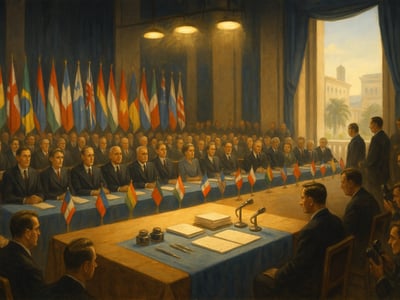
Delegates gather in San Francisco as the 1945 UN charter conference opens.
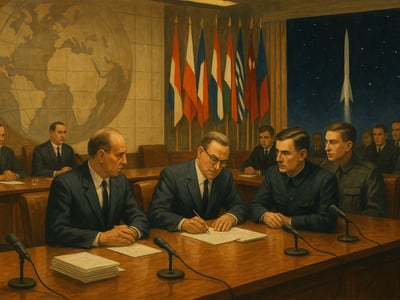
On April 25, 1945, as World War II was nearing its end but had not yet fully concluded, delegates from 50 countries gathered in San Francisco, California, to open the United Nations Conference on International Organization. The meeting began at the War Memorial Opera House, with additional work carried out in the nearby Veterans Building. Its purpose was not simply to stage a symbolic international gathering, but to complete a difficult diplomatic task: turning earlier wartime proposals into a charter that dozens of governments would accept.
The conference opened at a moment of unusual uncertainty. The war in Europe was in its final phase, but the political shape of the postwar world was still unsettled. Many governments agreed that some new international body was needed after the failure of the League of Nations and the devastation of another global war. Agreement in principle, however, did not settle the practical questions. States still had to decide what powers the new organization should have, how its main organs would be structured, and how national sovereignty would coexist with collective decision-making.
The principal working basis for the conference was the Dumbarton Oaks proposals, developed in Washington, D.C., during conversations held from August to October 1944. Those proposals had already outlined the broad structure of a future organization, including a General Assembly, a Security Council, an international court, and a secretariat. Yet many essential issues remained open. The conference in San Francisco was therefore the stage for final negotiation rather than first invention.
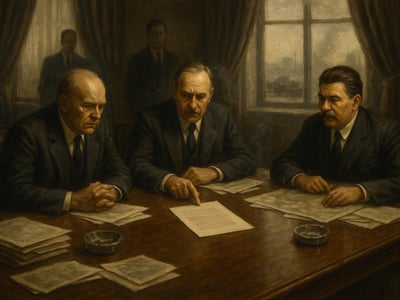
Recent wartime diplomacy had already shaped the limits of those negotiations. Decisions at Yalta earlier in 1945 helped settle key questions about participation and voting, especially the arrangements that would apply in the Security Council. That meant the delegates arriving in San Francisco were not working on a blank page. They were inheriting a framework created by earlier talks among the major Allied powers, then trying to adapt it into a document broad enough to win support from a much larger group of states.
The United States, as host country, played a central organizing role. U.S. Secretary of State Edward Stettinius Jr. served as chairman of the American delegation. Other prominent figures associated with the conference included Anthony Eden of the United Kingdom, Vyacheslav Molotov of the Soviet Union, and T. V. Soong of China. President Harry S. Truman addressed the gathering in the wake of Franklin D. Roosevelt’s death earlier that month, linking the conference to Roosevelt’s long-standing support for a postwar international organization.
Even so, the atmosphere was not one of complete harmony. Delegates represented governments with different war experiences, strategic interests, and political systems. Smaller states wanted assurances that the new organization would not be dominated entirely by the strongest powers. The major powers, meanwhile, were determined to preserve arrangements they believed necessary to keep them inside the system and to make it workable in questions of peace and security. The conference therefore involved constant bargaining over wording, authority, and institutional design.
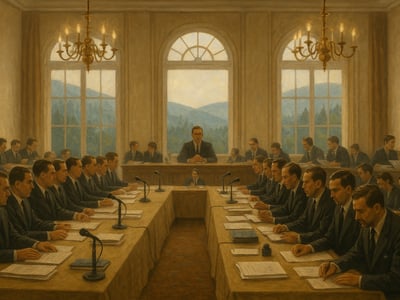
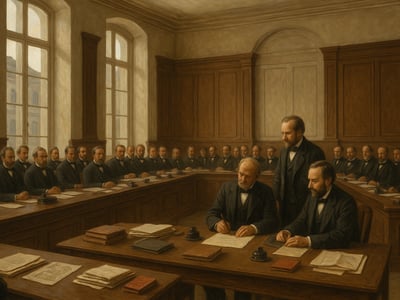
That bargaining unfolded in committees, commissions, and formal sessions rather than in a single dramatic debate. Representatives worked through draft language, revised articles, and argued over procedures. Questions of membership, voting, regional arrangements, trusteeship, and the balance between the General Assembly and the Security Council all required careful handling. Some of the most consequential choices concerned how to create an organization that was universal enough to claim broad legitimacy while still reflecting the realities of power at the end of the war.
In that sense, the San Francisco conference was both ambitious and constrained. It sought to define a durable framework for international cooperation, but it could do so only within political limits that the participating governments were willing to accept. The delegates were not building a world government. They were drafting a charter for an intergovernmental institution, one that would depend on member states for authority, resources, and enforcement.
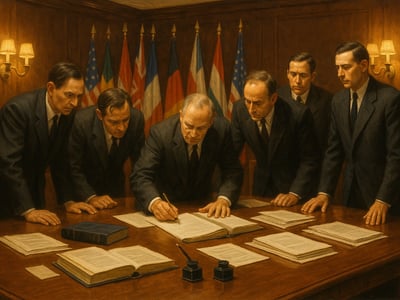
The work continued for two months. By the end of the negotiations, the conference had produced the text of the Charter of the United Nations. On June 26, 1945, that charter was signed in San Francisco. The signing marked the completion of the conference’s central task, though the organization itself would come into force only later, after the necessary ratifications.
Why it still matters
The San Francisco conference matters because it established the charter framework for a permanent international organization with defined organs, procedures, and legal purposes. Many later debates about peacekeeping, sovereignty, collective security, and international cooperation have taken place within structures first set out there.
It also illustrates how international institutions are usually formed: not in a single moment of idealism, but through layered negotiation. The conference depended on earlier planning at Dumbarton Oaks and on wartime agreements reached elsewhere, yet it still required weeks of drafting and compromise among 50 delegations. That process helped translate broad hopes for postwar stability into a written constitutional document for the United Nations system.
The Charter produced in San Francisco remains one of the foundational legal texts of modern international relations. Whatever judgments people make about the later successes or limits of the United Nations, the conference of April to June 1945 was the point at which a proposed institution became an agreed framework. In that respect, the opening session on April 25 was less an ending than the start of the final, decisive round of negotiation.
Timeline
- Dumbarton Oaks discussions begin
- Yalta Conference begins
- United Nations Conference opens in San Francisco
- UN Charter signed
- UN Charter enters into force
What you uncovered
Drafting a World Order
You didn't just… complete a puzzle; you traced a moment when governments tried to turn wartime plans into a workable international framework.
The San Francisco conference is often remembered as a founding scene, but its real significance lies in the drafting process behind the symbolism. Delegates were not starting from nothing: they were revising earlier proposals, bargaining over structure, and testing how far states would commit to shared rules. That helps explain why the UN Charter has endured as both an idealistic document and a practical compromise shaped by power, procedure, and caution after global war.
The conference opened on 25 April 1945 at San Francisco's War Memorial Opera House with delegations from 50 countries.
FAQ
What happened on 25 April 1945 in San Francisco?
On 25 April 1945, the United Nations Conference on International Organization opened at the War Memorial Opera House in San Francisco, California. Delegates from 50 countries gathered to begin the final negotiations for the United Nations Charter.
Who took part in the San Francisco conference?
Delegations from 50 countries took part in the conference. U.S. Secretary of State Edward Stettinius Jr. served as chairman of the United States delegation.
What proposals were used as the basis for the talks?
The conference used the Dumbarton Oaks proposals of August to October 1944 as its principal working basis. Those drafts guided the charter negotiations in San Francisco.
When was the United Nations Charter signed?
The Charter of the United Nations was signed in San Francisco on 26 June 1945. It was the result of the negotiations that began at the conference in April.