


About this story
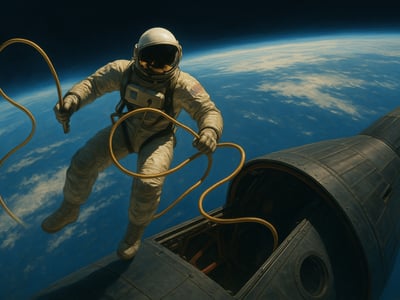
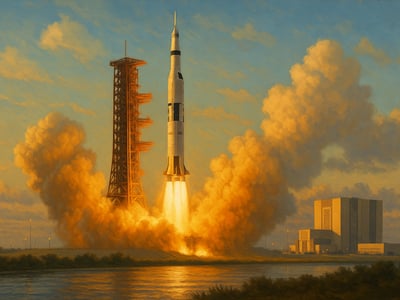
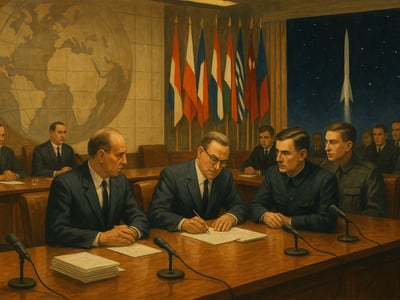
Yuri Gagarin and Vostok 1 during the first human orbital mission on 12 April 1961.
Video puzzle
On April 12, 1961, Yuri Gagarin flew into space aboard the Soviet spacecraft Vostok 1, completed one orbit of Earth, and returned safely after a mission lasting 108 minutes from launch to landing. The flight began at Baikonur Cosmodrome in the Kazakh Soviet Socialist Republic and ended with Gagarin descending by parachute in Saratov Oblast. In a little under two hours, the Soviet Union demonstrated that a human could be launched beyond the atmosphere, survive orbital flight, and come back alive.
That result was not a simple extension of earlier rocket tests. By 1961, the Space Race had already taken shape through satellite launches and increasingly ambitious demonstrations of missile and rocket technology. Sputnik 1, launched by the Soviet Union in 1957, had shown that an artificial satellite could circle the planet. But sending a person into orbit introduced a different level of difficulty. Engineers had to trust a launch vehicle powerful enough to reach space, a cabin capable of sustaining life, communication systems that would work across long distances, and a reentry sequence that would not destroy the craft or its occupant.
The Soviet crewed space effort was overseen by chief designer Sergei Korolev, whose team worked on the Vostok spacecraft and the launch system needed to carry it. The problem was not only technical but procedural. Human beings had not yet experienced orbital flight, so planners had to prepare for uncertainty at nearly every stage. They had to consider the stresses of ascent, the effects of weightlessness, the reliability of automated controls, and the practical question of how to recover the pilot after landing.
Yuri Gagarin, a young Soviet Air Force pilot, became the person chosen for this mission. His selection came after training within the first Soviet cosmonaut group, whose members were evaluated for physical endurance, discipline, and the ability to remain calm under unfamiliar conditions. The mission profile left little room for improvisation. Vostok 1 was designed to operate largely automatically, reflecting both engineering choices and concern about how a human might function in orbit for the first time.
When Vostok 1 lifted off from Baikonur on April 12, the stakes were clear even if many operational details remained secret at the time. A successful mission would have scientific, military, and political significance. A failure in launch, communication, orbital operations, reentry, or landing could have ended the flight catastrophically. Soviet officials and engineers nevertheless approved a crewed orbital attempt, accepting risks that could not be fully measured through previous human experience.
After launch, Gagarin entered Earth orbit and became the first human to travel in space. During the flight, Vostok 1 completed one full orbit of the planet. That single circuit was enough to prove several things at once: that a person could survive launch into orbit, that life-support systems could function during the mission, and that reentry after orbital flight was possible in practice rather than only in theory. The spacecraft's path was brief by later standards, but it crossed a threshold that had defined the ambitions of early spaceflight.
The mission's total duration was 108 minutes from launch to landing. Within that span, every major phase mattered. Reaching orbit was only the first challenge. Returning safely required the spacecraft to begin reentry after its orbital pass and to descend in a controlled way. Recovery planning was especially important because the mission could not be considered complete until the pilot was back on the ground alive. Gagarin landed by parachute in Saratov Oblast, in the Volga region, bringing the flight to a successful end.
News of the mission rapidly spread around the world. In the context of the Cold War, the flight was understood immediately as a major Soviet achievement in the competition for technological prestige. Yet the event was also larger than that rivalry. It changed public expectations about what space programs could attempt and accelerated discussion of future crewed missions. What had been an engineering objective became, after April 12, a demonstrated human capability.
The flight also shaped the next phase of space planning in both the Soviet Union and the United States. If one orbit was possible, then longer missions, more complex spacecraft, and eventually journeys involving rendezvous, docking, and lunar travel could be imagined less as speculation and more as engineering problems to solve. The United States soon followed with its own human spaceflights, including Alan Shepard's suborbital mission in May 1961 and John Glenn's orbital flight in 1962. Gagarin's mission did not settle the Space Race, but it reset its scale.
Why it still matters
Vostok 1 remains important because it established an operational sequence that later human spaceflight would continue to refine: launch, orbital flight, reentry, and recovery. Even though later missions became longer and more sophisticated, the basic challenge that Vostok 1 met was fundamental. The mission showed that human space travel required not one successful machine but a chain of systems working together under extreme conditions.
It also intensified state investment in rockets, aerospace engineering, research institutions, and training programs. Governments and scientific organizations treated the flight as evidence that space technology had moved from experimentation into a new phase of practical achievement. This influenced budgets, education, industrial priorities, and international perceptions of technical capacity.
Today, Gagarin's 108-minute mission is still used as a reference point in the history of Cold War competition and in the broader story of exploration beyond Earth. Its importance does not depend on later myths or celebrations. The historical fact is enough: on a single April morning in 1961, one crewed spacecraft completed an orbit and returned safely, turning human spaceflight from an ambition into a reality.
Timeline
- Sputnik 1 launch
- Selection and training of first Soviet cosmonaut group
- Development of Vostok spacecraft and launch system
- Yuri Gagarin completes first human orbital flight
- Alan Shepard Mercury-Redstone 3 flight
- John Glenn first U.S. orbital flight
What you uncovered
More Than One Orbit
You didn't just… complete an image of Yuri Gagarin; you reconstructed a moment when sending one person around Earth depended on launch systems, reentry control, and recovery plans all working together.
The significance of Vostok 1 was not only that it reached orbit, but that it linked several fragile systems into one complete mission. In 108 minutes, the flight had to prove that a human could be launched, survive orbital conditions, return through the atmosphere, and be recovered safely. That made it both a technical demonstration and a political signal, showing how spaceflight and state prestige were tightly connected in the early Cold War.
Vostok 1 lasted 108 minutes from launch at Baikonur to Gagarin's parachute landing in Saratov Oblast.
FAQ
When did Yuri Gagarin fly aboard Vostok 1?
Yuri Gagarin flew aboard Vostok 1 on 1961-04-12. The mission began with a launch from Baikonur Cosmodrome.
Where did Vostok 1 launch and where did Gagarin land?
Vostok 1 launched from Baikonur Cosmodrome in the Kazakh SSR, Soviet Union. Gagarin landed by parachute near the Volga region in Saratov Oblast.
How long did Gagarin's Vostok 1 mission last?
The mission lasted 108 minutes from launch to landing. During that time, Vostok 1 completed one orbit of Earth.
Who oversaw the Soviet crewed launch program in 1961?
Sergei Korolev served as the chief designer overseeing the Soviet crewed launch program in 1961. Yuri Gagarin was the cosmonaut aboard Vostok 1.