

About this story
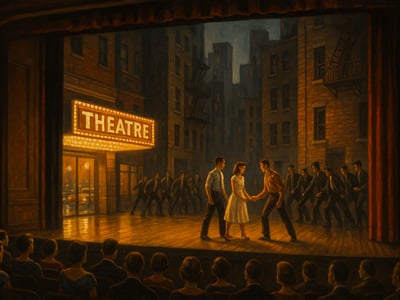
Teatro Kursaal in Lugano hosted the first Eurovision Song Contest on 12 April 1956.
On 12 April 1956, the first Eurovision Song Contest took place at the Teatro Kursaal in Lugano, Switzerland, in an experiment that brought several European broadcasters into a single live entertainment event. Organized within the framework of the European Broadcasting Union, the program linked national radio and television systems across borders for a music competition that was modest in scale but ambitious in execution. By the end of the evening, Swiss singer Lys Assia had won with "Refrain," and a new annual format had begun.
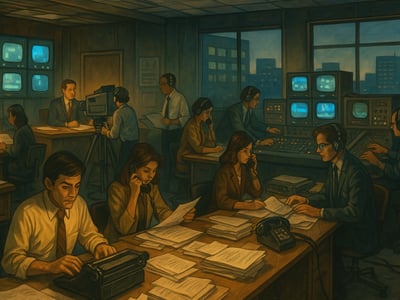
The setting was important. In the years after the Second World War, European broadcasting institutions were expanding their technical reach and thinking about what shared programming might look like. News and ceremonial events could be transmitted across borders, but entertainment posed different challenges. A live music contest required timing, agreed rules, reliable connections, and cooperation among broadcasters that served different audiences, languages, and cultural expectations.
The European Broadcasting Union, with planning developed under figures including Marcel Bezençon, provided the institutional framework for that cooperation. The idea was not only to stage a one-off performance evening, but to test whether a recurring international television event could work in practice. That meant building a format that national broadcasters would accept as fair enough to join and simple enough to produce live.
Seven countries took part in the first contest: Belgium, France, West Germany, Italy, Luxembourg, the Netherlands, and Switzerland. Under the rules used in 1956, each country entered two songs, a structure that would later change as the contest evolved. Even this small field created a complicated program for a live broadcast. Performers had to appear on schedule, juries had to be organized, and the event had to move from one national entry to the next without losing the continuity that made it feel like a single shared program rather than a set of disconnected domestic performances.
That logistical problem was central to the evening. Today, international live broadcasts are routine, but in 1956 they depended on coordination that could easily have failed. The technical links between broadcasters had to hold. The production had to accommodate multiple national delegations. The rules had to be understood in common. The voting process also had to produce a result that would be accepted, even though some details of the 1956 procedure are not preserved with the same completeness as in later years.
The contest therefore belonged as much to broadcasting history as to music history. It was a performance event, but it was also a demonstration of organizational confidence by public broadcasters. Instead of treating national audiences as entirely separate, the organizers assumed that viewers and listeners in different countries could follow the same evening, hear songs from abroad, and accept a shared result.
Lugano was a practical and symbolic host for such a beginning. The Swiss location fit the EBU's international character, and the Teatro Kursaal provided a contained venue suitable for a carefully managed live production. The scale was far smaller than the large arena shows associated with Eurovision decades later, but that smaller setting made the original contest easier to control. The first edition did not need spectacle on a grand scale; it needed to prove that the underlying concept could work.
Within that concept, the songs themselves still mattered. The 1956 contest drew on the popular music cultures of participating countries, presenting them one after another in a common frame. This was an early attempt to make national music industries visible to neighboring audiences through a regular international broadcast. Rather than exporting a single country's program abroad, the event assembled multiple national entries into one transnational schedule.
Lys Assia's victory for Switzerland with "Refrain" gave the inaugural contest a home winner, but the broader significance of the evening lay less in who placed first than in the fact that the competition reached a conclusion at all. A live cross-border program had been mounted, judged, and completed. For the organizers, that was evidence that a repeatable format was possible.
The first Eurovision was still a prototype. Later editions would standardize many elements, reduce entries to one song per country, and build a far more elaborate public identity. Yet the 1956 contest already contained the essential idea: national broadcasters cooperating through shared infrastructure to create an annual event larger than any single domestic program. That idea depended on institutions, engineering, scheduling, and trust as much as on singers and songs.
Why it still matters
The 1956 contest remains important because it shows how public broadcasters used shared technical systems to create cross-border live entertainment at a time when television itself was still developing as a mass medium in much of Europe. It was not simply a concert with an international guest list. It was a coordinated media project that required broadcasters to act together on rules, transmission, and presentation.
It also illustrates an early effort to turn national music production into a recurring international television system. Each country arrived with its own entry, but the event gave those separate efforts a common stage and a shared timetable. That model helped establish a durable kind of annual cultural event: one that depends on institutions and infrastructure, yet becomes meaningful to audiences through ritual repetition.
Over time, the Eurovision Song Contest grew far beyond the scale of the evening in Lugano. But its longevity makes the first edition especially revealing. The original contest shows that enduring cultural formats often begin as practical experiments. Before Eurovision became a large public spectacle, it had to succeed as a collaborative broadcast. On 12 April 1956, in a theater in Lugano, that experiment proved workable enough to continue.
Timeline
- Postwar European television network growth
- European Broadcasting Union planning
- First Eurovision Song Contest
What you uncovered
A Broadcast Built to Last
You didn't just… complete a puzzle; you reconstructed a moment when broadcasters tested whether live entertainment could work across borders as a shared European event.
The first contest mattered not only because it crowned a winner, but because it showed that cooperation among public broadcasters could turn a complicated live transmission into a repeatable format. What began as a technical and organizational challenge also created a framework in which different national music scenes could appear inside the same annual television event. That combination of infrastructure, rules, and routine helps explain why Eurovision lasted.
In the 1956 contest, each of the seven participating countries entered two songs rather than one.
FAQ
When was the first Eurovision Song Contest held?
It was held on 12 April 1956. The contest took place at the Teatro Kursaal in Lugano, Switzerland.
Where did the first Eurovision Song Contest take place?
The first contest was staged at the Teatro Kursaal in Lugano, Switzerland. Lugano is in Ticino, Switzerland.
Who won Eurovision in 1956?
Swiss singer Lys Assia won the 1956 contest. She won with the song "Refrain."
How many countries took part in the first Eurovision?
Seven countries took part on 12 April 1956. They were Belgium, France, West Germany, Italy, Luxembourg, the Netherlands, and Switzerland.
What was the 1956 Eurovision format?
Each participating country presented two songs in the 1956 contest format. The event was organized under the European Broadcasting Union framework.