

About this story
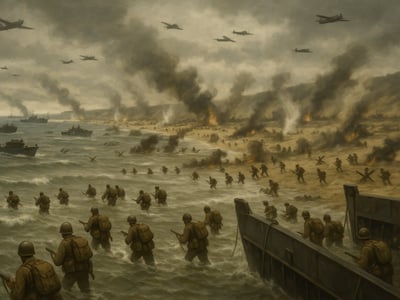
Brigade 2506 landing at Playa Girón and Playa Larga in the Bahía de Cochinos area, April 1961.
On April 17, 1961, about 1,400 Cuban exiles of Brigade 2506 came ashore at Playa Girón and Playa Larga in the Bahía de Cochinos, or Bay of Pigs, on Cuba’s southern coast. The landing was the central military phase of a CIA-backed operation, known as Operation Pluto, that aimed to remove Fidel Castro’s government. Instead, within three days, Cuban government forces had defeated the invasion and captured the remaining fighters, turning the episode into one of the most studied failures of the Cold War.
The invasion did not begin that morning alone. In the days before the landing, events had already narrowed the operation’s chances. On April 15, aircraft flown by anti-Castro pilots attacked Cuban airfields, including Ciudad Libertad, San Antonio de los Baños, and Santiago de Cuba. The strikes were intended to weaken Cuba’s air capacity before the amphibious assault. They also drew immediate international attention, raising questions about who stood behind the attack and putting pressure on the Kennedy administration’s effort to maintain limited visibility of direct U.S. involvement.
The following day, April 16, Castro appeared at a funeral ceremony in Havana for those killed in the air raids and publicly declared the Cuban Revolution socialist. That announcement gave the coming battle an even clearer ideological setting. What had already been a conflict over power in Cuba now unfolded in the language of the wider Cold War, with local events closely tied to global rivalry between the United States and the Soviet Union.
The force that landed on April 17 had been assembled from Cuban exiles, many of them opponents of Castro who had left the island after the 1959 revolution. Their unit, Brigade 2506, had been organized and trained with CIA support. The plan depended on several assumptions at once: that the landing force could secure a beachhead, that it could be supplied quickly enough to continue fighting, that Cuban government forces would be slower to respond, and that the assault might help trigger broader opposition to Castro inside Cuba.
Those assumptions met immediate difficulty on the ground. Playa Girón and Playa Larga lay in a coastal zone that was not easy terrain for a fast-moving invasion. The exile force needed to establish control before Cuban forces concentrated against it. That, in turn, required speed and coordination. The operation also depended heavily on prior air action and on expectations about how long the invaders could hold their position.
The political design of the invasion added another constraint. U.S. officials, under President John F. Kennedy, had approved a covertly backed exile landing rather than an open American military intervention. That meant the operation was shaped not only by battlefield needs but also by concerns about deniability. In practice, this created a difficult balance. The mission needed enough support to succeed, but it was also meant to avoid appearing as a direct U.S. invasion. The result was a plan whose military requirements and political limits were in tension with each other from the start.
Cuban armed forces responded quickly. Castro’s government was able to mobilize troops and resources against the beachheads before the invaders could convert their landing into a wider campaign. The hoped-for internal uprising did not materialize on the scale the planners had counted on. Without secure expansion inland and under mounting pressure, Brigade 2506 faced a narrowing set of options.
The battle unfolded over the next two days under increasingly unfavorable conditions for the exile force. The initial landing had failed to produce the rapid change in momentum on which the entire plan relied. Once that speed was lost, the weaknesses of the operation became harder to overcome. An amphibious landing is always vulnerable in its earliest stage; here, the invaders had to hold exposed positions while depending on assumptions that were already breaking down.
By April 19, Cuban government forces had captured the remaining invaders, ending the operation. The defeat was immediate and visible. For Castro, it became a powerful confirmation of his government’s ability to resist an externally backed attack. For the Kennedy administration, it was an early and damaging foreign policy setback. The episode also brought sharp scrutiny to the role of the CIA, to the planning behind the mission, and to the judgments made by senior U.S. officials.
The Bay of Pigs quickly became more than a failed landing. It marked a hardening in the relationship between Cuba and the United States and helped define how each side understood the other’s intentions. In Cuba, the invasion reinforced the government’s security outlook and provided a lasting symbol of resistance to foreign-backed intervention. In the United States, it stood as a warning about intelligence assessments, operational optimism, and the risks of trying to manage military force through political ambiguity.
Why it still matters
The Bay of Pigs remains important because it offers a clear case study in how covert action can depend on assumptions that are difficult to test once an operation begins. The invasion was built on expectations about secrecy, speed, air support, and local reaction. When those conditions did not hold, events moved too quickly for the original concept to recover.
It also shaped the institutional and political relationship between Cuba, the United States, and intelligence services in the Caribbean. The failed invasion deepened mistrust, strengthened Castro’s position at home and abroad, and intensified Cold War tensions in the region. Historians often place it on the road to the Cuban Missile Crisis the following year, when the consequences of that mistrust became far more dangerous.
Military planners and political leaders still study the episode for its broader lessons. It raises enduring questions about executive decision-making, the limits of exile-led regime change efforts, the role of air power in amphibious operations, and the gap that can open between political deniability and military necessity. More than six decades later, the landing at Playa Girón and Playa Larga is remembered not only for what happened on those beaches, but for how quickly a plan built on confidence and concealment unraveled in public view.
Timeline
- Castro takes power in Cuba
- Airstrikes on Cuban airfields
- Bay of Pigs invasion begins
- Remaining invaders are captured
What you uncovered
When Secrecy Meets Reality
You didn't just… complete a puzzle; you traced how the Bay of Pigs invasion depended on rapid success before its political and military weaknesses were exposed.
The operation relied on a narrow chain of assumptions: that the landing would hold, that outside involvement could remain obscured, and that pressure on the ground might trigger a broader revolt. Once those assumptions failed together, there was little room to adapt. That is why the episode still matters as a study in how covert action can collapse when secrecy, timing, and battlefield realities stop aligning.
Fidel Castro publicly declared the Cuban Revolution socialist on 1961-04-16, one day before Brigade 2506 landed at Playa Girón and Playa Larga.
FAQ
When did the Bay of Pigs invasion begin?
It began on 1961-04-17. On that day, Brigade 2506 landed at Playa Girón and Playa Larga in the Bahía de Cochinos area of Cuba.
What was Brigade 2506?
Brigade 2506 was the force of about 1,400 Cuban exiles that took part in the landing. It had been organized and trained with CIA support.
Why did the United States back the invasion?
The operation was intended to remove Fidel Castro's government. On 1961-04-17, John F. Kennedy's administration continued Operation Pluto, the CIA-backed plan behind the assault.
Where were Playa Girón and Playa Larga?
They are in the Bahía de Cochinos area on Cuba's southern coast, in Matanzas Province. The landing took place there on 1961-04-17.
What happened after the landing?
Cuban government forces responded, and on 1961-04-19 they captured the remaining invaders, ending the operation.