

About this story
San Francisco after the 1906 earthquake and fires in Northern California.
On 18 April 1906, at about 5:12 a.m. local time, a major earthquake struck Northern California along the San Andreas Fault. Its strongest urban impact fell on San Francisco, where violent shaking damaged buildings, split streets, broke gas and water lines, and disrupted transport and communications almost at once. The shock is now generally estimated at about magnitude 7.9. What followed was not only an earthquake disaster, but also a citywide emergency in which fire, damaged infrastructure, and urgent decisions shaped the scale of destruction.
People in San Francisco were thrown into confusion within minutes. Buildings that had not collapsed outright were often left unstable. Chimneys fell, walls cracked, and street surfaces buckled. Because the quake struck early in the morning, many residents were at home when the shaking began. Across the city, the immediate challenge was not just survival during the shock itself, but understanding what remained usable afterward: which streets were passable, which water lines still worked, and whether public authority could still function.
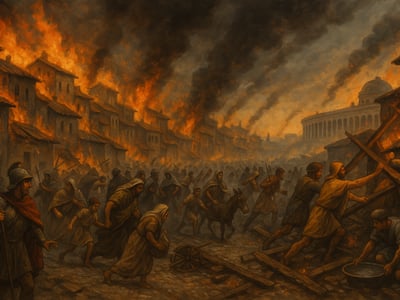
One of the most serious consequences was the failure of the water system. Broken mains left firefighters with too little pressure to control the blazes that began after the shaking. Fires broke out in different parts of the city and gradually merged into larger fire zones. In a dense urban environment built with many combustible structures, the combination of damaged infrastructure, wind, and limited firefighting capacity turned separate outbreaks into a prolonged urban fire emergency.
That same day, Mayor Eugene Schmitz issued an emergency proclamation authorizing police and other authorities to shoot looters and people caught committing crimes. The order reflected the breakdown of ordinary civil conditions and the pressure city leaders felt as they tried to maintain order. Such measures remain among the most debated parts of the response, and historians treat them carefully, noting the confusion and uneven reporting that often accompany disasters of this scale.
Federal military involvement also came quickly. Brigadier General Frederick Funston directed U.S. Army troop assistance in San Francisco on 18 April. Soldiers helped with emergency operations, guarded key sites, and supported public order. In practical terms, military presence became part of the city's effort to manage evacuation, secure supplies, and carry out difficult fire-control decisions while normal municipal systems were under extreme strain.
Those fire-control decisions could be harsh and uncertain. With water mains broken and fires spreading, officials, soldiers, and residents tried to create firebreaks by demolishing buildings, sometimes using dynamite. The aim was to stop flames from advancing block by block. In some places these efforts were partly effective; in others, poor handling or the chaotic conditions may have worsened damage. The broader problem was clear: once water, transport, and coordination were compromised, even a wealthy and prominent city could struggle to carry out basic emergency measures.
From 18 April to 21 April, fires continued to burn in San Francisco. They consumed large sections of the city, including important commercial and residential districts. Market Street became one of the best-known visual symbols of the disaster, photographed before and after the destruction. By the time the fires were finally controlled, much of central San Francisco had been devastated. The combined earthquake and fire left more than 3,000 people dead by many modern estimates, though exact figures have long been debated, and hundreds of thousands were left homeless.
Displacement became one of the defining human consequences of the disaster. Residents who had escaped the shaking and flames still had to find food, shelter, and safety in the days that followed. Refugee camps and temporary shelters were established as large numbers of people were forced out of their neighborhoods. The disaster therefore unfolded in stages: the initial rupture, the fires, and then the practical question of how a city would house and sustain its population after so much of its built environment had been damaged or destroyed.
The earthquake was also a turning point in scientific documentation. In 1908, the State Earthquake Investigation Commission, led by Andrew C. Lawson, published what became known as the Lawson Report. This official investigation assembled observations of ground rupture, structural damage, and regional effects across Northern California. It helped establish the 1906 earthquake as one of the foundational events in modern seismology and in the scientific study of faults, shaking intensity, and urban vulnerability.
The report mattered not only because it recorded what had happened in San Francisco, but because it connected city damage to a broader geological process along the San Andreas Fault. The disaster thus entered history in two forms at once: as a human and urban catastrophe, and as a major scientific case through which researchers could better understand earthquake behavior.
Why it still matters
The 1906 San Francisco earthquake remains a central reference point in earthquake engineering, fault science, and urban risk planning. It showed with unusual clarity that damage in a major earthquake does not come only from ground motion. Lifeline systems such as water mains, transport routes, communications, and emergency command structures can fail together, and those failures can magnify the original event.
That lesson still shapes how cities prepare for seismic hazards. Modern planning pays close attention to how hospitals, fire services, bridges, pipelines, and utilities will function after a quake, not just whether individual buildings can stand. The San Francisco disaster demonstrated that a city is a network, and that when the network breaks, secondary effects such as fire and displacement can become as destructive as the initial shock.
It also influenced how disasters are documented and studied. The Lawson Report helped set a model for systematic post-disaster investigation, linking eyewitness evidence, field observation, and engineering analysis. Rebuilding after 1906 likewise fed long discussions about building standards, street design, and the practical limits of urban reconstruction after catastrophe.
More than a century later, the event is still studied because it joins geology, engineering, governance, and daily life in one stark historical episode. It reminds us that earthquakes are not only movements of the earth beneath a city. They are also tests of how that city is built, supplied, and governed when ordinary systems fail.
Timeline
- San Francisco earthquake
- Fire outbreak in San Francisco
- Emergency measures in San Francisco
- Fire in San Francisco ends
- Lawson Report published
What you uncovered
When the City Kept Burning
You didn't just… piece together a famous earthquake; you traced how a city's damaged systems turned shaking into a longer urban catastrophe.
The 1906 event is often remembered for the rupture itself, but much of its destruction came from what failed afterward. Broken water mains, disrupted transport, and limited communications made firefighting and coordination far harder just when they mattered most. That is why the disaster still matters as more than a seismic event: it showed that urban risk depends on how tightly physical hazards and city infrastructure are linked.
The fires that followed the earthquake burned in San Francisco from 18 April to 21 April 1906.
FAQ
When did the 1906 San Francisco earthquake strike?
It struck at about 5:12 a.m. on 18 April 1906. The earthquake hit the San Francisco Bay region along the San Andreas Fault.
What area was most severely affected by the disaster?
The worst damage was centered in San Francisco, California, United States. Strong shaking damaged buildings, water mains, streets, and transport links across the city and nearby areas.
Why were the fires after the earthquake so difficult to stop?
The shaking damaged water mains, so firefighters had limited water to fight the blaze. Officials and troops also used emergency measures, including demolitions to create firebreaks, while the fires burned from 18 April to 21 April 1906.
What was the Lawson Report?
The Lawson Report was the 1908 publication of the State Earthquake Investigation Commission, led by Andrew C. Lawson. It documented the earthquake and the rupture.