

About this story
Lexington and Concord, Massachusetts, during the opening fighting of 19 April 1775.
On April 19, 1775, British regulars and Massachusetts militia exchanged fire at Lexington, fought again at Concord, and continued battling along the road back toward Boston. What had begun as a British expedition to seize military stores became, within a single day, a dispersed and costly confrontation across several towns in Middlesex County. Later generations would treat Lexington and Concord as the opening military engagements of the American Revolutionary War, but for those involved that morning, much still depended on hurried decisions, incomplete information, and the movement of men over dark roads.
The immediate background lay in the deepening conflict between imperial authorities and the Massachusetts countryside. General Thomas Gage, the British military governor in Boston, had received orders to maintain royal authority in a colony where resistance had become increasingly organized. Provincial leaders had been stockpiling arms, powder, and other supplies outside Boston. On April 18, Gage ordered Lieutenant Colonel Francis Smith to lead a force from Boston to Concord, where British commanders expected to find and destroy some of those stores.
The plan depended on speed and secrecy. British troops crossed from Boston at night and began the march westward. Yet secrecy was difficult to preserve in a region already alert to the possibility of such a move. Riders including Paul Revere and others helped spread the alarm on the evening of April 18, warning that regular troops were heading into the countryside. Church bells, drums, and mounted messengers carried the news farther. This alarm system did not create a single centralized response, but it gave local militia companies crucial time to assemble.
At Lexington, Captain John Parker gathered the local militia on the town green before dawn. His company was small, and its members faced a difficult choice. To disperse without appearing to yield, to stand visibly in formation, or to confront advancing professional soldiers each carried risks. As British advance troops under Major John Pitcairn approached, confusion and tension increased. The exact responsibility for the first shots has long been disputed, and sources differ on the sequence in those opening moments. What is clear is that firing broke out on Lexington Green, and when it ended, eight colonists were dead. The British column then continued on toward Concord.
The fighting at Lexington did not stop the expedition. Smith's force pressed forward to complete its orders. In Concord, British troops searched the town and looked for military supplies. Some stores had already been moved or concealed. Companies were also sent onward toward the farm of James Barrett, where military materials were believed to be kept. The British did destroy some items they found, but the expedition was not achieving a clean or uncontested seizure. Meanwhile, militia from Concord and neighboring towns were assembling in greater numbers.
That growing militia presence altered the balance of the day. Instead of facing one isolated town company, the British encountered a widening local mobilization. Men from across the region arrived in small units under their own officers, often familiar with local roads, fields, and bridges. Their purpose was not simply to observe. As smoke from searches and burning materials rose in Concord, militia leaders judged whether British actions signaled a broader attack on the town. That uncertainty contributed to the next major clash.
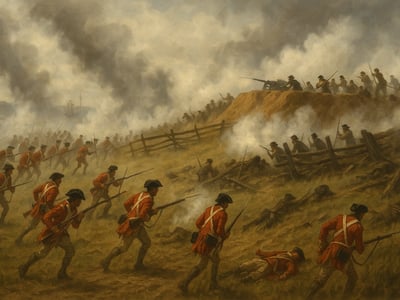
At North Bridge in Concord, militia companies advanced toward British troops posted there. The engagement marked a significant escalation. Here the colonists did not merely receive fire or scatter under pressure; they moved against regular troops in formed bodies. British soldiers were killed, and the detachment at the bridge withdrew. This forced withdrawal mattered both practically and symbolically. It showed that the British could be resisted in the field and that local militia, once assembled in sufficient numbers, could compel movement rather than simply react to it.
By this point the expedition's central problem had changed. Instead of a march out, search, and orderly return, Smith now had to withdraw a long column through hostile territory while more militia gathered on the route. The road back from Concord to Lexington and onward toward Charlestown exposed British troops to repeated attacks from behind walls, houses, fields, and roadside positions. The fighting became a running battle rather than a single set-piece engagement.
The British regulars retained discipline and training, and those qualities helped prevent the retreat from becoming a collapse. But training alone could not remove exhaustion, confusion, and mounting casualties. The column had marched through the night, searched a town, fought at several points, and then had to force its way back over many miles. Militia companies, by contrast, could appear in fresh groups along the road, fire, and fall back. Their actions were not perfectly coordinated, but taken together they imposed constant pressure.
When the retreating force reached Lexington later in the day, it was reinforced by additional troops sent out from Boston. That support helped the British continue the withdrawal eastward. Even so, the march remained dangerous. By evening, Smith's force had reached Charlestown after suffering heavy losses during repeated attacks. Casualties had occurred on both sides across multiple locations, and the events of the day had made further armed conflict far more likely.
Why it still matters
Lexington and Concord remain important because they show how eighteenth-century warfare could be shaped by logistics, communication, and local institutions as much as by battlefield drill. The British mission was aimed at supplies, not at winning a formal pitched battle. Yet the attempt to seize those stores triggered a chain of responses that transformed the expedition into a running fight. Alarm riders, militia musters, and local decision-making compressed the time available to commanders on both sides.
The day's events also help explain the transition from political protest to organized war. For years, tensions between Britain and its American colonies had produced petitions, boycotts, coercive measures, and intermittent violence. On April 19, those tensions took a form that could no longer be contained within ordinary civil dispute. Local militia systems proved capable of rapid mobilization, while imperial command discovered that enforcing authority in Massachusetts now meant sustained military risk.
In the days that followed, militia from across New England converged around Boston, beginning the Siege of Boston. That larger campaign did not arise from a single speech or decree alone; it followed from the accumulation of decisions made in towns, on roads, and at bridges. Lexington and Concord endure in historical study not only because they were first, but because they reveal how quickly an operation meant to control a crisis instead widened it into war.
Timeline
- British march from Boston toward Concord
- Battle of Lexington and Concord
- Lexington Green exchange of fire
- North Bridge engagement in Concord
- British retreat toward Boston
- Siege of Boston begins
What you uncovered
How a Raid Became a War
You didn't just…complete a scene from early fighting in Massachusetts; you traced the moment when a limited expedition collided with local mobilization and widened into open conflict.
What stands out is how quickly control narrowed for both sides once the alarm spread. A mission designed around speed and confiscation became a running battle because militia networks, local knowledge, and short decision windows kept changing the situation on the ground. The episode is still studied not only as a symbolic beginning, but as a case in how logistics, communication, and decentralized response can reshape military plans.
At Lexington Green, the first exchange of fire at dawn on 19 April 1775 left eight colonists dead.
FAQ
What happened on 19 April 1775 at Lexington and Concord?
British regulars and Massachusetts militia exchanged fire at Lexington and later fought at Concord and along the road back to Boston. The day’s fighting caused casualties on both sides in several places in Middlesex County.
Who led the British expedition toward Concord?
On 18 April 1775, General Thomas Gage ordered Lieutenant Colonel Francis Smith to lead the British expedition from Boston toward Concord. Captain John Parker led the Lexington militia that faced the British advance troops at dawn on 19 April.
What were British troops ordered to do at Concord?
They were ordered to march from Boston to Concord, search for military stores, and destroy them. British troops also sent companies to James Barrett’s farm for military stores.
What happened at North Bridge in Concord?
Militia companies engaged British troops at North Bridge in Concord. British soldiers were killed there and were forced to withdraw.
Why is Lexington and Concord seen as the start of the war?
The fighting on 19 April 1775 turned a British supply mission into open armed conflict with colonial militia. It is treated as the opening military event of the American Revolutionary War.