

About this story
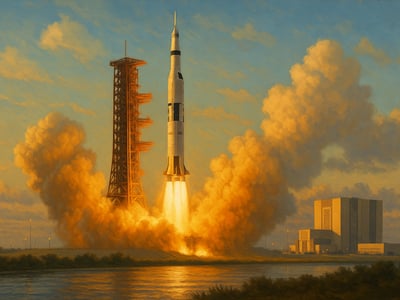
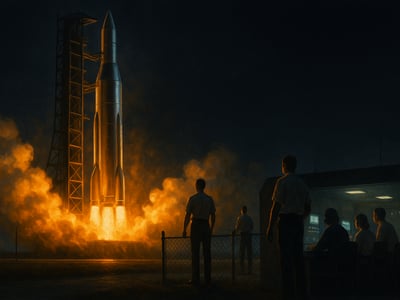
STS-31 launch at Kennedy Space Center with Hubble aboard Discovery in April 1990
Video puzzle
On April 24, 1990, Space Shuttle Discovery lifted off from Launch Complex 39B at Kennedy Space Center in Florida carrying the Hubble Space Telescope, one of the most ambitious astronomical instruments yet sent into orbit. The flight, designated STS-31, was a NASA mission conducted with participation from the European Space Agency. Its immediate task was clear but demanding: carry a large observatory into space, release it safely, and begin a program of long-term observations above Earth's atmosphere.
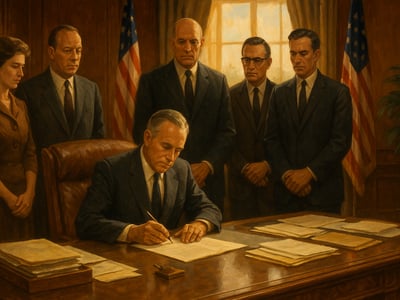
That launch was the visible result of years of planning, engineering, and political support. The idea of a large space telescope had been pursued for decades, and U.S. congressional funding approval in 1977 gave the project a practical path forward. European participation became part of the program as well, helping establish Hubble not simply as a national instrument but as shared scientific infrastructure. By the time Discovery rolled to the pad in 1990, the telescope represented a major investment in astronomy and a test of whether shuttle-era human spaceflight could reliably place a sophisticated observatory into working orbit.
The STS-31 crew reflected that combination of routine shuttle operations and unusual mission importance. Loren J. Shriver served as commander, with Charles F. Bolden Jr. as pilot. The mission specialists were Bruce McCandless II, Steven A. Hawley, and Kathryn D. Sullivan. Their work was not to operate Hubble as an observatory from the shuttle, but to transport it, monitor its condition, and carry out the careful sequence needed to release it from Discovery's payload bay.
That sequence mattered because the telescope was too valuable, and too complex, for improvisation. Hubble had to survive launch loads, reach the planned orbital conditions, and then separate cleanly from the shuttle. A problem at any stage could have ended or severely limited the mission. Unlike a simpler satellite, a major observatory carried expectations from astronomers, engineers, government agencies, and the international partners who had helped build it.
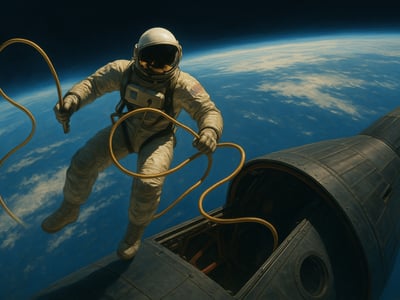
Discovery's ascent on April 24 placed the crew and payload into orbit, but launch day was only the first step. Hubble remained inside the shuttle's payload bay until the following day. On April 25, 1990, the astronauts carried out the deployment sequence, and the telescope was released into low Earth orbit at roughly 547 kilometers altitude. At that moment, the mission changed character: Hubble stopped being a shuttle payload and became an independent observatory.
The use of the shuttle was central to the mission's design. In that period, the Space Shuttle program offered a way to transport large payloads with astronauts on board, allowing direct oversight of deployment. Mission planners accepted both the advantages and the risks of this method. A crewed mission provided flexibility during release operations, but it also meant that human spaceflight and a high-profile scientific payload were tied together in a single operation that had to work as planned.
This approach also shaped how Hubble was understood from the beginning. It was not merely launched and forgotten. The telescope had been designed with servicing in mind, an important idea in shuttle-era space operations. That decision would later prove essential. But even in April 1990, before later repairs and upgrades, the launch itself already showed a distinct philosophy: large scientific instruments could be treated as long-term infrastructure, not one-time experiments.
The partnership behind the mission was part of that philosophy as well. NASA led the launch and shuttle mission, while the European Space Agency participated in the Hubble program as a major partner. In practical terms, this cooperation helped distribute resources, expertise, and access. In symbolic terms, it showed that a project aimed at observing the wider universe could also be built through international institutional cooperation.
For the STS-31 crew, the mission demanded precision rather than spectacle. Shuttle launches were public events, but the most important moments were procedural: checking systems, confirming orbital parameters, opening the payload bay doors, managing the deployment timeline, and ensuring that the observatory left the shuttle in proper condition. Success depended on training and sequence discipline as much as on engineering.
The launch did not instantly produce Hubble's later reputation. That reputation was built over time as the telescope began operations, encountered early difficulties, and was ultimately improved through servicing. Yet the starting point remains the same: without a successful launch and deployment in April 1990, none of the observatory's later scientific work could have followed. The mission's first achievement was simply to place the instrument where it had a chance to work.
Why it still matters
The launch of Hubble still matters because it demonstrated how human spaceflight could support the deployment of large scientific instruments rather than only transportation or short-duration experiments. STS-31 showed that the shuttle could function as a delivery system for complex research infrastructure, with astronauts directly involved in the process of placing an observatory into service.
It also remains an important example of long-term cooperation between NASA and the European Space Agency. Hubble was not only a technical mission but also an institutional one, built through agreements that linked funding, hardware, operations, and scientific participation across borders. That model helped define how major research projects could be shared internationally.
Finally, the 1990 launch marked the beginning of an observatory program designed for endurance. Hubble's later history, including servicing missions such as STS-61 in 1993, reinforced the value of building space science missions with maintenance and longevity in mind. The launch aboard Discovery was therefore more than a single shuttle flight. It was the opening act of a durable approach to space-based astronomy, in which deployment, partnership, and planned servicing were all part of the same idea.
Timeline
- Hubble Space Telescope launch
- Hubble deployment
- STS-31 landing
What you uncovered
A Telescope Built to Be Reached
You didn't just… complete an image; you traced the moment a shuttle crew placed a long-term scientific observatory into orbit and began a mission designed to be maintained over time.
Hubble’s launch mattered not only because it carried a powerful telescope into space, but because it reflected a specific way of building science infrastructure. Shuttle deployment meant astronauts could release a large observatory directly, while the NASA-ESA partnership spread costs, expertise, and institutional commitment across agencies. Planned servicing made the telescope less like a one-time payload and more like an orbital facility meant to evolve during its working life.
Hubble was deployed from Discovery’s payload bay on 25 April 1990, one day after launch.
FAQ
When was the Hubble Space Telescope launched?
It was launched on 24 April 1990. Space Shuttle Discovery lifted off on STS-31 from Launch Complex 39B at Kennedy Space Center with Hubble aboard.
Which Space Shuttle carried Hubble into orbit?
Hubble flew aboard Space Shuttle Discovery on STS-31. The mission was launched by NASA with participation from the European Space Agency.
Who were the astronauts on STS-31?
The STS-31 crew were Loren J. Shriver, Charles F. Bolden Jr., Bruce McCandless II, Steven A. Hawley, and Kathryn D. Sullivan.
Was Hubble deployed on the same day it launched?
No. Hubble was deployed from Discovery's payload bay on 25 April 1990, the day after launch.
How high was Hubble's initial orbit after STS-31?
STS-31 placed Hubble into low Earth orbit at roughly 547 kilometers altitude.