

About this story
Mactan Island encounter in 1521, where Ferdinand Magellan was killed.
On April 27, 1521, Ferdinand Magellan was killed in fighting on Mactan Island in the central Philippines, during an encounter between men from his Spanish expedition and forces led by Lapulapu. His death came in the middle of a voyage that had already crossed the Atlantic and Pacific and would later be remembered as the first circumnavigation of the globe. Yet at Mactan, the larger history of exploration narrowed into a local conflict shaped by coastal geography, political alliances, and a commander’s decision to intervene.
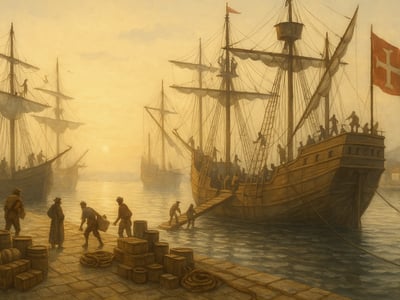
Magellan had sailed from Sanlúcar de Barrameda on September 20, 1519, with five ships under the Spanish Crown. The expedition’s goal was to find a westward route to the spice trade. The voyage was long and difficult. Ships were lost, crews suffered hunger and disease, and the crossing of the Pacific stretched far beyond what Europeans on board had expected. When the expedition reached the archipelago later called the Philippines on March 16, 1521, its survivors had already endured one of the most demanding sea journeys of the age.
Arrival did not simply mean relief. Like many expeditions of the period, Magellan’s enterprise depended not only on seamanship but on securing food, water, interpreters, and political support in unfamiliar places. In Cebu, Magellan established relations with Rajah Humabon. On April 14, 1521, Humabon and others were baptized after contact with the expedition. These ceremonies have often been treated as signs of Spanish influence, but they were also part of local diplomacy, in which alliances carried obligations and expectations.
It was within that setting that Magellan became involved in a dispute beyond his original mission. Lapulapu, a leader on nearby Mactan, did not submit to Humabon’s authority in the way Magellan appears to have expected. Magellan chose to support Humabon and to demonstrate force. This decision was risky. His men were operating far from any secure base, in waters where ships could not easily approach the shore. Their firearms and armor offered advantages, but only under conditions that allowed those advantages to be used effectively.
The attack at Mactan exposed those limits. Because of shallow water and reefs, the expedition’s boats could not bring Magellan’s force directly onto the beach. The men had to advance through the water before reaching land, while facing a larger defending force on terrain better known to the people of Mactan. Antonio Pigafetta, a member of the expedition who later wrote one of the best-known accounts of the voyage, described the fighting and Magellan’s death there.
The encounter was not a grand battle between equal armies in an open field. It was a coastal clash in which local conditions mattered greatly. A small expeditionary force, separated from full naval support, tried to impose authority in a place where it lacked both numbers and control of the ground. According to Pigafetta’s account, the fighting intensified as Magellan’s men struggled to advance and then to hold their position. Magellan remained exposed as others withdrew, and he was killed during the encounter.
His death immediately created a problem larger than the skirmish itself. Magellan had been the expedition’s commander, its chief strategist, and the figure around whom relations with local leaders had been organized. Losing him threatened discipline, confidence, and continuity. The expedition had not yet reached the Moluccas, the spice-producing islands that were a central objective of the voyage, and it was still thousands of miles from Spain.
The aftermath in the Philippines was unstable. Alliances that had seemed useful could no longer be taken for granted. The expedition had fewer men, fewer ships, and less room for error than when it had left Spain. Its survival depended on reorganizing leadership and narrowing ambitions to what was still possible. In the months that followed, the voyage continued under new commanders, and eventually Juan Sebastián Elcano led the ship *Victoria* back to Sanlúcar de Barrameda on September 6, 1522.
That return often defines the expedition in historical memory: one ship, reduced crew, global circuit completed. But Mactan remained one of the voyage’s clearest turning points. It showed that crossing oceans did not translate automatically into control on land. The expedition had achieved something extraordinary in navigation, yet it could still be checked decisively by local resistance in a shallow coastal encounter.
Why it still matters
Magellan’s death at Mactan matters because it reveals how early global expeditions actually worked. They were not sustained by ships and charts alone. They depended on provisions, interpreters, negotiated access, and alliances with local rulers whose priorities were their own. When those relationships shifted, a voyage that looked powerful from a distance could become vulnerable very quickly.
The episode is also important to the history of early Spanish expansion in Asia. It marks one of the first major recorded encounters between a European expedition and political communities in the Philippine archipelago. For historians, Mactan helps explain that maritime expansion was never a simple story of movement outward from Europe. It was shaped at every stage by decisions made in ports, islands, and coastal settlements where newcomers had limited knowledge and limited leverage.
In the Philippines, the event remains part of public memory, especially through Lapulapu’s place in national historical narratives. Because of that, Mactan is not remembered only as a moment in the history of exploration. It is also discussed as a colonial-era encounter whose meaning has been interpreted in different ways over time. A careful account therefore keeps the focus on what can be firmly said: Magellan entered a local conflict, led an attack at Mactan, and died there.
Seen in that light, the Battle of Mactan was both a local event and a global one. It took place on a specific shore, among specific communities and rivalries, but it altered the course of a voyage that connected Europe, the Pacific, and the emerging world of long-distance imperial trade. Its significance lies not only in the death of a famous navigator, but in the reminder that global history is often decided in local settings.
Timeline
- Departure of the Spanish expedition from Spain
- Arrival of the expedition in the Philippine archipelago
- Baptism ceremonies at Cebu
- Death of Ferdinand Magellan at Mactan
- Return of the Victoria to Sanlúcar de Barrameda
What you uncovered
Local Power at Sea
You didn't just… reconstruct Magellan's death at Mactan; you traced the moment when an ocean-spanning voyage was forced to answer to local power on shore.
The episode is often folded into the larger story of the first circumnavigation, but it also shows that such voyages did not move through empty space. Once expeditions entered inhabited trading worlds, navigation mattered less than negotiation, alliance, and misreading local authority. Mactan is a reminder that early global expansion depended on decisions made by people the expedition could not simply command.
After Magellan's death in 1521, the expedition continued, and the Victoria reached Spain under Juan Sebastián Elcano on 6 September 1522.
FAQ
What happened to Ferdinand Magellan on 27 April 1521?
On 27 April 1521, Ferdinand Magellan was killed at Mactan Island in the central Philippines during an armed encounter with forces led by Lapulapu. The event was recorded by expedition member Antonio Pigafetta.
Where did Magellan die?
Magellan died at Mactan Island, near Cebu, in the Philippine archipelago. The fighting took place during the expedition's time in the central Philippines.
Why was Magellan's expedition fighting there?
The expedition had reached the archipelago after crossing the Pacific and had become involved in local alliances after arriving. On 27 April 1521, Magellan chose to intervene in a local conflict and led an attack against Lapulapu's forces.
Did Magellan's death end the circumnavigation?
No. After Magellan's death, the voyage continued, and the ship Victoria returned to Sanlúcar de Barrameda on 6 September 1522 under Juan Sebastián Elcano, completing the circumnavigation.