

About this story
Operation Frequent Wind begins in Saigon on 29 April 1975 amid the final evacuation.
On 29 April 1975, with North Vietnamese forces closing in on Saigon, the United States began Operation Frequent Wind, the final evacuation of U.S. personnel and many Vietnamese civilians from South Vietnam. What had been a long military and political withdrawal was compressed into urgent hours. As attacks struck Tan Son Nhut Air Base and fixed-wing departures became increasingly difficult, helicopters took over as the last organized means of escape from a city on the edge of capture.
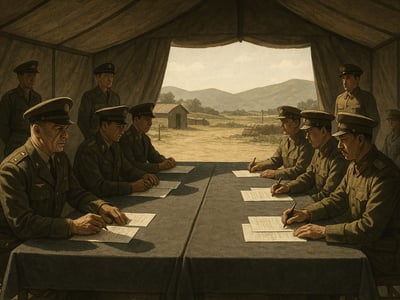
The moment came at the end of a longer unraveling. The Paris Peace Accords of 1973 had been followed by the withdrawal of U.S. combat forces, but the war inside Vietnam did not end there. In the spring of 1975, North Vietnamese advances accelerated, and South Vietnamese defenses collapsed in a series of rapid setbacks. By late April, Saigon was no longer a distant objective but the final center of a state under immediate pressure.
South Vietnam's leadership was also changing in its last hours. Duong Van Minh took office as president on 28 April 1975, when political and military options were already narrowing sharply. Hopes that a leadership change might create space for negotiation existed in some quarters, but events on the ground were moving faster than diplomacy. The problem facing American and South Vietnamese officials was no longer how to stabilize the situation, but how to move people out before routes closed completely.
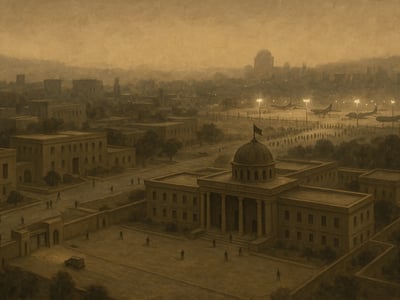
Tan Son Nhut Air Base was central to that question. For days, evacuation planning had relied heavily on fixed-wing aircraft. That system depended on runways, ground access, and enough security to load and launch planes in sequence. On 29 April, rocket and artillery attacks hit the air base, helping bring fixed-wing evacuations to an end. This changed the practical logic of the entire operation. Instead of using larger aircraft to move evacuees in volume, the evacuation had to pivot toward helicopters operating under tighter limits of space, time, and weather, with the battlefield situation worsening around them.
President Gerald Ford ordered Operation Frequent Wind on 29 April. The order marked the beginning of the final U.S. evacuation operation from Saigon. Helicopters began carrying evacuees from Tan Son Nhut and from the U.S. Embassy compound to ships waiting in the South China Sea. The operation required coordination among embassy personnel, military commanders, aircrews, and naval forces, but its human meaning was clearest on the ground, where crowds gathered with documents, bags, children, and incomplete information, trying to determine whether they still had a path out.
For Americans in Saigon, the operation was the last stage of an official departure. For many Vietnamese, it was something more uncertain and more personal: an attempt to avoid political danger, imprisonment, or permanent separation from family members. Not everyone seeking evacuation had the same access to transport or the same official status. Some had worked directly with the United States or South Vietnamese institutions. Others were connected through family ties or professional associations. As helicopters came and went, each departure could be seen as both a rescue and a reminder that capacity was limited.
Ambassador Graham Martin remained at the U.S. Embassy until the helicopter evacuation was underway on 29-30 April. His presence reflected one of the central tensions of the final hours. Leaving too early could be read as a public acknowledgment that the South Vietnamese government had no future. Waiting too long risked reducing the time available for evacuation. In such circumstances, political symbolism and operational necessity were in constant conflict. The embassy, which later became the most remembered image of the evacuation, was only one part of a larger airlift, but it came to stand for the final compression of a much larger war.
The visual record of those hours helped shape how the event would be remembered. Helicopters on rooftops, people climbing stairs toward a possible exit, and ships receiving evacuees offshore became lasting images of withdrawal and collapse. Yet those images can also narrow the story if taken in isolation. Operation Frequent Wind was not a single dramatic scene but a rapidly improvised transport system linking urban extraction points, aircraft crews, and naval vessels under the pressure of an advancing military front.
The evacuation continued into the early hours of 30 April. By then, the remaining time for organized departure was nearly gone. Saigon was taken by North Vietnamese and Viet Cong forces on 30 April 1975, one day after Operation Frequent Wind began. That capture closed the final window for a coordinated U.S. evacuation. For those who had left, the next stage was uncertain resettlement. For those who had not, the end of the war brought a new political order and, for many, difficult consequences that would unfold over years.
Why it still matters
Operation Frequent Wind remains an important reference point in the history of evacuations. Officials and military planners still study it as a case in how quickly assumptions can fail when security conditions collapse faster than transport systems can adjust. A plan built around runways and large aircraft had to be replaced by one built around helicopters, rooftops, embassy grounds, and ships at sea.
It also endures in public memory because it condensed the end of a long conflict into a set of visible, immediate choices. The fall of institutions is often discussed in abstract terms, but in Saigon it became legible through movement: who reached an airfield, who reached an embassy, who boarded a helicopter, and who could not. That is one reason the event still appears so often in histories of the Vietnam War and of the wider Cold War.
Finally, it matters because it is part of the history of displacement and resettlement. The people lifted out of Saigon did not simply vanish into safety; many entered refugee processing systems and began new lives far from Vietnam. Their experiences, and the memories carried by families and communities, kept the evacuation alive not only as a military episode but as a human turning point whose effects extended well beyond April 1975.
Timeline
- Paris Peace Accords signed
- South Vietnamese defenses collapse
- Operation Frequent Wind begins
- Saigon falls
What you uncovered
A City Reduced to Airlifts
You didn't just… complete a scene from the end of the Vietnam War; you traced how a final evacuation unfolded as time, transport, and political order were all breaking down at once.
What makes this moment enduring is not only the image of helicopters leaving Saigon, but the way an entire evacuation system had to be improvised when normal routes no longer worked. Once fixed-wing departures from Tan Son Nhut became untenable, movement depended on a much narrower chain linking buildings, landing zones, ships, and split-second decisions. That compressed system turned logistics into destiny, because every delay changed who could still be moved before the city fell. It is one reason the event still shapes how governments think about embassy evacuations, state collapse, and civilian extraction under pressure.
Rocket and artillery attacks on Tan Son Nhut Air Base on 29 April 1975 helped end fixed-wing evacuation from Saigon, pushing the operation toward helicopter lifts instead.
FAQ
What happened on 29 April 1975 in Saigon?
On 29 April 1975, the United States began Operation Frequent Wind, the final evacuation from Saigon. Helicopters were used to remove U.S. personnel and many Vietnamese evacuees as North Vietnamese forces approached the city.
Why was Operation Frequent Wind launched?
It was launched because the military situation around Saigon was collapsing and fixed-wing evacuation from Tan Son Nhut Air Base had become impossible. Rocket and artillery attacks on the air base helped force the switch to helicopters.
What happened at the U.S. Embassy in Saigon?
U.S. Ambassador Graham Martin remained at the embassy until the helicopter evacuation was underway on 29-30 April 1975. The embassy became one of the main evacuation points during the final hours before Saigon fell.
Who was evacuated from Saigon in late April 1975?
U.S. personnel and large numbers of Vietnamese evacuees were flown out during Operation Frequent Wind. Many evacuees were people who feared capture, reprisals, or separation from their families.
How does 29 April 1975 relate to the fall of Saigon?
29 April 1975 was the first day of the final U.S. evacuation, while Saigon was taken on 30 April 1975. Operation Frequent Wind began one day before the city fell.