


About this story
George Washington's presidential oath at Federal Hall, New York City, on 30 April 1789
On April 30, 1789, George Washington took the presidential oath of office at Federal Hall in New York City, giving visible form to a government that had existed on paper before it fully existed in practice. The United States Constitution had been ratified, electors had cast their votes, and Congress had counted them, but the new executive office still had to be occupied in a way that the public could recognize as lawful, orderly, and legitimate. Washington's inauguration became that moment.
The presidency itself was a new creation. Under the Articles of Confederation, the United States had no single national executive comparable to the office described in the Constitution. The new framework, drafted in 1787 and put into operation after ratification, assigned significant responsibilities to a president, but it could not by itself show how the office would look in public life. Much depended on the first person to hold it, and on whether the first transfer into office would inspire confidence rather than uncertainty.
That first test unfolded over several months. On February 4, 1789, presidential electors chose Washington unanimously under the procedures laid out in the Constitution. Even with that result, the machinery of the new government moved slowly. Congress, meeting in New York, formally opened and counted the electoral votes on April 6, confirming Washington as president and John Adams as vice president. This was not merely administrative routine. It was part of the larger effort to show that the constitutional system could operate through established steps rather than through improvisation or force.
Washington was still at Mount Vernon in Virginia when the result became official. On April 23, he departed for New York to assume office. His journey north attracted close attention. Along the route, local communities marked his passage with ceremonies, celebrations, and public greetings. These receptions reflected Washington's personal standing after the Revolutionary War, but they also revealed something broader: many Americans understood that the new office would be judged, in part, through him. The presidency had not yet acquired traditions of its own, so public expectations gathered around the reputation of the man entering it.
When Washington arrived in New York, the city was serving as the national capital, and Federal Hall stood at the center of the new government's activity. Crowds gathered in and around Wall Street. Political leaders, officeholders, and spectators all had reason to see the inauguration as more than a formality. If the ceremony appeared confused, contested, or overly monarchical, it could damage confidence in a still-fragile federal system. If it appeared lawful and measured, it could help turn constitutional theory into accepted public authority.
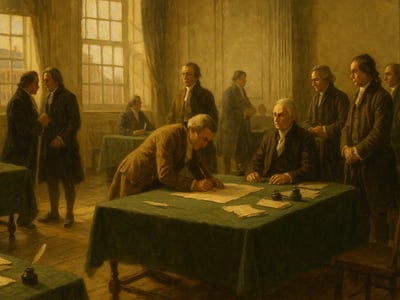
The oath itself was administered by Chancellor Robert R. Livingston of New York. On the balcony of Federal Hall, Washington took the oath before the public, making the moment visible rather than confined to a closed chamber. That visibility mattered. A written constitution could describe powers and duties, but a balcony oath before witnesses demonstrated that executive authority was being assumed through a known legal act. The office began not with conquest, inheritance, or personal claim, but with words prescribed by constitutional order.
The scene joined ceremony and restraint. Washington was already one of the most famous figures in the country, and his presence drew intense attention. Yet the meaning of the event did not rest only on personal prestige. The oath emphasized that the president was bound to the Constitution. In that sense, the ceremony presented the executive not as a ruler standing above the system, but as an officeholder entering it under publicly recognized limits.
After taking the oath, Washington returned inside Federal Hall and delivered his First Inaugural Address to the Senate and House of Representatives. That sequence also mattered. The ceremony did not end with applause on the balcony; it moved directly into the work of government. By addressing Congress, Washington linked the symbolic act of inauguration to the practical responsibilities of a constitutional administration. The new government was not complete simply because a president had been chosen. It had to function through institutions acting together.
John Adams, already confirmed as vice president, was also part of this opening of the federal government under the Constitution. The executive branch was emerging alongside the legislative branch, not in isolation from it. That helped establish an early expectation that the presidency would operate within a larger constitutional structure of offices, procedures, and mutual obligations.
For later generations, it is easy to see Washington's inauguration as inevitable because his election had been unanimous and his public reputation was exceptional. But in 1789, little about the long-term success of the new constitutional system could be taken for granted. The United States was still testing whether a republic spread across multiple states could build durable national institutions. The inauguration was therefore not only an honor for Washington. It was an early demonstration that a new form of federal authority could appear in public without abandoning the language of law, representation, and civilian government.
Why it still matters
Washington's inauguration remains important because it offered an early model of how a written constitution becomes something more than text. Constitutions describe offices, powers, and procedures, but people must still recognize those arrangements as real. The public oath at Federal Hall helped show how legitimacy could be built through transparent ceremony, legal form, and visible adherence to process.
It also helped shape expectations about the presidency itself. From the start, the office was presented as one entered by oath and connected to accountability, not simply by personal stature. Washington's fame gave the moment weight, but the ceremony emphasized that the presidency belonged to the constitutional system rather than to the individual who occupied it.
Later presidential inaugurations would develop many customs of their own, but this first one set a benchmark. It demonstrated that symbolic acts can stabilize a political order when institutions are new and untested. On April 30, 1789, the presidency did not just begin. It became publicly legible as an office governed by law.
Timeline
- Presidential electors choose George Washington
- Congress counts presidential electoral votes
- George Washington departs Mount Vernon for New York
- George Washington presidential oath of office
What you uncovered
When Office Became Real
You didn't just… complete a puzzle; you traced the moment when the presidency shifted from words in the Constitution to a public office people could see, judge, and expect to function.
Washington's first inauguration mattered not only because he was the first president, but because the office itself was still undefined in practice. The oath, the balcony appearance, and the address to Congress showed that executive authority would operate through visible constitutional forms rather than personal status alone. In that sense, the ceremony helped establish that legitimacy in a republic depends on public process as much as on the individual who holds office.
After taking the oath on April 30, 1789, Washington delivered his First Inaugural Address to the Senate and House of Representatives.
FAQ
When did George Washington take the first presidential oath?
George Washington took the presidential oath of office on 30 April 1789. It marked the start of the U.S. presidency under the new Constitution.
Who administered Washington's first presidential oath?
Chancellor Robert R. Livingston administered the oath to George Washington. The ceremony took place at Federal Hall in New York City.
Where did the first U.S. presidential inauguration take place?
It took place at Federal Hall in New York City, New York. Washington took the oath on the building's balcony before spectators.
What happened after Washington took the oath in 1789?
After taking the oath, George Washington delivered his First Inaugural Address to the Senate and House of Representatives. This followed the formal start of his presidency.
How was George Washington chosen president in 1789?
Presidential electors chose George Washington unanimously on 4 February 1789 under the procedures established by the U.S. Constitution. Congress then opened and counted the electoral votes on 6 April 1789, formally confirming him as president.