

About this story
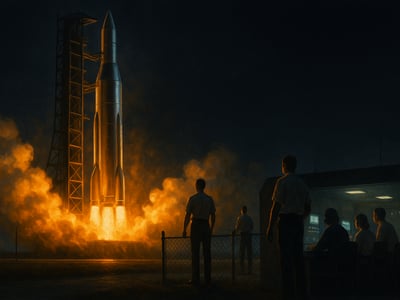
Alan Shepard and Freedom 7 during the Mercury-Redstone 3 flight on 5 May 1961.
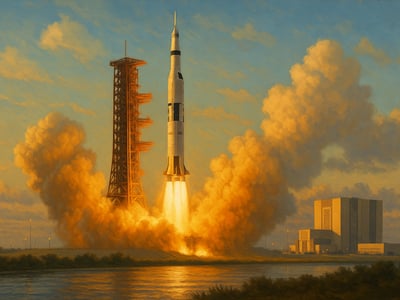
On May 5, 1961, Alan Shepard became the first American to travel into space when NASA launched Mercury-Redstone 3 from Launch Complex 5 at Cape Canaveral, Florida. The spacecraft, named *Freedom 7*, did not circle Earth. Instead, it followed a short suborbital path, climbing to about 116 miles, or roughly 187 kilometers, before descending toward the Atlantic Ocean. From liftoff to splashdown, the mission lasted about 15 minutes, but those minutes carried unusual weight for a young space program still proving that a human being could be launched, control a spacecraft, survive reentry, and be recovered at sea.
By the time Shepard flew, the United States had already spent several years building Project Mercury, its first program for human spaceflight. Engineers, physicians, military test pilots, and mission planners were trying to answer basic questions that had no long operational history behind them. Could a small capsule protect a pilot during launch and reentry? Would manual controls remain useful in flight? Could tracking stations, communications links, and ocean recovery forces all work together as one system? Earlier Mercury test flights had helped reduce uncertainty, but a crewed launch introduced a different level of risk.
The pressure surrounding the mission was not only technical. Less than a month earlier, on April 12, 1961, Yuri Gagarin of the Soviet Union had completed the first human spaceflight, orbiting Earth and showing that space achievement had become a visible measure of Cold War capability. In the United States, NASA now faced the challenge of demonstrating a successful mission of its own without overstating what that mission was. Shepard's flight would be historic, but it would also be limited: a suborbital trajectory rather than a full orbit. That distinction mattered to engineers and policymakers, even as the launch still carried major symbolic importance.
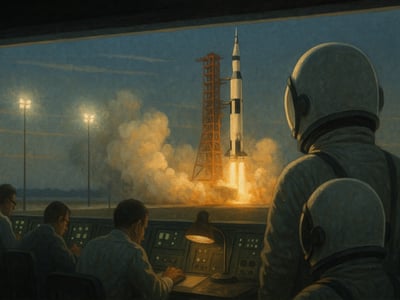
Mercury-Redstone 3 relied on the Redstone launch vehicle, adapted for a crewed mission. Wernher von Braun and his team had played central roles in the Redstone program, while Robert Gilruth led Project Mercury's overall direction. The spacecraft itself was compact, leaving Shepard with only the essential controls and instruments needed for the flight. The mission design asked the hardware, the pilot, and the ground teams to perform a tightly timed sequence. If any stage failed—launch, attitude control, reentry, parachute descent, or recovery—the mission could end badly.
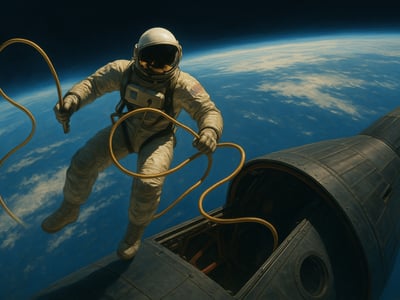
When the rocket lifted off, it carried Shepard on a steep upward arc rather than into sustained orbit. During the brief period of weightlessness, he was able to observe the Earth below and monitor the capsule's condition while mission control and tracking assets followed the flight. The mission also gave NASA a chance to test the relationship between human pilot and automated systems. Shepard was not simply a passenger. Even on such a short mission, his role helped demonstrate that an astronaut could function as an active operator inside the spacecraft.
At the top of its trajectory, *Freedom 7* reached about 187 kilometers above Earth before beginning its descent. Reentry and splashdown were as important as launch. A successful human spaceflight required not just getting into space, but getting back in a controlled and survivable way. After descending by parachute, the capsule landed in the Atlantic Ocean, where recovery forces retrieved both Shepard and *Freedom 7*. The mission ended without the kind of visible crisis that could have undone public confidence in the program.
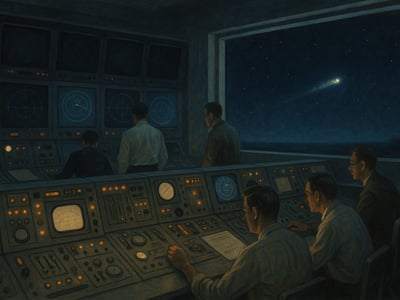
In practical terms, the flight did not erase the gap between the Soviet and American programs. Shepard had not orbited Earth, and NASA still had difficult steps ahead before achieving that goal. Yet the mission provided a tested operational model. It connected astronaut training, launch procedures, spacecraft performance, tracking, communications, medical monitoring, and naval recovery into one completed event. For an early human spaceflight program, that mattered as much as the headline milestone.
The flight also helped shape what followed. Project Mercury was still an experimental program, but it was now one with a successful American crewed mission behind it. Less than a year later, John Glenn would become the first American to orbit Earth, and the knowledge gained from Mercury missions would feed into later Gemini and Apollo planning. In that sense, Shepard's short flight belonged to a longer chain of development rather than standing alone.
Why it still matters
*Freedom 7* remains important because it showed that human spaceflight was not a single technical feat but a coordinated system. A mission had to combine a launch vehicle, a life-supporting capsule, trained personnel, reliable communications, tracking networks, and a recovery operation that could bring astronaut and spacecraft home safely. Shepard's flight was brief, yet it tested that full sequence under real conditions.
It also occupies a clear place in the institutional growth of the U.S. space program. Project Mercury was the starting point for methods and standards that later became routine in orbital missions and, eventually, lunar missions. Procedures for crew safety, mission rules, hardware testing, and coordination across agencies and military recovery units all developed through such early flights. The mission is therefore remembered not only as a first for the United States, but as part of the process by which crewed spaceflight became more systematic and repeatable.
Today, the image of *Freedom 7* often invites attention because of its place in the early Space Race. But the lasting historical value of Shepard's mission lies in something more durable than symbolism. On May 5, 1961, NASA completed a short, risky, carefully structured human flight and brought both pilot and capsule back from it. That achievement helped turn human spaceflight from an aspiration into an operating practice.
Timeline
- Project Mercury testing
- Mercury-Redstone program development
- Cold War space competition
- Yuri Gagarin orbital flight
- Mercury-Redstone 3 launch
- John Glenn orbital mission
What you uncovered
More Than a First Step
You didn't just… reconstruct a famous launch; you traced a mission that tested whether an astronaut, spacecraft, and recovery network could function together under real conditions.
Freedom 7 is often remembered as a first, but its deeper importance was operational rather than purely symbolic. In about 15 minutes, NASA was testing training, countdown procedures, capsule handling, reentry behavior, tracking, and ocean recovery as one connected process. That systems view mattered because later orbital and lunar missions would depend on each part working reliably with the others.
The Freedom 7 flight lasted about 15 minutes from liftoff to Atlantic splashdown.
FAQ
What happened on May 5, 1961?
On May 5, 1961, NASA astronaut Alan Shepard flew aboard Mercury-Redstone 3, known as Freedom 7. It was the first U.S. human spaceflight.
Where did Alan Shepard launch from?
Mercury-Redstone 3 lifted off from Launch Complex 5 at Cape Canaveral, Florida. Alan Shepard was aboard the Freedom 7 capsule.
How long did the Freedom 7 flight last?
The flight lasted about 15 minutes from liftoff to splashdown. It was a short suborbital mission, not an orbital one.
How high did Freedom 7 go?
The spacecraft reached an altitude of about 116 statute miles, or approximately 187 kilometers. After that, it descended toward the Atlantic Ocean.
What happened after splashdown?
NASA recovery forces retrieved Alan Shepard and the Freedom 7 capsule from the Atlantic Ocean. The mission ended safely after recovery.