


About this story
Final German surrender ceremony in Berlin-Karlshorst, following the earlier Reims signing.
On 9 May 1945, shortly after midnight in Berlin-Karlshorst and already on 9 May by Moscow time, representatives of Nazi Germany signed the final act of unconditional surrender before Soviet, American, British, and French representatives. The ceremony did not begin the end of the war in Europe from nothing: German surrender terms had already been signed at Reims on 7 May. But the Berlin document gave the surrender a final form acceptable to the Soviet command and publicly affirmed it in the defeated German capital.
That combination of battlefield collapse, alliance politics, and legal procedure helps explain why this moment remains so important. By early May 1945, Germany's military position had disintegrated. Berlin had fallen after intense fighting, Adolf Hitler was dead, and the remaining German authorities were trying to manage a military catastrophe that could no longer be reversed. Yet even at the end of a war so vast and destructive, the final step still required signatures, witnesses, wording, and a ceremony that all major Allied powers would recognize.
The immediate background lay in Reims, France, where on 7 May Alfred Jodl signed the German Instrument of Surrender at the Supreme Headquarters Allied Expeditionary Force. That agreement was a major step toward ending hostilities in Europe. However, Soviet leaders insisted that the surrender also be formally enacted in Berlin, the center of the Nazi state and the city captured at enormous cost by the Red Army. For the Soviet command, the question was not merely symbolic. Authority, representation, and procedure mattered in a coalition war, especially in its closing hours.
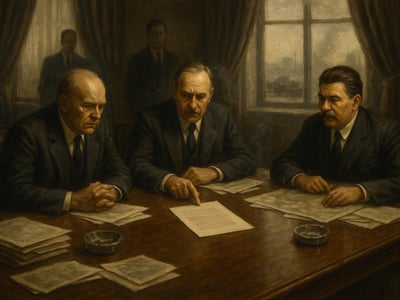
The result was a second ceremony in Berlin-Karlshorst, a district on the city's eastern side. There, Field Marshal Wilhelm Keitel signed for the German High Command shortly after midnight. He was joined by General Hans-Jürgen Stumpff and Admiral Hans-Georg von Friedeburg, whose signatures represented other branches of the German armed forces. On the Allied side, Marshal Georgy Zhukov signed on behalf of the Soviet High Command, while Air Chief Marshal Arthur Tedder signed on behalf of the Allied Expeditionary Force. French General Jean de Lattre de Tassigny and American General Carl Spaatz were also present in the wider Allied framework associated with the surrender arrangements.
The wording mattered because the Allies wanted no ambiguity. Germany was not negotiating terms between equals; it was accepting unconditional surrender. The instrument specified that German armed forces were to cease active operations at 23:01 Central European Time on 8 May 1945. That deadline created one of the most enduring features of the event's historical memory. In much of Western Europe, the end of the war in Europe became associated with 8 May. In Moscow, because of the time difference, the same developments were already part of 9 May.
This difference in date has sometimes made the sequence seem more confusing than it was. The war in Europe ended through a process rather than a single instant. There was the signing at Reims on 7 May, the ceasefire deadline at 23:01 CET on 8 May, and the Berlin ceremony shortly after midnight that was linked to 9 May in Soviet time. All were part of the same closing act of the European war. The distinction came from military procedure, diplomatic insistence, and the clock, not from two separate surrenders to two separate alliances.
Berlin itself gave the ceremony an added meaning. By holding the final act there, the Allies underscored that the war had ended at the political and military heart of the regime that had begun it in Europe. The city was devastated, and the surrender took place in a setting shaped by recent combat, not by peacetime diplomacy. That setting mattered to the Soviet Union in particular, whose forces had borne a vast share of the fighting on the Eastern Front and had taken Berlin at exceptional human cost.
At the same time, the ceremony showed that coalition warfare did not end when the shooting stopped. Allied unity had to be expressed formally. Zhukov's and Tedder's signatures, together with the wider participation of French and American senior commanders, made the act recognizably multinational. The war had been fought by allied commands with different fronts, priorities, and losses. Its ending had to be framed in a way that reflected that shared authority.
Why it still matters
The surrender at Berlin-Karlshorst is a reminder that wars end not only through battlefield victory but also through documents that define who has authority, what obligations apply, and when fighting must stop. Military collapse alone did not settle every question. The final act turned that collapse into a formally recognized conclusion at the Allied level.
It also helps explain why public commemoration can follow more than one date without changing the underlying facts. The association of the event with 8 May in some countries and 9 May in others grew from the sequence of the Reims and Berlin signings, the ceasefire deadline, and the time difference with Moscow. Calendars and ceremonies shaped memory as much as the text of the surrender itself.
Finally, the Berlin ceremony shows how coalition procedure matters in international conflict. The presence of Soviet, British, American, and French authority was not a decorative detail. It was part of making the end of the war in Europe legible, lawful, and accepted across the alliance that had defeated Nazi Germany.
For that reason, the event remains more than a closing scene. It is a case study in how military defeat becomes official history: through signatures, witnesses, timing, and the careful conversion of armed force into a recognized peace in one theater of war.
Timeline
- Battle of Berlin begins
- Surrender signed in Reims
- VE Day in Western Europe
- Final German surrender in Berlin
- Victory Day in the Soviet Union
What you uncovered
Why Two Victory Dates
You didn't just… complete a timeline puzzle; you traced how the end of a war also had to be fixed through procedure, signatures, and shared recognition.
The end of the war in Europe is often tied to both 8 May and 9 May because military surrender, formal ceremony, and public commemoration did not line up perfectly. Germany first signed at Reims on 7 May, then a final ceremony was held in Berlin to satisfy Allied command requirements, and the moment fell after midnight in Moscow. That combination turned a single military outcome into two enduring calendar traditions.
The surrender terms required German armed forces to cease active operations at 23:01 Central European Time on 8 May 1945.
FAQ
What happened on 9 May 1945 in Berlin-Karlshorst?
Shortly after midnight on 9 May 1945, German military representatives signed the final act of unconditional surrender in Berlin-Karlshorst. This formalized the cessation of German armed resistance in Europe at the Allied level.
Who signed the surrender in Berlin-Karlshorst?
Field Marshal Wilhelm Keitel signed for the German High Command. Marshal Georgy Zhukov signed for the Soviet High Command, and Air Chief Marshal Arthur Tedder signed for the Allied Expeditionary Force; General Hans-Jürgen Stumpff and Admiral Hans-Georg von Friedeburg also signed for Germany.
Why are 8 May and 9 May both linked to Germany's surrender?
The surrender terms set German forces to stop active operations at 23:01 Central European Time on 8 May 1945. Because the Berlin ceremony took place shortly after midnight on 9 May local Moscow time, the event became associated with 9 May commemorations in the Soviet Union and several successor states.
How did the Berlin ceremony differ from the Reims signing?
On 7 May 1945, Alfred Jodl signed the German Instrument of Surrender at Supreme Headquarters Allied Expeditionary Force in Reims, France. The Berlin-Karlshorst ceremony followed as the final act of unconditional surrender and included representatives of the Soviet, American, British, and French sides.