

About this story
Mandela's inauguration in Pretoria marked the start of South Africa's Government of National Unity.
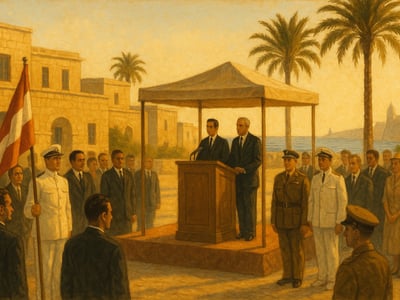
On 10 May 1994, Nelson Mandela was inaugurated as President of South Africa at the Union Buildings in Pretoria, marking the formal installation of a new government after the country's first national election held on the basis of universal adult suffrage. The ceremony came only days after the announcement of the election results and one day after Mandela had been elected president by the National Assembly in Cape Town. It was a highly visible public moment, but it also represented something more specific: the transfer of state authority into a new constitutional order after decades of apartheid-era exclusion.
That transfer had not been inevitable. South Africa's political system had long denied the majority of its people equal political rights, and the final years of apartheid were marked not only by negotiation but also by sharp uncertainty, detention, mistrust, and violence. By the early 1990s, however, political leaders and negotiators had moved toward a different path. Mandela's release from prison in 1990 was one major turning point. Another was the series of negotiations that followed, including the CODESA process and the work that led to the Interim Constitution of 1993.
The Interim Constitution created a framework for a democratic transition that was meant to be workable under difficult conditions. It did not resolve every conflict in South African society, but it established the legal basis for an election, a new parliament, and a Government of National Unity. That framework mattered because the transition required more than a popular desire for change. It required institutions that rivals would accept, procedures that could be followed, and enough confidence in the process for the result to be implemented.
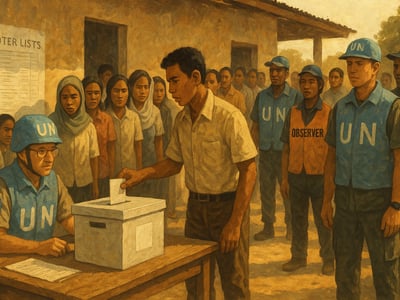
South Africans went to the polls between 26 and 29 April 1994, and on 27 April many voted in a national election conducted under universal suffrage for the first time. The scale of the event was historic, but also practical and administrative. Millions of people who had been excluded from previous national elections were now participating in the formal selection of a government. The Independent Electoral Commission later announced the results on 6 May 1994, with the African National Congress receiving the largest share of the national vote.
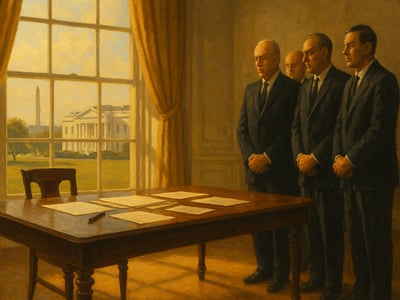
That result did not simply place one party in office in the ordinary sense. Under the interim arrangements, it set in motion a broader distribution of authority meant to stabilize the transition. On 9 May 1994, the National Assembly elected Mandela as president. The next day, at the Union Buildings, he took the oath of office. F. W. de Klerk and Thabo Mbeki were also sworn in on 10 May as deputy presidents in the Government of National Unity.
The presence of those figures together was part of the institutional logic of the moment. De Klerk had been the last state president under the old order and had played a central role in the negotiations that led to the transition. Mbeki was one of the African National Congress leaders who would become central to the next phase of government. Their joint participation in the new executive was not a sign that South Africa's conflicts had disappeared. Rather, it reflected an attempt to manage a transfer of power through shared constitutional arrangements instead of renewed confrontation.
That is one reason the inauguration remains so closely studied. Public memory often emphasizes the symbolism of Mandela taking office, and that symbolism was real. Yet the event was also the visible endpoint of a chain of legal and political steps: negotiations, constitutional drafting, election administration, parliamentary selection, and the final swearing-in of officeholders. If any of those steps had broken down, the legitimacy of the new order could have been weakened.
The location itself added to the significance. The Union Buildings in Pretoria had long been associated with the central authority of the South African state. Holding the inauguration there underscored that this was not an uprising outside the state but a change in who could claim democratic authority within it. The buildings remained the seat of government, but the electorate, the constitutional framework, and the officeholders had changed.
Even so, the day should not be understood as a simple ending. The inauguration did not erase the effects of apartheid, nor did it settle every argument about justice, memory, or material inequality. It established a lawful government with broad electoral legitimacy and made a new political order visible to South Africans and to the wider world. But building that order would require years of further institution-making, policy choices, and constitutional development, including the adoption of South Africa's 1996 Constitution.
Why it still matters
Mandela's inauguration is still referenced because it offers a clear example of how a state can move from an exclusionary system toward electoral government through negotiated constitutional change. The importance of the event lies not only in the identity of the person taking office, but in the method by which office changed hands. Elections, legislatures, interim legal frameworks, and coalition-style arrangements all played a part in making the transfer credible.
That makes the event relevant well beyond South African history. It is often discussed in relation to suffrage expansion, constitutional design, and the problem of how institutions gain legitimacy after systemic conflict. In many countries, debates about democratic transition focus on leaders or protests alone. The South African case highlights a different but connected question: how power is transferred, recognized, and limited once a breakthrough becomes possible.
It also remains important because the Government of National Unity showed one way of handling immediate post-transition politics. Shared executive arrangements are not a universal solution, and they do not remove deeper social divisions. But in South Africa in 1994, such arrangements formed part of a practical effort to keep the state functioning while a new democratic order took shape.
For that reason, 10 May 1994 is remembered not only as an inaugural ceremony, but as a constitutional milestone. It was the day a negotiated settlement became unmistakably real in the institutions of government.
Timeline
- Release of Nelson Mandela from prison
- Interim Constitution of South Africa
- South African general election
- 1994 election results announced
- Inauguration of Nelson Mandela as President of South Africa
- Formation of Government of National Unity
- Constitution of South Africa
What you uncovered
Power Made Constitutional
You didn't just… complete a puzzle about an inauguration; you traced a moment when state power was transferred through ballots, law, and shared institutions rather than force.
Mandela's inauguration mattered not only because of who took office, but because it confirmed that a new political order would operate through agreed legal procedures. The ceremony gave public form to the Interim Constitution, the election result, and the Government of National Unity as working institutions. That makes the moment useful beyond South Africa itself: it shows how legitimacy after systemic conflict depends on rules being accepted, enacted, and seen to function.
Nelson Mandela was elected President by South Africa's National Assembly on 9 May 1994, one day before he was sworn in at the Union Buildings in Pretoria.
FAQ
When was Nelson Mandela inaugurated as President of South Africa?
Nelson Mandela was inaugurated on 10 May 1994. The ceremony took place after the national election held from 26 to 29 April 1994.
Where did Mandela's inauguration take place?
He was sworn in at the Union Buildings in Pretoria, South Africa. That was the official venue for the inauguration.
Why was the 1994 South African election historically significant?
It was the first national election in South Africa conducted on the basis of universal adult suffrage. The election marked the transition to a nationally elected government under the Interim Constitution.
Who served as deputy presidents in the Government of National Unity?
F. W. de Klerk and Thabo Mbeki were sworn in on 10 May 1994 as Deputy Presidents. They served alongside Mandela in the Government of National Unity.