

About this story
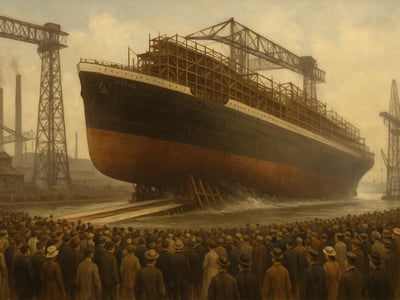
Sir John Franklin's expedition leaves Greenhithe in HMS Erebus and HMS Terror, 1845
On 12 May 1845, Sir John Franklin’s expedition sailed from Greenhithe on the River Thames in southern England, beginning a voyage that aimed to find and chart a navigable Northwest Passage through the Canadian Arctic. The two ships, HMS *Erebus* and HMS *Terror*, carried 129 officers and men. Their departure was public, organized, and confident, the start of a major Royal Navy mission. Yet it would become one of the nineteenth century’s most enduring maritime mysteries.
By the time Franklin left England, the search for a sea route through the Arctic had occupied European powers for generations. For Britain, the Northwest Passage promised geographical knowledge, naval prestige, and the possibility of a shorter route linking oceans. Much of the region remained only partly mapped by Europeans, and what was known of it suggested a place of narrow channels, drifting ice, long winters, and extreme isolation. Any expedition entering those waters had to plan for distance, cold, and the possibility of becoming trapped far from help.
Franklin himself was an experienced naval officer with a long record of service, including earlier Arctic travel. With him were Francis Rawdon Moira Crozier, who commanded *Terror*, and James Fitzjames, captain of *Erebus*. The ships chosen for the voyage were sturdy bomb vessels that had already proved themselves in difficult conditions. Even so, wooden ships, however reinforced, faced severe limits in ice-bound seas. Every ton of food, fuel, equipment, and clothing had to be loaded in advance or obtained at a small number of planned stops before the expedition entered the high Arctic.
That basic problem shaped the entire undertaking. Franklin and the Admiralty were sending a large crew into a region where summer access was brief and uncertain, where channels could close unexpectedly, and where retreat might become impossible if sea ice blocked the route behind them. The expedition did not set out as an improvised gamble. It was a formal state mission, carefully supplied and commanded. But its very scale meant that failure in navigation or timing could quickly become failure in survival.
After leaving Greenhithe, the ships continued through the North Atlantic on the outward stage of the voyage. Later they reached Disko Bay in Greenland, one of the last important points before entering more remote Arctic waters. From there, *Erebus* and *Terror* moved on toward Baffin Bay. In July 1845, whaling vessels encountered the expedition there and recorded seeing the two ships waiting to enter Lancaster Sound. This sighting is the last confirmed report by Europeans of Franklin’s expedition while it was still underway.
At that moment, nothing in the surviving record suggested disaster. The ships had reached the threshold of the Arctic archipelago, where earlier expeditions had pushed westward in search of a route. But the geography ahead was difficult: a maze of channels, islands, and seasonal ice conditions that could vary sharply from one year to the next. A passage that looked open in one season might be impassable in another. For Franklin’s men, progress depended not only on seamanship and endurance, but also on timing and luck.
What happened after the ships disappeared had to be reconstructed slowly, over years and then generations. One of the most important documents later found in the Arctic was a note on King William Island, often called the Victory Point record. Its first dated message, from 28 May 1847, stated that all was well. That brief statement suggested that nearly two years after leaving England, the expedition was still intact, at least officially.
But the same record contained a later addition dated 25 April 1848, and its message changed the story completely. It reported that Sir John Franklin had died on 11 June 1847. It also stated that *Erebus* and *Terror* had been deserted. Those few lines became central to understanding the expedition’s fate. They did not explain every cause or every event, but they established a stark timeline: the expedition had survived into 1847, Franklin had died that year, and by the spring of 1848 the crews had abandoned the ships.
From there, evidence scattered across time and place. Search expeditions sent by Britain and others combed the Arctic for traces. They produced maps, reports, relics, and testimonies, but no immediate single answer. The disappearance became not just a naval loss, but an accumulating historical problem: how to understand a voyage that had begun in formal order and ended in fragmentary records, scattered remains, and unanswered questions.
Why it still matters
The Franklin expedition still matters because it shows the limits of nineteenth-century maritime planning in one of the harshest environments on Earth. The Royal Navy brought experienced officers, strong ships, and extensive provisions, yet ice, distance, and uncertainty could still overcome a carefully organized mission. Historians continue to study the expedition as a case in logistics, cold-weather operations, and decision-making under environmental pressure.
Its disappearance also reshaped Arctic exploration itself. The long search for Franklin generated repeated missions and left behind a large body of charts, journals, and official correspondence. In that sense, the loss expanded knowledge of the Arctic even as it exposed the risks of pursuing that knowledge through imperial-era exploration. The expedition’s story is therefore tied not only to one failed voyage, but also to the wider history of how the region was mapped and documented.
More recently, the expedition has remained important because later research brought different kinds of evidence together. Archival records, Inuit testimony, and maritime archaeology all contributed to a fuller picture. The modern identification of the wrecks of *Erebus* and *Terror* showed how a nineteenth-century disappearance could be revisited with new methods while also drawing attention to evidence that had long existed outside official British documents.
The departure from Greenhithe on 12 May 1845 can look, at first, like a straightforward moment: two naval ships setting out with a clear mission. In retrospect, it marks the beginning of a much longer story, one assembled from sightings, notes, searches, and archaeology. That is why the date remains significant. It was the last fully visible moment of an expedition that would soon pass from public ceremony into uncertainty.
Timeline
- Franklin Expedition departs Greenhithe
- Erebus and Terror sighted in Baffin Bay
- Victory Point record dated
- Victory Point message added
What you uncovered
From Voyage to Evidence
You didn't just… place a departure on the timeline; you traced the beginning of an expedition that later had to be reconstructed from fragments of evidence left across the Arctic.
What makes the Franklin expedition endure is not only that it vanished, but that its story shifted from naval mission to evidentiary problem. Historians and archaeologists have had to assemble it from official records, later search efforts, written notes, Inuit testimony, and eventually the wrecks themselves. That makes it a revealing case about the limits of planning and the way historical knowledge is often built after failure, not during success.
The last confirmed sighting of Erebus and Terror by Europeans was in July 1845, when whaling ships saw them in Baffin Bay waiting to enter Lancaster Sound.
FAQ
What happened on 12 May 1845?
On 12 May 1845, HMS Erebus and HMS Terror sailed from Greenhithe on the River Thames under Sir John Franklin. The expedition was heading into the Arctic to seek a navigable Northwest Passage.
How many men were on the Franklin Expedition?
The expedition left Britain with 129 officers and men aboard the two ships. Franklin commanded the mission.
When was the Franklin Expedition last seen by Europeans?
Whaling vessels reported seeing HMS Erebus and HMS Terror in Baffin Bay in July 1845. They were waiting to enter Lancaster Sound.
What did the King William Island note say about Franklin's fate?
A note dated 28 May 1847, later found on King William Island, said that all was well at that time. A second message added on 25 April 1848 reported that Sir John Franklin had died on 11 June 1847 and that the ships had been deserted.