
About this story
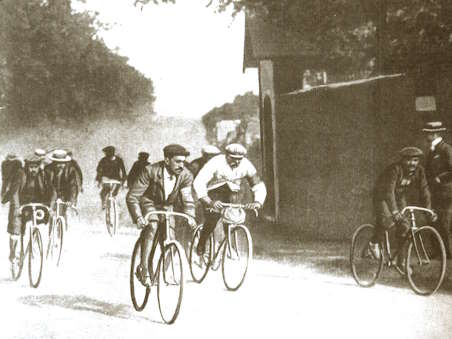
Start of the 1909 Giro d'Italia in Milan, organized by La Gazzetta dello Sport
On 13 May 1909, the first Giro d'Italia began from Corso Loreto in Milan, marking the start of a new kind of national sporting event in Italy. Organized by *La Gazzetta dello Sport*, the race was planned as an eight-stage road contest stretching more than 2,400 kilometers across the country. What now looks like the opening chapter of a famous tradition was, at the time, a practical gamble: a newspaper and its promoters were attempting to prove that a multi-stage bicycle race could attract riders, hold public attention, and be carried through on a national scale.
The early 20th century was a period when cycling had already become a major public sport in Europe. Long-distance road races drew interest, and the success of other events, especially in France, showed that newspapers could use sport both to build readership and to create spectacles that people would follow day by day. In Italy, *La Gazzetta dello Sport* saw the possibility of doing something similar. Tullo Morgagni and Armando Cougnet were central figures in promoting and managing the enterprise, turning the idea of a national tour into a detailed route, a schedule, and a public event that had to work not only on paper but on the road.
That challenge was considerable. The 1909 Giro was not a modern stage race with tightly controlled teams, smooth roads, and extensive technical support. It was run over very long stages on the road network of the time, with all the uncertainty that implied. The race was scheduled between 13 May and 30 May 1909, linking Milan with Bologna, Chieti, Naples, Rome, Florence, Genoa, Turin, and back to Milan. Even setting aside the demands on the riders, the organizers had to make the route legible to the public, keep the event functioning from city to city, and maintain confidence that the race would reach its conclusion.
The opening from Milan therefore mattered as more than a ceremonial departure. It was a test of whether the organizers' plan could survive its first real contact with distance, logistics, and public expectation. A national route promised visibility, but it also multiplied opportunities for failure. If the race did not retain riders, if the administration faltered between stages, or if the public treated it as a curiosity rather than a continuing drama, the Giro might have remained a one-time experiment.
Instead, the race established a rhythm that would become familiar in stage cycling: a sequence of departures, finishes, recoveries, and renewed competition spread across multiple cities. The route carried the event through major parts of Italy, helping define it as more than a local contest. Each stage connected places as well as competitors. Milan was the starting point, but Bologna, Chieti, Naples, Rome, Florence, Genoa, and Turin were all part of the race's identity, giving the event a geographic breadth that matched its national ambition.
Within that structure, riders competed not just in a single day of effort but over a sustained sequence of stages. That format changed the meaning of victory. Endurance, consistency, and the ability to remain competitive over time became central to the race. In this first edition, Luigi Ganna emerged as the winner when the Giro concluded back in Milan on 30 May 1909. His success gave the new event a clear first champion, something every lasting competition needs: a name attached to its origin.
Ganna's victory also helped make the inaugural Giro legible to the public as a complete sporting story. A beginning alone would not have been enough. The race needed a finish, a result, and evidence that it had worked as a contest rather than simply as a promotional idea. By reaching Milan again at the end of May with a winner recognized, the Giro demonstrated that the eight-stage model could produce both sporting meaning and public narrative.
The role of *La Gazzetta dello Sport* is especially important in understanding why the event took the form it did. Newspapers in this period were not only reporting on sport; they were often active in shaping it. Organizing a race could increase circulation, create recurring interest, and bind readers to a publication through anticipation and follow-up coverage. But such a strategy depended on success in the real world. The paper and its promoters were placing money, reputation, and organizational capacity behind a race whose future was not guaranteed.
That is part of what makes 13 May 1909 significant. The date marks the launch of a competition, but also of an institutional model. A newspaper-backed event attempted to transform long-distance cycling into a repeatable national spectacle. The Giro did not become historically important simply because bicycles set off from Milan; it mattered because the race was structured to continue over days, to connect cities, to hold public attention, and to return to its point of origin with a result that could be remembered.
Why it still matters
The first Giro d'Italia still matters because it helped establish the recurring multi-stage format that became central to major road cycling tours. A race spread across stages creates a different kind of drama from a one-day event: it rewards durability, turns geography into part of the contest, and gives spectators a story that unfolds over time. The 1909 Giro showed that this structure could work in Italy on a national scale.
It also illustrates how sport and media were closely linked in the early 20th century. *La Gazzetta dello Sport* did not merely describe a public spectacle after it happened; it played a direct role in creating one. The inaugural Giro is therefore a useful example of how newspapers, promoters, and sporting institutions together helped build mass spectator events before radio and television became dominant.
Finally, the race's long survival gives the 1909 edition importance beyond its immediate results. The original commercial motives of its organizers belonged to a specific moment, but the competition outlasted that moment and became an annual institution with its own prestige. Looking back to the departure from Corso Loreto in Milan, it is possible to see not just the start of one race in May 1909, but the beginning of a sporting structure that proved durable far beyond its first organizers' immediate aims.
When the riders left Milan that morning, there was no certainty that the Giro d'Italia would become one of cycling's major tours. There was only a route, an ambitious schedule, and the willingness of organizers and riders to test whether such an event could be sustained. By the time Luigi Ganna returned as the winner on 30 May, the answer was clear enough to ensure that the experiment would not remain a single episode.
Timeline
- First Giro d'Italia begins
- First Giro d'Italia concludes
What you uncovered
A Race Built to Last
You didn't just… complete a sports puzzle; you traced the start of an event designed to prove that a demanding race could be organized, followed, and repeated across an entire country.
The first Giro mattered not only because riders covered long distances, but because it showed that those distances could be packaged into a recurring public spectacle. A newspaper did more than report on sport here; it helped create the event itself, linking promotion, logistics, and audience attention into one system. That model helped make stage racing feel less like a one-time stunt and more like a durable institution.
The inaugural Giro d'Italia began on 13 May 1909 from Corso Loreto in Milan and ended there on 30 May after eight stages.
FAQ
When did the first Giro d'Italia begin?
The inaugural Giro d'Italia began on 13 May 1909. The race started in Milan, Italy.
Who organized the inaugural Giro d'Italia?
La Gazzetta dello Sport organized the 1909 race. Tullo Morgagni and Armando Cougnet were central to its promotion and management.
How many stages were in the first Giro d'Italia?
The first Giro d'Italia consisted of eight stages. It was run between 13 May and 30 May 1909.
Where did the 1909 Giro d'Italia start and finish?
It started from Corso Loreto in Milan and finished in Milan on 30 May 1909. The route linked Milan with several Italian cities before returning to Milan.
Who won the first Giro d'Italia?
Luigi Ganna won the 1909 Giro d'Italia. He was the winner when the race concluded in Milan on 30 May 1909.