About this story
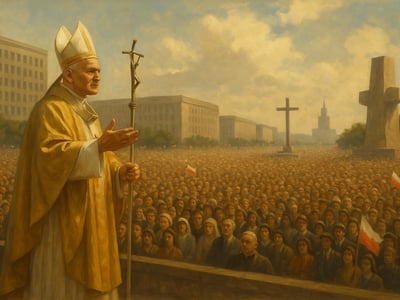
John Paul II in Warsaw at the start of his 1979 papal visit to Poland.
On 2 June 1979, Pope John Paul II arrived in Warsaw to begin a nine-day visit to Poland, the first time he had returned to his home country since his election to the papacy on 16 October 1978. What might have been a routine pastoral journey was, in the Polish People’s Republic, something more complicated: a public pilgrimage by a Polish-born pope in a one-party communist state that closely supervised mass gatherings, public speech, and symbolic displays of national identity.
Karol Wojtyła’s election as pope had already altered the political and cultural atmosphere around Poland. For Polish Catholics, it was an event of unusual importance. For the state authorities, it raised immediate practical and political questions. Could the head of the Roman Catholic Church be allowed to return and speak before huge crowds? How should a government built on strict control of public life manage an event whose significance could not be contained within ordinary protocol?
The visit went ahead only after negotiations between the Vatican and Polish communist authorities. That fact alone revealed the balancing act involved. The government did not simply invite an honored guest into an open public sphere; it had to calculate the risks of permitting a figure of global stature, and one with deep personal roots in Poland, to move across the country in full public view. Blocking the trip would have carried its own costs, both domestically and internationally. Allowing it meant accepting a form of collective expression that the state did not fully direct.
When John Paul II landed in Warsaw, the beginning of the pilgrimage became a national event. The trip was not confined to closed churches or private meetings. It unfolded in major public places and continued through multiple cities, including Warsaw, Gniezno, Częstochowa, and Kraków. Large outdoor masses and appearances drew very large crowds, making visible a scale of collective participation that was unusual in a political system accustomed to organizing and monitoring public assembly from above.
One of the most remembered moments came in Warsaw’s Victory Square, where John Paul II celebrated Mass and delivered a homily that included the prayer beginning, “Let your Spirit descend.” The words were religious, but the setting mattered as much as the text. In a state that sought to regulate the language and limits of public life, an enormous gathering centered on faith carried meaning beyond doctrine alone. It showed that people could assemble in vast numbers around something not created by the party-state, and that they could do so peacefully, openly, and with a strong sense of shared presence.
That does not mean the event had one simple political message. The pilgrimage was first of all a religious journey, and its participants did not necessarily understand it in the same way. Many came as believers to see the pope, attend Mass, and mark an extraordinary moment in Catholic life. Others also saw, in the very fact of the crowds, a reminder that Polish society contained institutions, loyalties, and memories that the communist system had never fully absorbed. Later interpretations often emphasized this wider meaning, but historians are careful to distinguish between what was evident at the time and what was understood more clearly in retrospect.
As the pilgrimage continued, its geography also mattered. In Gniezno, one of the historic centers of Polish Christianity, the pope linked contemporary Poland to a longer history that stretched beyond the communist era. In Częstochowa, he visited Jasna Góra Monastery, home of the Black Madonna and one of the country’s central religious shrines. Such stops reinforced the sense that the visit was moving through landscapes of memory and identity that had deep roots independent of the socialist state.
The scale of the journey was itself important. This was not a single ceremony in the capital but a multi-day pilgrimage crossing much of the country. At each stage, the authorities had to permit, secure, and manage gatherings whose emotional force they could not fully script. The state remained present, and the visit was not a breakdown of communist power. Yet the images produced by the trip—crowded squares, open-air liturgies, national attention focused on a non-state event—suggested that public life in Poland was not identical with official political structures.
The visit also placed two powerful institutions in view at once: the communist state and the Catholic Church. Poland had long been marked by a complicated relationship between them, and Cardinal Stefan Wyszyński remained an important figure in that history. John Paul II’s return did not settle that relationship, but it exposed its limits and tensions with unusual clarity. A transnational religious authority, represented by a pope who was also a son of Poland, was now operating publicly inside a state that claimed to shape the nation’s collective future.
In later years, especially after the rise of Solidarity in 1980, many people looked back on June 1979 as a turning point. It would be too simple to describe the pilgrimage as the sole cause of what followed. Economic pressures, labor unrest, political organization, and many other factors were essential to the changes of the next decade. Still, the visit became part of the story because it offered a memorable demonstration of collective presence and moral confidence before those later confrontations fully unfolded.
Why it still matters
The 1979 pilgrimage remains important because it helps explain how change in late communist Europe could begin not only in formal opposition movements or government institutions, but also in culture, ritual, and public gathering. Historians often study the visit as an example of how a religious event could create visible civic space within an authoritarian system without immediately becoming a direct political confrontation.
It also matters because it complicates simple accounts of power during the Cold War. The Polish state could negotiate, permit, and police the visit, but it could not entirely define its meaning. The Church could organize a pilgrimage, but its significance reached beyond strictly ecclesiastical boundaries. Between those institutions stood millions of people whose presence gave the event its weight.
For that reason, 2 June 1979 is remembered not only as the day a pope came home, but as the opening of a journey that revealed how much public life could exist beyond official control. Its legacy lies less in a single speech or ceremony than in the sight of a society appearing before itself in full view.
Timeline
- Election of Karol Wojtyła as pope
- John Paul II arrives in Warsaw
- Mass at Victory Square, Warsaw
- Visit to Gniezno
- Visit to Jasna Góra, Częstochowa
- Emergence of Solidarity
What you uncovered
A Crowd Becomes Visible
You didn't just place a papal visit on the timeline; you traced a moment when mass public presence itself carried unusual weight in communist Poland.
What made the visit historically resonant was not only what John Paul II said, but the fact that vast crowds could gather and be seen gathering across the country. In a state that tightly managed assembly and expression, a religious pilgrimage became a practical demonstration of how far official control could stretch and where it met social realities. That is why historians often discuss the trip as part of a broader change in civic visibility, rather than as a single direct cause of later events.
Karol Wojtyła was elected pope on 16 October 1978, less than eight months before this visit began in Warsaw.
FAQ
What happened on 2 June 1979 in Poland?
On 2 June 1979, Pope John Paul II landed in Warsaw to begin his first papal pilgrimage to Poland. It was a nine-day visit that started in the Polish People's Republic.
Which places did Pope John Paul II visit in 1979?
The pilgrimage included Warsaw, Gniezno, Częstochowa, and Kraków, among other places. He also visited Jasna Góra Monastery in Częstochowa, the principal shrine of the Black Madonna.
What did John Paul II do in Victory Square, Warsaw?
During the visit, John Paul II celebrated Mass in Warsaw's Victory Square. He delivered a homily that included the prayer beginning 'Let your Spirit descend.'
Why was the 1979 papal visit politically significant?
It took place in a one-party communist state that tightly managed public assembly and political expression. A pope born in Poland was speaking publicly before very large crowds, making the visit a major public event under communist rule.