
About this story
Opening phase of the Second Battle of the Marne near Reims and the Marne, 15 July 1918
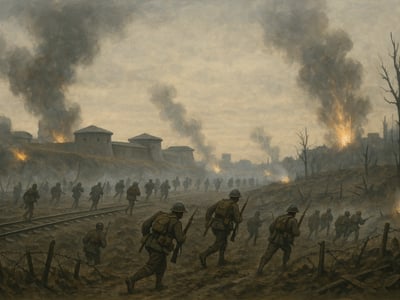
On 15 July 1918, German armies opened a major offensive along the Marne sector and in Champagne in northeastern France, beginning what is known as the Second Battle of the Marne. The attack fell on French positions east of Reims and across parts of the Marne front at a moment when the First World War had entered its final year but not yet its final outcome. After months of heavy fighting on the Western Front, the German high command was still seeking a decisive result before the balance of men, matériel, and coordination turned more firmly toward the Allies.
The offensive did not come out of nowhere. In the spring of 1918, Germany had launched a series of large attacks intended to break the deadlock in the west. These operations had gained ground in places and created real concern among Allied leaders, but they had also consumed troops, ammunition, and transport resources at a high rate. By July, the central question was whether one more major blow could force a breakthrough, or whether the effort would instead expose the limits of offensive warfare against defenders who had learned from years of trench conflict.
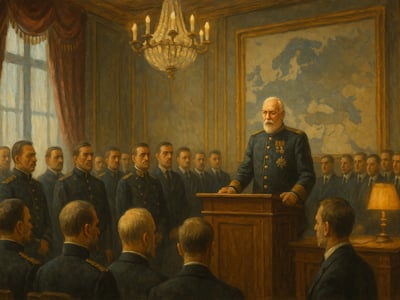
Erich Ludendorff, the leading figure in Germany's military direction during the 1918 offensives, chose to commit again. The plan called for attacks in sectors near Reims and along the Marne River. Reims mattered not only as a geographic point on the front but also because the surrounding sectors formed part of the wider defensive system protecting northeastern France. The German command hoped to split or dislocate Allied lines, compel the French to commit reserves, and create conditions for further operations.
On the Allied side, the command situation had changed from earlier stages of the war. Marshal Ferdinand Foch was serving as Allied Generalissimo on the Western Front, a role that reflected the growing effort to coordinate British, French, American, and other Allied forces more closely. The importance of that unified direction lay not in dramatic gestures but in timing, reserve management, and the ability to respond across sectors rather than treating each army in isolation.
The French defenses in Champagne were especially important on the opening day. General Henri Gouraud commanded the French Fourth Army there during the German attack of 15 July 1918. His sector was one of the places where prepared defense would prove decisive. By this stage of the war, defending armies had refined methods that included defense in depth, flexible use of artillery, and carefully organized positions intended not merely to hold a single line at all costs but to absorb, disrupt, and weaken an attacking force.
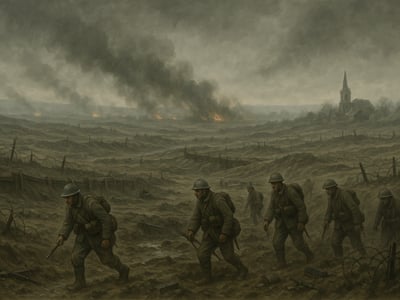
That mattered because the German army was attempting a difficult task. To turn a large offensive into an operational success, it had to break through entrenched defenses, maintain momentum, move supplies forward, and exploit any opening before Allied reserves sealed it. On paper, concentration of force could still promise results. In practice, every attacking formation faced the same harsh conditions that had shaped the war for years: broken ground, exposed movement, heavy artillery, and the need to coordinate infantry and supporting fire under pressure.
The opening attacks on 15 July therefore carried both military ambition and substantial risk. Earlier German offensives in 1918 had already strained manpower and matériel. Another major operation meant betting that the remaining offensive capacity of the German army could still produce a strategic effect. If the assault stalled, losses would mount without delivering the breakthrough needed to change the course of the war.
In Champagne, the defense proved difficult for the attackers to overcome. East of Reims, French forces resisted strongly, and the German advance faced prepared positions rather than a disorganized line. Along the Marne as well, the opening phase involved large forces but did not produce the clean rupture that German planning required. The battle's first day was therefore significant not because it settled everything at once, but because it showed that the offensive was meeting resistance under conditions more favorable to the defenders than Germany may have hoped.
This opening phase also reveals how much the war had become a contest of endurance, staff work, and coordination as much as battlefield courage. The commanders involved were not operating in a vacuum. Philippe Pétain oversaw the French Army as a whole, Foch coordinated at the Allied level, Gouraud managed a key front under immediate attack, and Ludendorff had to weigh the diminishing returns of repeated offensives. Their decisions shaped how reserves were placed, how intelligence was read, and how much risk each side was willing to accept.
Within days, the larger meaning of the German move would become clearer. The Allied counteroffensive launched on 18 July shifted the battle's direction and is often treated as the beginning of a broader turning point. But even before that counterstroke, the events of 15 July had already shown that Germany's latest effort would not unfold under the same conditions as earlier operations. Prepared defenses and more coherent Allied command had narrowed the attacker's options.
Why it still matters
The beginning of the Second Battle of the Marne remains important because it helps explain the transition from the crisis of early 1918 to the final Allied campaigns later that year. Historians study it as an example of how coalition warfare functioned when armies had to coordinate across a long front under intense pressure. Foch's role did not remove national commands, but it improved the ability of Allied forces to think and act as parts of a larger system.
The battle's opening also illustrates the limits of offensive warfare against prepared defenses. The First World War is often remembered for stalemate, yet commanders on both sides kept searching for ways to restore movement. The events of 15 July 1918 show how difficult that remained even after years of tactical adaptation. An attack could be large, carefully planned, and energetically carried out, and still fail to achieve the operational breakthrough on which the entire plan depended.
Finally, the date matters because it connects directly to the sequence that led toward the war's end. The fighting at the Marne did not end the conflict on that day, or even that week, but it formed part of the chain of events that led into the Hundred Days Offensive and, eventually, the Armistice of 11 November 1918. Looking back from that endpoint, 15 July stands as the start of a battle that revealed the changing balance on the Western Front more clearly than many earlier offensives had done.
The opening of the Second Battle of the Marne was therefore more than another attack on a crowded wartime map. It was a test of whether Germany could still impose its will through one more major offensive, and a test of whether the Allies' increasingly coordinated defense could withstand it. The answer began to emerge on the first day, in the fields and fortified sectors near Reims, in Champagne, and along the Marne River.
Timeline
- German Spring Offensive
- Second Battle of the Marne begins
- Allied command under Ferdinand Foch
- French defense in Champagne
- Allied counteroffensive begins
- Hundred Days Offensive
- Armistice of 11 November 1918
What you uncovered
Command, Timing, and Limits
You didn't just… complete a puzzle; you retraced the opening of an offensive whose outcome depended as much on coordination and preparation as on force.
The opening of the Second Battle of the Marne is often read not only as another attack, but as a test of whether offensive momentum could still overcome organized defense in 1918. It also shows how command structure mattered: by midwar standards, Allied coordination was stronger, and that changed how a major blow could be absorbed and answered. In that sense, the battle helps explain why the Western Front's final phase turned on timing and organization as much as on battlefield ambition.
General Henri Gouraud commanded the French Fourth Army in Champagne during the German attack that began on 15 July 1918.
FAQ
What happened on 15 July 1918 at the Second Battle of the Marne?
On 15 July 1918, German forces began the offensive that opened the Second Battle of the Marne. The attack marked a major assault on the Western Front in the final year of World War I.
Who commanded the German and Allied forces at the start?
Erich Ludendorff directed Germany's 1918 spring and summer offensives, including the 15 July operation at the Marne. Marshal Ferdinand Foch served as Allied Generalissimo on the Western Front, and General Henri Gouraud commanded the French Fourth Army in Champagne.
Where did the opening attacks take place?
The opening attacks fell on sectors near Reims and along the Marne River in France. They also struck parts of the Champagne front in northeastern France.
Why is the Second Battle of the Marne linked to World War I's final phase?
It was part of the fighting in mid-1918, when Germany launched one more major offensive after earlier attacks had already strained its forces. The battle belongs to the sequence of operations that led into the war's final campaigns.