
About this story
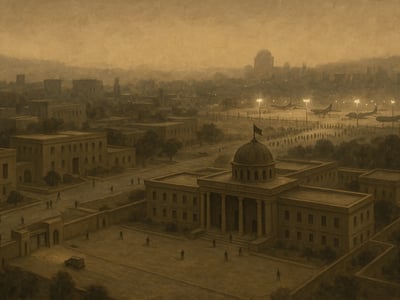
Košice, Slovakia: the government approved the Košice Government Programme on 17 April 1945.
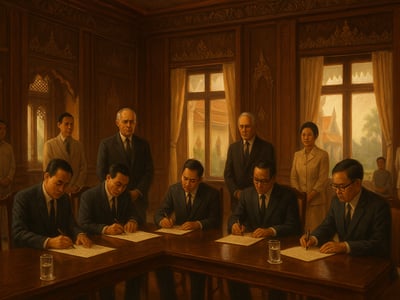
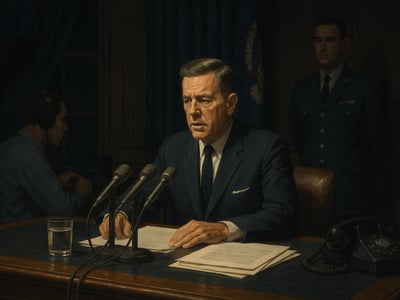
On 17 April 1945, in the eastern Slovak city of Košice, the re-established Czechoslovak government approved a document that would help shape the country’s immediate postwar order. The Košice Government Programme was adopted while the Second World War in Europe was still in its final weeks, and while state authority was only gradually being restored across liberated territory. It was both a practical plan for governing and a political statement about what the renewed republic would look like.
The timing mattered. Czechoslovakia was emerging from occupation, wartime division, and the collapse of the prewar political system. Prague had not yet resumed its role as the center of government life, so important state institutions were being rebuilt in the east, on territory that had already been liberated. Košice therefore became more than a temporary seat of administration. For a brief but significant period, it was the place where the restored state began to define itself.
A few days earlier, on 5 April 1945, a new government under Prime Minister Zdeněk Fierlinger had been appointed in Košice. President Edvard Beneš also returned to liberated Czechoslovak territory in April, underscoring that the republic was being reconstituted not in exile alone but on the ground. The setting reflected wartime realities: a government was trying to create a workable framework for administration before the war had fully ended and before all of the country was securely back under its control.
That urgency helps explain the programme’s broad scope. It was not a narrow cabinet statement dealing only with short-term reconstruction. Instead, it laid out how postwar state administration should function, which political forces would be allowed to operate legally, how collaborators would be treated, and which international alignment the state would follow. In other words, it set the terms for political life at the moment of restoration.
One of its central features was the establishment of the National Front as the framework for legal political parties in postwar Czechoslovakia. Rather than restoring the full range of prewar party competition, the programme accepted a limited-party structure. This was presented as a means of securing unity after occupation and war, but it also narrowed the space of legal politics from the start. The arrangement became one of the defining institutional choices of the postwar settlement.
The programme also addressed retribution against those regarded as collaborators or traitors. In the atmosphere of 1945, this was a politically important and widely expected element of state restoration. The government aimed to signal that the occupation period would not simply be followed by a return to ordinary politics, but by a reckoning with wartime conduct. In discussing this part of the programme, it is important to distinguish the document itself from the wider range of later postwar measures and from subsequent political developments. Even so, the inclusion of retribution in the programme shows how closely justice, punishment, and reconstruction were linked in official thinking at the time.
Foreign policy was another defining area. The Košice Government Programme confirmed an orientation toward the Soviet Union. That choice reflected the military and diplomatic realities of spring 1945, when Soviet forces played a decisive role in the liberation of much of Czechoslovak territory. It also reflected the balance of political influence inside the restored state. Alignment with the Soviet Union was therefore not a secondary detail but a formal part of the new government’s declared direction.
Several important political figures were associated with this moment, including Beneš, Fierlinger, and Klement Gottwald. In the Slovak context, figures such as Gustáv Husák and Vavro Šrobár also belonged to the wider political landscape of the period. The programme emerged from negotiation among major actors who needed agreement quickly. Without such agreement, the restored state risked entering the final phase of the war without a clear governing framework, without defined authority on liberated territory, and without a common political structure accepted by the leading forces in public life.
Košice’s role in this story is especially notable. The city had been liberated in January 1945, months before the war ended in Europe. That made it one of the first major places in Czechoslovakia where central state institutions could begin to function again. The programme’s adoption there linked the city directly to the legal and political reconstruction of the republic. It also showed how geography shaped politics: decisions about the future of the state were made where the state could first operate safely and concretely.
The Košice Government Programme did not by itself determine everything that followed. Later events, including the communist consolidation of power by February 1948, had their own dynamics. But the programme did establish some of the key assumptions of postwar governance. It narrowed party competition through the National Front, tied reconstruction to retribution, and formally located the state within a Soviet-oriented foreign-policy framework. These were not minor administrative choices. They helped set the parameters within which later politics would unfold.
Why it still matters
The programme remains important because it shows how a postwar state can be rebuilt through a single foundational political document. It was written at a moment of uncertainty, when institutions had to be re-created quickly and with limited room for delay. In that sense, it offers a clear example of how emergency conditions can shape long-term political design.
It also matters because it helps explain the legal and institutional foundations of postwar Czechoslovakia. The National Front system was not an accidental later development; it was built into the framework at an early stage. The same is true of the programme’s emphasis on retribution and its declared orientation toward the Soviet Union. Understanding those choices makes it easier to understand the state that emerged after the war.
Finally, the Košice Government Programme remains relevant because it connects local place and broad historical change. A government operating from a newly liberated city in Slovakia produced a document with consequences for the whole republic. That combination of wartime urgency, political negotiation, and institutional design is what gives the programme its lasting historical significance.
Timeline
- Fierlinger government appointed in Košice
- Košice Government Programme approved
- Communist consolidation of power
What you uncovered
Blueprints of Postwar Power
You didn't just… complete a date puzzle; you traced the moment when a government in Košice turned wartime recovery into a working framework for postwar rule.
The Košice Government Programme mattered not only for what it declared, but for what it made administratively possible. Adopted while authority was being rebuilt on liberated territory, it translated wartime conditions into lasting rules about which parties could operate, how the state would function, and where the country would look for support abroad. That is why it helps explain postwar Czechoslovakia as a product of both immediate necessity and structured political choice.
The National Front framework established by the programme became the only legal basis for party politics in postwar Czechoslovakia.
FAQ
What was the Košice Government Programme?
It was a postwar government programme approved by the Czechoslovak government on 17 April 1945 in Košice. The document set out plans for state administration, the National Front political framework, retribution against collaborators, and foreign-policy alignment with the Soviet Union.
Why was it adopted in Košice?
It was adopted in Košice because the restored Czechoslovak government was operating on liberated territory in eastern Slovakia during the closing phase of the Second World War. State institutions were being re-established there before the whole country was fully under control again.
Who were the main figures connected with the programme?
Key figures associated with the April 1945 government were Edvard Beneš, Zdeněk Fierlinger, Klement Gottwald, Gustáv Husák, and Vavro Šrobár. The government that approved the programme had been appointed in Košice on 5 April 1945 under Prime Minister Zdeněk Fierlinger.
How did the programme shape postwar Czechoslovakia?
It established the National Front as the permitted framework for legal political parties and confirmed a pro-Soviet foreign-policy orientation. It also defined retribution measures, making it an important basis for postwar state power and political life in Czechoslovakia.