

About this story
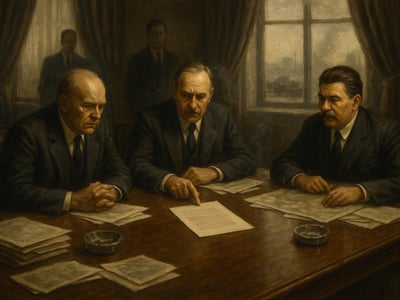
Rudolf Schuster signed Slovakia's EU ratification instrument in Bratislava on 23 April 2004.
On 23 April 2004, President Rudolf Schuster signed Slovakia’s instrument of ratification for the Treaty of Accession to the European Union in Bratislava. The act was formal and procedural, but it carried immediate practical weight. By signing the ratification instrument before the scheduled enlargement date, Slovakia completed the last constitutional step required on its side for entry into the European Union on 1 May 2004.
That moment was not the beginning of the story, and it was not even the first time Slovakia had publicly committed itself to joining the EU. Rather, it was the end of a long sequence in which diplomacy, domestic politics, constitutional procedure, and a fixed international timetable had to align. The signature in Bratislava mattered because accession was never achieved by symbolism alone. It depended on each stage being completed in the right order.
Slovakia’s path to EU membership grew out of the broader reorientation that followed the end of communist rule in 1989 and the later establishment of the independent Slovak Republic in 1993. Like other states in Central and Eastern Europe, Slovakia spent the following years redefining its political and economic institutions while seeking integration into Euro-Atlantic structures. Membership in the European Union was not only a foreign-policy objective; it also required domestic legal and administrative changes. Candidate states had to adapt laws, build regulatory capacity, and negotiate the terms under which they would enter the Union.
Those negotiations culminated in the Treaty of Accession, signed by Slovakia in Athens on 16 April 2003. The ceremony in Greece placed Slovakia among the states preparing to join the EU in what would become the largest single enlargement in the Union’s history up to that time. But signing the treaty did not itself make Slovakia a member. The document still had to pass through domestic approval procedures. In constitutional terms, the country had to do more than express political support. It had to ratify.
That process involved several institutions. In May 2003, Slovakia held a referendum on European Union membership, on 16 and 17 May. Participating voters approved accession. The referendum was an important public endorsement, but it was one step in a larger chain rather than a standalone act. It showed electoral support for joining the Union, yet constitutional procedure still required parliamentary action and presidential completion.
The next major stage came on 1 July 2003, when the National Council of the Slovak Republic approved the Treaty of Accession. This parliamentary vote gave the ratification process its legislative basis. It also demonstrated that accession was being handled through the normal machinery of the state: public vote, parliamentary decision, and formal action by the head of state. Figures such as Prime Minister Mikuláš Dzurinda, President Rudolf Schuster, and parliamentary leaders including Pavol Hrušovský were associated with the institutional side of that process, even though the legal sequence itself mattered more than any single speech or ceremony.
By April 2004, timing had become especially important. The enlargement date of 1 May was fixed. For Slovakia to enter together with the other accession states, its ratification process had to be completed without delay. That is what made Schuster’s signature on 23 April 2004 significant. It completed Slovakia’s constitutional ratification before the enlargement took effect. In practical terms, it closed the gap between political intention and legal readiness.
This was not the kind of event that produced dramatic images of sudden change. No border moved that day, and daily life did not transform in an instant. Yet the signature represented the point at which years of negotiation and preparation became legally final on the Slovak side. It confirmed that the country had met the procedural requirements needed to enter a supranational legal and political system with its own institutions, obligations, and decision-making processes.
Just over a week later, on 1 May 2004, Slovakia became one of ten states to enter the European Union. The enlargement also included the Czech Republic, Estonia, Cyprus, Latvia, Lithuania, Hungary, Malta, Poland, and Slovenia. For Slovakia, accession marked entry into the EU’s common legal framework and participation in its institutions. It was also one of the clearest markers of the country’s post-communist transition into a new European political setting.
The ratification sequence is worth noticing because public memory often compresses accession into a single date. In fact, there were several distinct milestones: the treaty signing in Athens, the referendum in May 2003, parliamentary approval in July 2003, the presidential signature in April 2004, and entry into force on 1 May 2004. Each step had a different function. Together, they turned a negotiated agreement into legal membership.
Why it still matters
The event still matters because it shows how European Union enlargement depended on domestic constitutional procedure as much as on international diplomacy. States did not join simply because negotiations ended or because leaders favored membership. They had to complete ratification through their own institutions. In Slovakia’s case, the referendum, the National Council, and the president each had a role in bringing accession into force.
It also remains important as a case study in how treaty commitments are translated into state action. The process linked public approval, parliamentary consent, and executive formalization within a strict international timetable. That combination helps explain why 23 April 2004 was more than a ceremonial date. It was the final domestic legal act that made participation in the 2004 enlargement possible.
More broadly, the ratification marked Slovakia’s entry into the European Union’s institutional, economic, and legal framework after the transformations that followed 1989. For historians, teachers, and readers looking back at the period, the date is a reminder that major geopolitical shifts are often completed not in a single dramatic instant, but through a sequence of documents, votes, and signatures that give political decisions their binding form.
Timeline
- Slovakia signs the EU Accession Treaty
- Slovakia holds an EU membership referendum
- Slovak National Council approves the Accession Treaty
- Slovakia ratifies the EU Accession Treaty
- Slovakia joins the European Union
What you uncovered
The Last Legal Step
You didn't just… complete a date and name puzzle; you traced the final legal step in Slovakia's path into the European Union.
EU accession is often remembered as a single day of entry, but it depended on a chain of domestic and international procedures being completed in order. In Slovakia's case, the referendum, parliamentary approval, presidential signature, and treaty process each had a distinct role within a fixed timetable. That sequence shows how major geopolitical changes can rest on routine constitutional acts as much as on public symbolism.
Before the April 2004 ratification, Slovakia had signed the EU Treaty of Accession in Athens on 16 April 2003.
FAQ
What happened in Slovakia on 23 April 2004?
On 23 April 2004, President Rudolf Schuster signed Slovakia's instrument of ratification for the Treaty of Accession to the European Union in Bratislava. This completed Slovakia's constitutional ratification process before EU enlargement took effect on 1 May 2004.
Who signed Slovakia's EU instrument of ratification?
President Rudolf Schuster signed Slovakia's instrument of ratification. The signing took place in Bratislava on 23 April 2004.
When did Slovakia officially join the European Union?
Slovakia became one of ten states that entered the European Union on 1 May 2004. That date marked the 2004 enlargement.
How did the 2003 referendum relate to Slovakia's EU accession?
On 16-17 May 2003, Slovakia held a referendum on European Union membership, and participating voters approved accession. That approval was part of the process that led to the treaty's later ratification and entry into the EU.