

About this story
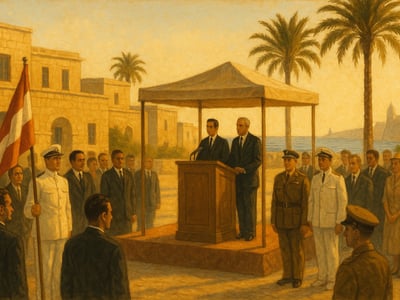
David Ben-Gurion proclaims the new state at the Tel Aviv Museum, 14 May 1948.
On May 14, 1948, David Ben-Gurion stood in the Tel Aviv Museum and read the Declaration of the Establishment of the State of Israel. The moment came in the final hours of British rule in Palestine, with the mandate due to end at midnight. What was announced that afternoon was not simply a new political claim. It was an attempt to turn a movement, an administration in preparation, and a contested international situation into a functioning state before the legal framework of the mandate disappeared.
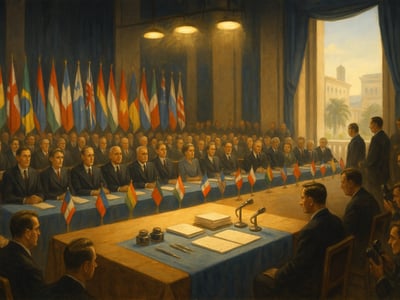
The declaration was made in a setting shaped by both urgency and uncertainty. In the months before it, the future of the territory had become increasingly unstable. The United Nations Partition Plan for Palestine, adopted in November 1947, had proposed the end of the mandate and the partition of the territory into separate states, with Jerusalem under a special international arrangement. But the plan did not settle the conflict. Violence intensified in the mandate territory, and by spring 1948 the question was no longer only how sovereignty might be arranged on paper, but who would exercise authority when British power withdrew.
For the Jewish leadership, this created an immediate decision. Waiting might have reduced the appearance of haste, but it also risked leaving a political and legal vacuum just as British rule ended. Declaring statehood, on the other hand, meant taking responsibility for government, administration, defense, and diplomacy under conditions in which borders, security, and international acceptance were all uncertain. Ben-Gurion and his colleagues chose to proceed despite the likelihood that the proclamation would be followed by war.
The declaration itself was therefore both symbolic and administrative. It announced the establishment of the State of Israel, but it also served as a claim to legitimacy at a moment when legitimacy needed to be enacted quickly. A state required institutions, authority, and recognition, not only words. The proclamation helped provide the legal and political basis for a provisional government and for early state organs to operate in the name of the new state rather than under the fading structure of the British Mandate.
Timing mattered. The British Mandate for Palestine ended at midnight between May 14 and 15, 1948. That deadline gave the ceremony its compressed force. There was little room for delay, and no settled peace in which to stage a gradual transition. The declaration took place in the narrow interval when one governing order was ending and another was trying to establish itself. Such moments are often treated later as inevitable turning points, but at the time they are usually uncertain and exposed. This one was no exception.
International reaction was immediate. On the same day as the proclamation, the United States extended recognition to the new state. That did not remove the dangers facing the provisional authorities, but it gave Israel an important measure of diplomatic standing at once. Recognition mattered because new states do not exist only through internal declaration. They must also navigate how other governments respond to their claims, their institutions, and their capacity to act as members of the international system.
Yet diplomacy did not create stability on its own. By May 15, armed forces from neighboring Arab states had entered the former mandate territory, widening the conflict. What had already been violent struggle within the territory now shifted into interstate war. The declaration of statehood, made under pressure, was almost immediately followed by a test of whether the new state could survive militarily while also building the basic structures of governance.
That dual challenge defined the first days after the declaration. The leadership had to act as though sovereignty were already established while events on the ground threatened to overwhelm any claim to orderly transition. Administration, military organization, and international representation had to move forward together. The declaration was therefore not the conclusion of a process but the opening of a more dangerous phase in which the existence of the state had to be defended and institutionalized at the same time.
Other early steps quickly followed. On May 16, 1948, the Provisional State Council elected Chaim Weizmann as the first President of Israel. This was part of a broader effort to convert the proclamation into durable state institutions. Titles, offices, and councils did not resolve the conflict around them, but they were part of the work of making a state function beyond the founding announcement.
The event has remained historically important not only because it marked the creation of Israel, but also because it was inseparable from the larger crisis around it. For Israelis, Palestinians, neighboring Arab states, and outside powers, the date sits within a wider history of war, displacement, contested claims, and competing national narratives. Even a straightforward factual account therefore requires care. The declaration itself is a documented event; its meaning has been understood differently by different communities ever since.
Why it still matters
The proclamation on May 14, 1948, remains central to discussions of recognition and sovereignty because it shows how a state can emerge under intense international and military pressure. It is often studied as an example of how the end of imperial rule did not necessarily produce a stable handover. Instead, the collapse of one governing framework could create a rapid and hazardous transition in which legal authority, diplomatic recognition, and armed conflict all unfolded at once.
It also matters because it shaped the legal and diplomatic foundations of the Arab-Israeli conflict. Questions of borders, status, recognition, and competing national claims did not end with the declaration. In many ways, they became more sharply defined after it. The events of May 1948 are also closely connected to the histories of war, displacement, and refugee issues that have continued to influence regional politics and international diplomacy for decades.
For historians, the declaration is a reminder that state formation is not only a constitutional act or a ceremonial milestone. It can be a compressed crisis in which decisions taken within hours have consequences that last for generations. On May 14, 1948, the founding of Israel was announced in a museum hall in Tel Aviv, but its significance reached far beyond that room almost immediately.
Timeline
- United Nations Partition Plan for Palestine
- Declaration of the State of Israel
- End of the British Mandate for Palestine
- First President of Israel elected
What you uncovered
Between Mandate and State
You didn't just… complete a date puzzle; you traced a moment when the end of one governing system and the declaration of another collided under intense uncertainty.
What stands out is how little separation existed between legal change and geopolitical consequence. The declaration did not arrive after institutions, borders, and recognition were securely settled; it was part of the process of creating them in real time. That helps explain why 14 May 1948 remains so important in debates about sovereignty and legitimacy. It also shows how the end of imperial rule could produce not a clean transfer of authority, but an immediate struggle over status, recognition, and force.
The British Mandate for Palestine ended at midnight between 14 and 15 May 1948.
FAQ
What happened in Tel Aviv on 14 May 1948?
On 14 May 1948, David Ben-Gurion read the Declaration of the Establishment of the State of Israel at the Tel Aviv Museum in Tel Aviv. It was the formal proclamation of the new state.
When did the British Mandate for Palestine end?
The British Mandate for Palestine ended at midnight between 14 and 15 May 1948. The declaration of statehood came just before that transition.
Where was the Israeli declaration of independence read?
It was read at the Tel Aviv Museum in Tel Aviv. That was the site of the proclamation on 14 May 1948.
Did the United States recognize Israel on the same day?
Yes. On 14 May 1948, the United States extended recognition to the new state shortly after the proclamation.
What happened after the declaration on 14 May 1948?
On 15 May 1948, armed forces from neighboring Arab states entered the former mandate territory after the proclamation. The conflict widened immediately after the declaration.