

About this story
Junko Tabei's 1975 Everest ascent with the Japanese Women's Everest Expedition.
Video puzzle
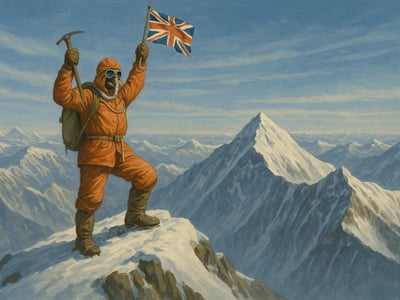
On May 16, 1975, Japanese mountaineer Junko Tabei reached the summit of Mount Everest, becoming the first woman known to complete the climb. She did so as part of the Japanese Women's Everest Expedition, a team effort that moved through the high camps of the world's highest mountain under the same hard constraints that had shaped Everest climbing for decades: altitude, weather, route conditions, limited supplies, and the need to keep people functioning in a place that offers little margin for error.
Mount Everest stands in the Himalayas on the frontier between Nepal and Tibet. At the time, it was widely cited as 8,848 meters above sea level, a figure familiar to generations of climbers even though later measurements have been revised in some sources. By 1975, Everest already carried a powerful place in modern mountaineering history. Edmund Hillary and Tenzing Norgay had made the first recorded ascent on May 29, 1953, and their climb had established the mountain as the defining test of high-altitude expedition climbing.
Tabei's ascent came 22 years after that first recorded summit. In those two decades, Everest expeditions remained large and demanding undertakings. Success depended not only on individual strength but on planning, transport, camp placement, oxygen management, and the ability of a whole team to keep moving in difficult conditions. That was especially true in the 1970s, when Himalayan climbing still relied heavily on coordinated expedition structures to carry equipment and maintain support high on the mountain.
The Japanese Women's Everest Expedition was organized to make a serious summit attempt rather than a symbolic appearance. Its members had to prepare for the same practical problems faced by any team on Everest: how to move people and gear upward, how to establish and sustain camps, and how to judge whether the mountain would allow a final push. Every stage of the climb depended on recovery, timing, and the ability to respond to changing conditions.
That is part of what makes the event important in mountaineering terms. Everest records are often remembered through the brief fact of who stood on the summit and when. But a summit day is the end point of a much longer process. Before Tabei reached the top, her expedition had to function as an organized unit on dangerous terrain, where progress could be slowed or stopped by fatigue, unstable snow, worsening weather, or the accumulated effects of altitude. A summit bid could fail long before the final ridge if support broke down or if climbers were unable to continue safely.
When Tabei did reach the top on May 16, she entered a record book already shaped by the prestige of Everest. Yet her climb also altered that record book. The achievement did not change the physical demands of the mountain, but it changed who was visibly included in the history of elite Himalayan climbing. Accounts of Everest had long centered on male climbers, expedition leaders, and institutions that were often built around men's participation. Tabei's ascent became a documented and enduring point of reference showing that those assumptions about access and recognition were neither fixed nor complete.
Her summit was therefore both an individual accomplishment and the outcome of collective organization. The expedition mattered because it created the conditions in which that ascent could happen. This balance between personal success and team structure is central to understanding Everest history. Even the most celebrated climber on the mountain depends on others: teammates, route preparation, camp support, and the broader institutions that make an expedition possible. Tabei's climb fits squarely within that pattern.
The event also stood at the intersection of national and international mountaineering history. A Japanese climber reached the summit through a Japanese women's expedition on the world's most internationally recognized mountain. That gave the ascent significance beyond a single country's sporting record. It entered a global narrative about exploration, high-risk achievement, and the changing place of women in fields that had often restricted opportunity or visibility.
Why it still matters
Junko Tabei's ascent remains important because it belongs to several histories at once. In mountaineering history, it is a clear record: on May 16, 1975, she reached the summit of Everest. In expedition history, it shows how organized teams, logistics, and institutional support shape who is able to attempt the highest objectives. And in gender history, it became a durable example of women widening their presence in a field that had long presented extreme exploration as mostly male territory.
That does not mean the climb should be reduced to symbolism alone. Tabei's summit mattered because it was a real Everest ascent, achieved under the same severe environmental conditions that confront any climber on the mountain. The historical significance comes from the combination of those facts: the technical and physical reality of Everest, the structure of the expedition that supported the climb, and the barrier her success helped to challenge.
In the years since, Tabei has remained a reference point in discussions of women's mountaineering and the broader history of access to elite sport and exploration. Her summit is still cited because it connects a specific day on a mountain to larger questions about opportunity, recognition, and participation. For that reason, May 16, 1975, remains more than a notable date in Everest chronology. It marks a moment when one ascent also expanded the visible boundaries of who belonged in the story of the world's highest peak.
Timeline
- First recorded Everest ascent by Edmund Hillary and Tenzing Norgay
- Junko Tabei summit of Mount Everest
What you uncovered
Who Gets to Climb
You didn't just… complete a mountain puzzle; you traced a moment when a summit also reflected who had the chance to take part in top-level expeditions.
Tabei's ascent is often remembered as an individual first, but Everest expeditions depended on far more than one climber's strength. Team structure, funding, logistics, and institutional support all influenced who could train, travel, and remain in contention for a summit attempt. That is part of why the climb still matters: it points not only to personal achievement, but to changing access within elite mountaineering.
Tabei reached Everest's summit on 1975-05-16 as part of the Japanese Women's Everest Expedition.
FAQ
What happened on Mount Everest on 16 May 1975?
On 16 May 1975, Junko Tabei reached the summit of Mount Everest. She did so as a member of the Japanese Women's Everest Expedition.
Who was Junko Tabei?
Junko Tabei was a Japanese mountaineer. She became the first woman to reach the summit of Mount Everest on 16 May 1975.
What expedition was Junko Tabei part of?
She was part of the Japanese Women's Everest Expedition. The climb was carried out by that expedition team on Mount Everest.
Where is Mount Everest located?
Mount Everest lies in the Himalayas on the frontier between Nepal and Tibet. A widely cited elevation for it at the time was 8,848 meters above sea level.
Why was Junko Tabei's Everest ascent important?
Her summit was the first successful female ascent of Mount Everest. It is also remembered in mountaineering history and women's history.