

About this story
On 15 May 1940, Richard and Maurice McDonald opened a drive-in barbecue restaurant at 1398 North E Street in San Bernardino, California. That opening predates the 1948 Speedee Service redesign and the later franchise era.
Richard and Maurice McDonald's 1940 drive-in restaurant in San Bernardino.
On May 15, 1940, Richard and Maurice McDonald opened a restaurant at 1398 North E Street in San Bernardino, California. At the time, it was not yet the simplified hamburger operation later associated with the McDonald's name. It began as a drive-in barbecue restaurant, serving motorists in a region where car travel, roadside commerce, and new patterns of dining were reshaping everyday business life.
That distinction matters because the early history of McDonald's is often compressed into a single founding myth. The 1940 opening was one moment, the brothers' 1948 reorganization of the restaurant was another, and the later franchising expansion tied to Ray Kroc was a separate phase again. Looking closely at the first of those milestones shows a local business taking shape before it became a model others would study.
Southern California in the 1930s and 1940s offered fertile ground for this kind of venture. Growing automobile ownership changed how people moved through cities and between them. Roadside businesses competed for drivers' attention with signs, parking space, and quick service. Drive-ins were part of that landscape, promising food without asking customers to leave the comfort of their cars for long. For owners, however, that convenience came with practical difficulties: labor costs, large menus, uneven demand, and the challenge of serving many customers efficiently at a single location.
Richard and Maurice McDonald entered that environment under their own family name. Their decision carried both financial and personal risk. A roadside restaurant depended on a steady flow of motorists and on operations that could keep up with orders. If service slowed, if the menu was too broad to manage profitably, or if the location failed to build regular business, the restaurant could easily have remained one more local establishment in a crowded market.
The brothers' original operation reflected the standard drive-in model of its moment. It was built around car-based service and a broader barbecue menu rather than the later, narrower focus on hamburgers, fries, and drinks. In other words, the restaurant that opened in 1940 was part of an existing roadside dining culture, not yet a break from it. Its significance in retrospect lies partly in that fact: before it became historically notable, it had to function as a real working restaurant facing ordinary business constraints.
Running such a place meant coordinating food preparation, customer service, and turnover across the day. Drive-in restaurants often aimed to offer variety, but variety could complicate the kitchen and increase waste. Serving customers at their cars also required enough staff and enough speed to keep traffic moving. These were not abstract management questions. They determined whether a single-site restaurant could last long enough to become profitable.
The San Bernardino location gave the brothers a chance to test what worked. The restaurant's survival and growth in the 1940s created the local business context for the change that came later. By 1948, after years of operating the drive-in, Richard and Maurice McDonald reorganized the business around a reduced menu and a more tightly ordered kitchen workflow. That redesign is often remembered because it became associated with a highly efficient service model. But it was not the opening day story. It was a later response to the practical lessons of running the 1940 restaurant.
Seen in that sequence, the opening on North E Street becomes more than a brand milestone. It marks the start of an experiment in roadside food service that was still grounded in local conditions. The brothers first had to establish a viable business in San Bernardino before they could refine it. Their later decisions did not appear in a vacuum; they emerged from experience with customer demand, staffing, menu complexity, and the rhythms of a car-oriented restaurant.
Another commonly blended chapter came in 1954, when Ray Kroc visited the San Bernardino restaurant after learning that the brothers had ordered multiple Multimixer milkshake machines. That visit belongs to yet another stage of the story. By then, the restaurant had already passed through its original 1940 opening and its 1948 redesign. Kroc's involvement was important to the later expansion of the McDonald's name, but it should not erase the earlier phases that made the site noteworthy in the first place.
This is why historians and careful accounts separate the chronology. The local founding happened in 1940. The operating-system breakthrough came in 1948. The large-scale franchise story gained momentum later. Treating those as one event obscures how businesses actually evolve: first as small local ventures, then as revised operating models, and finally, in some cases, as corporate systems that reach far beyond their original setting.
Why it still matters
The 1940 opening still matters because it helps explain where one of the best-known business histories of the modern era actually began. Not with an instantly perfected global formula, but with a single drive-in barbecue restaurant trying to make itself work in the competitive roadside economy of Southern California.
It also offers a useful example of how standardized food service develops. The later emphasis on limited menus and repeatable kitchen workflows did not emerge as a theory alone. It grew out of the problems the brothers faced in an earlier, more conventional drive-in format. To understand why the 1948 redesign mattered, it helps to understand what came before it.
More broadly, the San Bernardino opening shows how local enterprises can become templates. Many global brands trace their origins to one shop, one workshop, or one storefront, but the first phase is often messier and more contingent than the later legend suggests. In this case, the original restaurant was a neighborhood business shaped by traffic patterns, service demands, and the economics of a single site.
Remembering that sequence also keeps the public history of McDonald's more accurate. The first restaurant, the brothers' later redesign, and the subsequent franchise expansion were connected, but they were not identical. Distinguishing among them gives a clearer view of how a roadside restaurant in San Bernardino became part of a much larger story in business and consumer culture.
The opening on May 15, 1940, therefore remains significant not because it already contained the full form of the later corporation, but because it was the starting point from which those later developments became possible.
Timeline
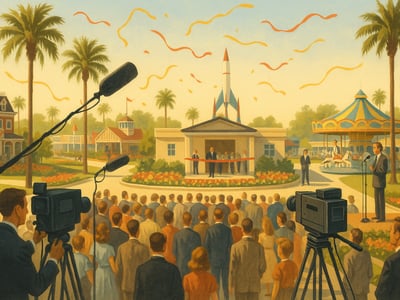
- McDonald brothers open restaurant in San Bernardino
- McDonald brothers redesign restaurant operations
- Ray Kroc visits San Bernardino restaurant
What you uncovered
Before the global chain
You didn't just… place a familiar name in history; you traced it back to a single San Bernardino drive-in before its later redesign and franchise expansion changed what that name meant.
What makes the 1940 opening historically useful is not that it already contained the later system, but that it created the local business setting from which that system emerged. The brothers were first operating a car-oriented barbecue restaurant, and only later reworked it into a more standardized, repeatable model. That distinction helps explain why historians separate the founding of the restaurant from the later operating breakthrough and from the rise of the global corporation.
The original McDonald brothers restaurant opened at 1398 North E Street in San Bernardino, California.
FAQ
When did Richard and Maurice McDonald open their first restaurant?
Richard McDonald and Maurice McDonald opened their restaurant on 1940-05-15. It was their first restaurant in San Bernardino, California.
Where was the original McDonald brothers restaurant located?
It was located at 1398 North E Street in San Bernardino, California, United States. The site was a drive-in restaurant serving car-based customers.
What kind of business was the 1940 McDonald restaurant?
The original business operated as a drive-in barbecue restaurant. It was not yet the later limited-menu hamburger format associated with McDonald's.
How did the 1940 restaurant differ from the 1948 redesign?
In 1940, the brothers ran a broader drive-in barbecue operation. In 1948, they reorganized the San Bernardino restaurant around a reduced menu and an assembly-line kitchen system.
Was the first McDonald's the same as the later franchised company?
No. The 1940 opening, the 1948 redesign, and the later franchising phase are distinct milestones in early McDonald's history. The original San Bernardino restaurant was the starting point, not the later corporation itself.