
About this story
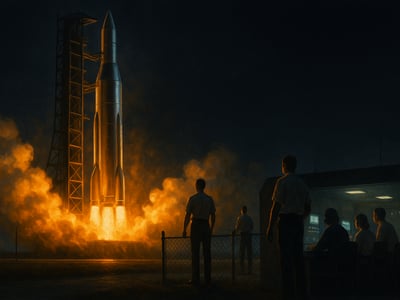
On 18 May 1969, Apollo 10 launched as a full dress rehearsal for the first Moon landing. The crew tested lunar-orbit procedures that cleared the way for Apollo 11.
Apollo 10 mission rehearsal for lunar landing operations, May 1969
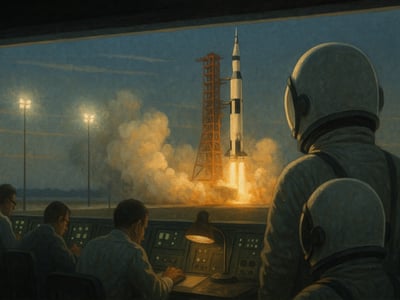
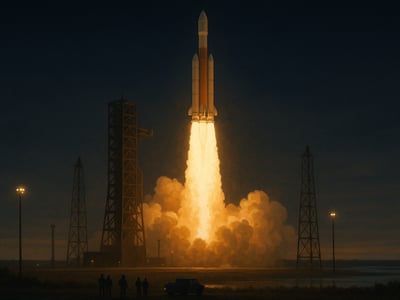
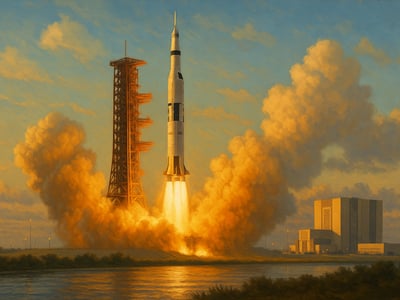
On May 18, 1969, Apollo 10 lifted off aboard a Saturn V rocket from Launch Complex 39B at Kennedy Space Center in Florida, beginning one of the most carefully defined missions of the Apollo program. The crew—Thomas P. Stafford, John W. Young, and Eugene A. Cernan—were not going to be the first people to land on the Moon. Their task was in some ways more specific and more technical: to carry out the final full rehearsal of the lunar landing sequence without actually touching down.
By the time Apollo 10 launched, NASA had already achieved two major steps toward a landing. Apollo 8 had taken astronauts to lunar orbit in December 1968, proving that a crew could travel to the Moon, circle it, and return safely. Apollo 9, flown in Earth orbit in March 1969, had tested the lunar module with astronauts aboard. What remained was to connect those accomplishments into one complete operational sequence around the Moon itself. Apollo 10 was designed to do that.
The mission used the same broad architecture planned for a landing flight. A command and service module, named *Charlie Brown*, would remain in lunar orbit under the control of John Young. A separate lunar module, named *Snoopy*, would detach and descend toward the lunar surface with Stafford and Cernan aboard. The point was not simply to demonstrate that the spacecraft worked in isolation, but to verify that the crew, hardware, navigation, and timing all functioned together in the environment where a real landing would soon take place.
That made Apollo 10 a mission of controlled restraint. NASA needed the crew to go far enough into the landing profile to test critical procedures, but not so far that the mission became something other than a rehearsal. Every major phase carried consequences. A launch problem could have ended the mission before translunar flight began. Navigation errors on the way to the Moon could have affected entry into lunar orbit. Difficulties during separation of the lunar module or during its powered descent rehearsal could have undermined confidence in the entire landing plan. Even a failure to rendezvous cleanly afterward would have raised serious questions about the method NASA intended to use for a lunar landing and return.
Apollo 10 reached lunar orbit on May 22, 1969. There, the mission moved into its most demanding phase. Stafford and Cernan undocked *Snoopy* from *Charlie Brown* and began the lunar module portion of the flight while Young remained in the command module. This separation was central to the whole concept of Apollo. The lunar module was built for a very particular job: descending toward the Moon and then lifting back up to rejoin the command module in orbit. Apollo 10 had to show that this could be done close to the actual conditions of a landing mission.
As *Snoopy* descended, Stafford and Cernan flew it deep into the planned landing profile, coming to within about 15 kilometers of the Moon's surface. That was close enough to test how the spacecraft handled in the low-altitude environment and to confirm that the mission sequence was practical. Yet the descent was intentionally stopped short of touchdown. Apollo 10 was not meant to claim the landing itself. Its purpose was to reduce uncertainty, not to change the mission order NASA had established.
The descent rehearsal also emphasized how much of lunar flight depended on procedure rather than spectacle. The crew had to monitor fuel, propulsion, orientation, communications, and timing while moving through a sequence in which several systems had to work together. The mission tested not only spacecraft design but the discipline of crewed operations. A successful lunar landing would require more than a powerful rocket and a destination; it would require a chain of practiced actions, each one fitting into the next.
After the low pass, the next test was just as important: ascent and rendezvous. In the Apollo method, astronauts who descended toward the Moon still had to return to orbit and reconnect with the command module. This was a demanding orbital operation carried out far from Earth, with no possibility of immediate rescue. Apollo 10 therefore had to prove that the lunar module could separate, maneuver, and then reunite with the orbiting spacecraft as planned. The successful rendezvous with Young in *Charlie Brown* confirmed one of the central operational assumptions behind the coming landing attempt.
The mission did not end at the Moon. A complete rehearsal also required a safe trip home. After completing its work in lunar orbit, Apollo 10 departed for Earth and splashed down in the Pacific Ocean on May 26, 1969. In strictly procedural terms, the mission had done what it was meant to do: launch, travel to the Moon, enter orbit, deploy the lunar module, rehearse descent, complete rendezvous, and return.
That sequence helps explain why Apollo 10 occupies a distinctive place in Apollo history. It is often remembered in relation to Apollo 11, which followed two months later and made the first crewed lunar landing. But Apollo 10 was not merely a preliminary mission in a general sense. It was the point at which plans became operationally tested practice. Earlier missions had demonstrated important components. Apollo 10 assembled them near the Moon in the order a landing would require.
Why it still matters
Apollo 10 remains important because it shows how high-risk exploration is often made possible by rehearsal. NASA did not move directly from broad capability to the most demanding objective. Instead, it divided the larger problem into stages: reaching lunar orbit, testing the lunar module in Earth orbit, and then conducting a near-complete mission rehearsal in lunar orbit before attempting a landing. That sequence illustrates a durable principle of engineering and flight operations.
The mission also highlights the importance of procedures in crewed spaceflight. Hardware mattered, but so did timing, communication, checklists, navigation, and crew coordination. Apollo 10 demonstrated that success in space depends on systems working together under real conditions, not simply on isolated technical achievements.
For that reason, Apollo 10 is still a useful reference point in the history of space exploration. It marks the transition from proving that the Apollo system could work to showing that it could be used for its intended purpose. When Apollo 11 landed in July 1969, it did so on a path that had already been traced, tested, and refined by the mission that came just before it.
Apollo 10 did not take the final step to the lunar surface. Its significance lies in making that final step less uncertain. In a program defined by complexity, that was an achievement in its own right.
Timeline
- Apollo 8 lunar orbit mission
- Apollo 9 Earth orbit lunar module test
- Apollo 10 launch
- Apollo 10 lunar orbit
- Apollo 10 Earth return and Pacific splashdown
- Apollo 11 launch
What you uncovered
Testing the Landing Before Landing
You didn't just… complete a space puzzle; you traced the mission that turned a planned Moon landing into a sequence of procedures tested under real lunar conditions.
Apollo 10 mattered because it narrowed the gap between theory and operation. By rehearsing almost the entire landing profile without committing to touchdown, NASA could evaluate how hardware, timing, crew coordination, and rendezvous procedures worked together in the environment that mattered most. That kind of full-mission rehearsal shows how major technical programs reduce uncertainty: not by eliminating risk, but by isolating and testing critical steps before the point of no return.
On 1969-05-22, Thomas P. Stafford and Eugene A. Cernan undocked the lunar module Snoopy from the command module Charlie Brown while in lunar orbit.
FAQ
What happened on 18 May 1969 with Apollo 10?
Apollo 10 lifted off on 18 May 1969 aboard a Saturn V from Launch Complex 39B at Kennedy Space Center. It was a lunar mission that entered orbit around the Moon a few days later.
Who flew on Apollo 10?
The Apollo 10 crew were Thomas P. Stafford, John W. Young, and Eugene A. Cernan. Stafford and Cernan later undocked the lunar module Snoopy from the command module Charlie Brown in lunar orbit.
How close did Apollo 10 come to the Moon?
Apollo 10 flew the lunar module Snoopy to within about 15 kilometers of the Moon’s surface. It did this as a rehearsal for the landing mission without actually touching down.
Why did Apollo 10 not land on the Moon?
NASA used Apollo 10 to test the full lunar-orbit and lunar-module flight sequence before a landing attempt. The mission was designed as a dress rehearsal, so it stopped short of touchdown.