
About this story
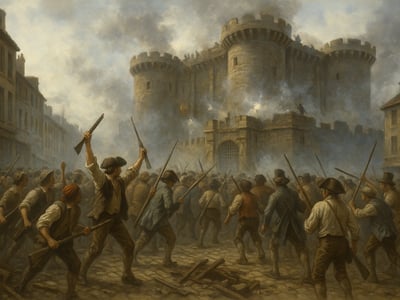
The Bastille in Paris, taken on 14 July 1789 after fighting with its garrison.
On 14 July 1789, armed crowds in Paris seized the Bastille, a medieval fortress and state prison in the Faubourg Saint-Antoine. The event quickly became one of the best-known moments of the French Revolution, but on the day itself it grew out of an immediate and practical problem. Parisians had obtained muskets earlier that day at Les Invalides, yet they still needed gunpowder. The Bastille, a fortified royal stronghold inside the city, seemed to offer both powder and a direct challenge to royal authority.
The storming did not come out of nowhere. In the weeks before, political tension had been rising across France. The Estates-General had met in May 1789, and by June the conflict over representation and authority had sharpened with the Tennis Court Oath. In Paris, fear deepened after the dismissal of Jacques Necker on 11 July. Many residents suspected that royal troops might be used against the capital or against the new political movement gathering around the National Assembly.
By the morning of 14 July, the search for arms had become urgent. Crowds went first to Les Invalides, where they took large numbers of muskets. But firearms without powder were of limited use. Attention then turned to the Bastille. Although it was no longer a major prison in numerical terms, it remained a heavily walled fortress with towers, cannon, drawbridges, and a garrison. Its presence in eastern Paris gave it a significance greater than the number of prisoners inside.
Governor Bernard-René de Launay commanded the Bastille that day. The garrison was made up largely of Invalides pensioners, with additional Swiss soldiers present. This was not a large defending force, but the fortress itself made direct assault dangerous. Thick walls, controlled entry points, and elevated firing positions meant that even a modest garrison could hold off a crowd for some time.
As people gathered outside, there were attempts at negotiation. Those outside wanted access to arms and powder, and the situation remained unstable for hours. The crowd was not a single, centrally commanded body. Different groups pressed forward with different expectations, and the line between negotiation and confrontation was thin. Once firing began, events became much harder to control.
The danger was real and immediate. To advance toward the outer works and drawbridges meant moving into musket and cannon fire. Yet the crowd continued. This was one of the central tensions of the day: not simply anger against a symbol, but a repeated decision by ordinary participants to keep moving forward despite confusion, fear, and deadly risk. Inside the fortress, de Launay faced a narrowing set of options. Continued resistance might preserve formal obedience to the crown, but it also increased the chance of a catastrophic outcome for the garrison if the defense failed.
As the fighting stretched on, the balance shifted. Men from the crowd, along with others who had some military experience, worked to overcome the fortress defenses. Eventually the drawbridges came down, and the garrison capitulated. The Bastille had fallen.
What happened next helped define the meaning of the day. Records show that seven prisoners were found inside the Bastille when it was taken. That fact has often been used to point out the fortress's limited practical role as a prison in 1789. But for the people outside its walls, the building had mattered as a state stronghold, a store of military supplies, and a visible sign of royal power within Paris.
The surrender also did not end the violence. Bernard-René de Launay was taken from the Bastille but was killed by the crowd before reaching the Hôtel de Ville. Jacques de Flesselles, the provost of merchants of Paris, was also killed that day. These killings became part of the event's historical memory, showing that the fall of the Bastille was not only a military seizure of a fortress but also a violent transfer of authority in the city.
News moved quickly. On 15 July 1789 at Versailles, Louis XVI was informed of the rising in Paris. Later retellings attached famous words to that moment, but historians treat some of those quotations cautiously. What is clear is that the monarchy now faced a transformed situation. Authority in Paris had shifted, and the political meaning of that change extended well beyond the fortress itself.
In the days that followed, the fall of the Bastille fed a broader revolutionary momentum. Paris began reorganizing its civic and military structures, including the formation of the National Guard. In the months ahead came the August abolition of feudal privileges and the Declaration of the Rights of Man and of the Citizen. The storming of the Bastille did not by itself create all that followed, but it marked a decisive rupture: a point at which a contested political crisis became inseparable from popular action in the streets.
Why it still matters
The fall of the Bastille still matters because it shows how quickly power can shift when state authority weakens in a capital city. Control of weapons, fortifications, and municipal institutions became central within hours. The event is therefore studied not only as an episode of revolutionary symbolism, but as a case of urban political breakdown and reorganization.
It also remains important as an example of how public memory forms around a single day. The Bastille held only seven prisoners when it fell, yet the event far exceeded that immediate fact in significance. It came to stand for the collapse of absolute royal authority in Paris and for the claim that political legitimacy could move elsewhere, toward new representative institutions and new forms of civic power.
Its annual commemoration in France further shaped that legacy. Over time, 14 July became part of national civic ritual, linking a violent and uncertain uprising to a later, more formal public memory. For historians, that long afterlife is part of the story itself. The storming of the Bastille was both a concrete struggle over powder and a turning point in how a revolution represented its own beginnings.
Timeline
- Meeting of the Estates-General
- Tennis Court Oath
- Dismissal of Jacques Necker
- Storming of the Bastille
- Seizure of arms at Les Invalides
- Formation of the National Guard
- Abolition of feudal privileges
- Declaration of the Rights of Man and of the Citizen
What you uncovered
Symbol and Stronghold
You didn't just…complete a puzzle; you retraced the moment when taking one fortress helped turn a Paris uprising into a wider crisis of royal authority.
The Bastille mattered in 1789 not because it was a major prison holding large numbers of inmates, but because it concentrated several meanings in one place: royal force, fear, and the city's access to arms. Its fall showed that political power can shift when a regime's symbols no longer intimidate and its fortified positions no longer secure obedience. That helps explain why a limited military objective could become such a lasting public marker of legitimacy changing hands.
When the Bastille fell on 14 July 1789, seven prisoners were recorded as being inside.
FAQ
What happened on 14 July 1789 in Paris?
On 14 July 1789, armed crowds in Paris stormed the Bastille, a medieval fortress and state prison in the Faubourg Saint-Antoine. After hours of fighting, the fortress fell, Governor Bernard-René de Launay was captured, and he was killed before reaching the Hôtel de Ville.
Why did Parisians attack the Bastille?
The crowd went to the Bastille after arms had been taken from Les Invalides, but gunpowder was still needed. The fortress was also a royal stronghold inside the city, so taking it had both a practical and political purpose.
Who defended the Bastille on 14 July 1789?
The Bastille was defended by Governor Bernard-René de Launay and a garrison made up largely of Invalides pensioners, with additional Swiss soldiers present.
What was found inside the Bastille when it fell?
When the Bastille fell on 14 July 1789, records show that seven prisoners were inside. The fortress also held gunpowder, which was one of the main reasons the crowd targeted it.
Why is the storming of the Bastille remembered today?
It became a major symbol of resistance to royal authority and a turning point in the public memory of the French Revolution. Its anniversary is commemorated in France on 14 July.