
About this story
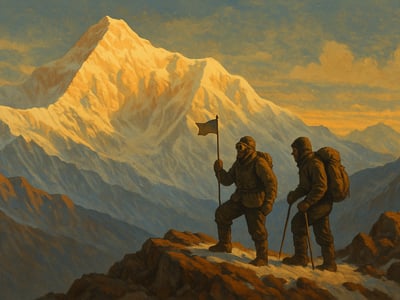
Kangchenjunga summit area reached by Joe Brown and George Band in 1955
Video puzzle
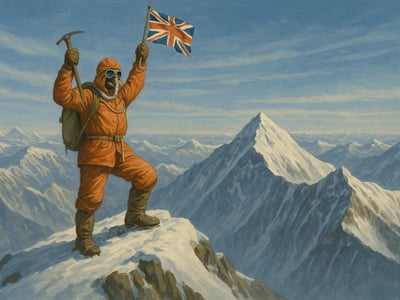
On 21 May 1955, Joe Brown and George Band reached the summit area of Kangchenjunga, completing the first successful ascent of the great Himalayan peak on the Nepal-Sikkim frontier. At 8,586 meters, Kangchenjunga is generally ranked as the world's third-highest mountain. The climb was a major postwar mountaineering achievement, but it is remembered not only for altitude and difficulty. In accordance with an agreement tied to local wishes in Sikkim, the two climbers stopped short of the mountain's absolute highest point.
The ascent came during a period when Himalayan exploration had entered a new phase. After the successful climb of Everest in 1953, attention turned to other very high peaks whose routes, weather, and technical challenges were still imperfectly understood. Kangchenjunga had long held a formidable reputation. Earlier attempts and reconnaissance had shown both its scale and the complexity of reaching a viable line upward. Success would depend on more than a strong summit pair; it required careful planning, sustained logistical support, and a route that could be established and defended against the conditions of a very high mountain.
The 1955 British Kangchenjunga Expedition was led by Charles Evans, an experienced figure in British mountaineering. Under his leadership, the expedition organized the laborious process typical of large Himalayan climbs of the period: identifying the route, moving supplies upward through successive camps, and preparing summit teams capable of functioning in thin air near the limits of human endurance. Every stage carried risk. A route that looked feasible from below might prove too dangerous or too slow. Weather could reverse progress quickly. Fatigue accumulated with every carry and every night spent high on the mountain.
Brown and Band were the pair who made the decisive summit push on 21 May. By then, the expedition's work had already laid the foundation for success. Their climb was the visible conclusion of many earlier efforts by the whole team, from route finding to camp establishment. That was characteristic of national expeditions in the 1950s, when Himalayan mountaineering often depended on coordinated, large-scale organization rather than a small self-contained party.
As they neared the top, however, the climb retained a distinctive complication. Expedition accounts state that the summit party had undertaken to respect a promise associated with the Chogyal of Sikkim. The understanding was that they would not tread on the exact highest point of Kangchenjunga. So the first successful ascent was completed in an unusual way: Brown and Band climbed to the summit area, high enough to achieve what mountaineers and later historical records accepted as the mountain's first ascent, yet they deliberately left the last few feet untouched.
That decision has helped define the event ever since. In most accounts of mountaineering, the summit is treated as a simple objective: either attained or not. On Kangchenjunga in 1955, success was recorded together with a self-imposed limit. The expedition did not present the decision as a failure or hesitation, but as part of the conditions under which the climb had been undertaken. The mountain was not only a physical challenge. It was also a place connected to local authority and belief, and the expedition's conduct reflected that reality.
The next day, 22 May 1955, Norman Hardie and Tony Streather also reached the summit area by the same route. Their ascent confirmed the expedition's achievement and showed that the line established on the mountain was workable for a second summit party as well. Together, the two summit days strengthened the standing of the expedition as a disciplined and effective operation.
The success on Kangchenjunga also illustrated the character of high-altitude climbing in the postwar era. These expeditions were complex enterprises, requiring leadership, logistics, acclimatization, and coordinated movement over many days. Individual climbers remained central, especially at the summit stage, but their efforts rested on a broad structure of planning and support. In that sense, the 1955 climb belongs to a particular chapter in Himalayan history, when national teams sought major peaks through organized campaigns and carefully prepared routes.
Why it still matters
The 1955 ascent of Kangchenjunga still matters because it marks an important point in the development of 8,000-meter mountaineering. It showed that another of the highest Himalayan peaks could be climbed through patient expedition planning and sustained effort, adding to the growing record of what postwar climbers could accomplish at extreme altitude.
It also remains notable for the decision at the top. The near-summit halt is often cited when people discuss ethics in mountaineering, especially when climbing ambitions meet local authority, custom, or religious significance. The episode does not fit neatly into a purely triumphal story of conquest. Instead, it offers a historical example of success being defined not only by reaching high ground, but also by observing a commitment made before the final steps.
Finally, the expedition helps document how Himalayan climbing was organized in the 1950s. Leadership under Charles Evans, the establishment of a route, the use of successive camps, and the follow-up ascent by Hardie and Streather all show how these large undertakings functioned. Kangchenjunga's first ascent therefore endures both as a mountaineering milestone and as a record of how such milestones were achieved.
In the end, the story of 21 May 1955 is not only about standing near the top of one of the world's highest mountains. It is also about the terms on which that success was accepted. That combination of physical achievement and deliberate restraint is what gives the first ascent of Kangchenjunga its lasting place in mountaineering history.
Timeline
- First ascent of Kangchenjunga
- Second summit party on Kangchenjunga
What you uncovered
Success Short of the Top
You didn't just… complete a mountain puzzle; you traced a moment when reaching the summit area also meant honoring a prior commitment about the final steps.
Kangchenjunga's first ascent is often remembered for a useful complication: in mountaineering, success is not always defined only by standing on the absolute highest spot. The 1955 climb is frequently discussed because it joined technical achievement to restraint, showing that expedition goals could be shaped by local authority as well as by altitude. That makes the ascent part of a larger postwar pattern, when Himalayan expeditions were not just tests of endurance but also negotiations over how ambition would be carried out.
A second summit party from the same expedition, Norman Hardie and Tony Streather, reached the summit area by the same route on 22 May 1955.
FAQ
What happened on 21 May 1955 at Kangchenjunga?
On 21 May 1955, Joe Brown and George Band made the first successful ascent of Kangchenjunga. They were part of the 1955 British Kangchenjunga Expedition.
Who led the 1955 British Kangchenjunga Expedition?
The expedition was led by Charles Evans. Brown and Band were members of that team.
Where is Kangchenjunga, and how high is it?
Kangchenjunga lies on the Nepal-Sikkim frontier in the Himalayas. It rises to 8,586 meters and is generally ranked as the world’s third-highest mountain.
Why did the summit party stop short of the highest point?
Expedition accounts say the climbers stopped short of the absolute highest point in observance of a promise associated with the Chogyal of Sikkim. The ascent was completed while respecting that agreement.
Who reached the summit area on 22 May 1955?
On 22 May 1955, Norman Hardie and Tony Streather also reached the summit area by the same expedition route.