
About this story
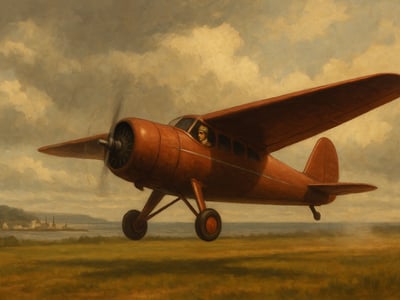
Amelia Earhart before or during her 1932 solo transatlantic flight from Newfoundland
On 20 May 1932, Amelia Earhart lifted off from Harbour Grace, Newfoundland, in a Lockheed Vega 5B and headed east over the North Atlantic. The date was not accidental. It came five years almost to the day after Charles Lindbergh's 1927 solo nonstop crossing, a flight that had already become a benchmark in aviation history. Earhart's attempt placed her within that established tradition of long-distance flight, but it also tested whether a single pilot in a small aircraft could manage the same harsh route under difficult conditions and intense public attention.
By 1932, Earhart was already widely known. In 1928 she had crossed the Atlantic as a passenger aboard the Fokker F.VII *Friendship*, an achievement that brought fame but also an awkward kind of celebrity. She had not been the pilot, and she was open about that fact. In the years that followed, she built a more substantial flying record through races, altitude marks, and endurance flying. The solo Atlantic attempt was therefore not simply a publicity gesture. It was a demanding technical flight that required preparation, judgment, and the willingness to accept long stretches of uncertainty over cold water.
The aircraft she chose, the Lockheed Vega 5B, was well suited to such an effort. The Vega had a strong reputation in record-setting aviation, combining relatively high speed with sturdy construction and enough range for ambitious routes. Even so, a transatlantic flight in 1932 remained a serious gamble. Navigation equipment was limited by modern standards. Weather forecasting over the ocean was incomplete. Once airborne, a pilot had few good options if conditions deteriorated. The North Atlantic was not only long; it was unforgiving.
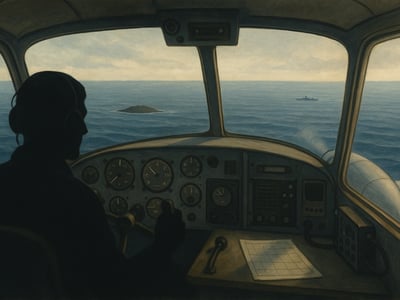
Earhart's departure from Harbour Grace followed a route already associated with eastbound Atlantic attempts because Newfoundland offered one of the shortest jumping-off points from North America to Europe. But a shorter route did not mean an easier one. Soon after takeoff, the crossing became a struggle against the atmosphere as much as against distance. Contemporary and archival accounts describe poor weather, icing, and mechanical problems during the flight. Those difficulties were not minor inconveniences. Ice could change the handling of the aircraft and threaten lift. Mechanical trouble could reduce engine reliability at precisely the moment when there was nowhere safe to stop.
Among the reported problems were trouble with manifold pressure and a fuel leak. Either issue would have been alarming to a pilot alone over the ocean. A manifold pressure problem raised concern about engine performance, while a fuel leak introduced uncertainty into the most basic calculation of the journey: whether the aircraft would have enough range to reach land. At the same time, weather forced constant attention. Flying through darkness, cloud, and rough conditions required steady correction and concentration. The challenge was not one dramatic crisis followed by relief, but the accumulation of smaller threats that could become dangerous together.
At several points, the safer choice might have seemed to be abandoning the attempt or diverting earlier. But the structure of such a flight made decision-making difficult. Turning back did not erase the weather already encountered, and every hour in the air changed the available alternatives. Earhart continued eastward, committed to finding land on the European side of the Atlantic rather than trying to reverse course across the same expanse of water. That decision defined the flight. It was not only a matter of courage, though courage was part of it. It was also a matter of assessing aircraft condition, fuel, weather, and the narrowing geography of possible outcomes.
On 21 May 1932, after 14 hours and 56 minutes in the air, Earhart reached Northern Ireland and landed in a pasture at Culmore, near Londonderry. The arrival was practical rather than ceremonial. Like many long-distance flights of the period, it ended not at a prepared public stage but in the nearest usable ground once land had finally appeared. Yet the plainness of the landing only underscored what had been achieved. She had completed a solo transatlantic crossing from North America to Europe, alone in the cockpit and under difficult conditions.
The immediate response was swift. Newspapers and radio treated the flight as major international news, linking it at once to Lindbergh's earlier crossing while also recognizing its distinct place in aviation history. Precision mattered then, as it does now. Earhart was not the first woman to cross the Atlantic by air; her 1928 passenger journey had already formed part of that history. What made May 1932 different was that she had done this crossing solo as pilot. That distinction was central to how the achievement was understood by the public and by aviation institutions.
Recognition followed quickly. The flight strengthened Earhart's standing not just as a public figure but as an aviator whose accomplishments could be discussed in technical as well as symbolic terms. It also helped fix her image in popular memory: leather jacket, practical speech, modern aircraft, and a willingness to test the margins of what contemporary machines could do. Even before her later flights and her disappearance in 1937, the 1932 Atlantic crossing had become one of the defining episodes of her career.
Why it still matters
Earhart's 1932 flight still matters because it sits at the intersection of several important histories. One is the history of aviation itself. Long-distance flying between continents depended on route planning, engine reliability, weather judgment, and navigation skill, and her crossing remains a useful example of all four. It belongs to the interwar period when aircraft were improving quickly, but when every major over-water flight still carried substantial risk.
It also matters in the history of public life and technical work. Earhart's visibility showed that aviation fame was not reserved for men, even in a field strongly shaped by military experience, engineering culture, and record competition. Her career did not end barriers for women in aviation, but it broadened what many people imagined possible. Because the flight was both technically credible and widely publicized, it became a durable reference point in discussions of women entering highly visible, skilled professions.
Finally, the crossing helps explain the media world of early aviation. Flights like this were not private tests. They were followed by newspapers, discussed across countries, and treated as signs of national and technological modernity. Earhart's departure from Newfoundland and arrival in Northern Ireland linked geography, machinery, personal endurance, and public imagination in one event. That combination is why the flight remains memorable: it was a real operational feat, but also a moment when aviation seemed to shrink the ocean and enlarge the possibilities attached to a single pilot.
Timeline
- Charles Lindbergh completes solo Atlantic flight
- Earhart crosses the Atlantic as a passenger
- Preparation and aircraft selection for the 1932 attempt
- Recognition and awards following the flight
- Amelia Earhart departs Harbour Grace, Newfoundland
- Earhart lands near Londonderry, Northern Ireland
- Press reports follow the landing
- Later long-distance flights and world flight attempt
What you uncovered
A Flight at the Edge
You didn't just… complete a puzzle; you traced a moment when one pilot, one aircraft, and a hazardous route tested how far interwar aviation could really go.
Earhart's departure mattered not only as a personal achievement but as a demonstration of how aviation was being judged in the interwar years. Flights like this were tests of route planning, machine endurance, and pilot decision-making under unstable conditions, all under intense public scrutiny. That combination helps explain why the crossing still stands as both a technical benchmark and a measure of changing visibility for women in highly public technical work.
Earhart's 1932 solo Atlantic crossing took 14 hours and 56 minutes from Harbour Grace to her landing near Londonderry.
FAQ
Where did Amelia Earhart begin her 1932 solo Atlantic flight?
She took off from Harbour Grace, Newfoundland, on 20 May 1932. She was flying a Lockheed Vega 5B on a solo transatlantic attempt.
How long did Earhart's 1932 Atlantic crossing take?
The flight took 14 hours and 56 minutes. She landed on 21 May 1932.
Where did Amelia Earhart land after crossing the Atlantic in 1932?
She landed in a field at Culmore, near Londonderry, Northern Ireland. That landing completed her solo crossing from North America to Europe.
What difficulties did Earhart face during the 1932 flight?
Contemporary and archival accounts describe poor weather, icing, and mechanical trouble. Reported issues included manifold pressure trouble and a fuel leak.