
About this story
On 6 June 1944, Allied forces began the D-Day landings in Normandy. Operation Overlord opened the long-awaited Western Front against Nazi Germany in World War II.
Allied landings in Normandy on 6 June 1944 during Operation Overlord
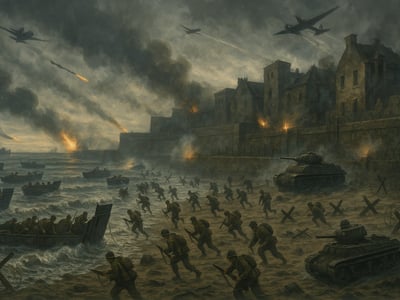
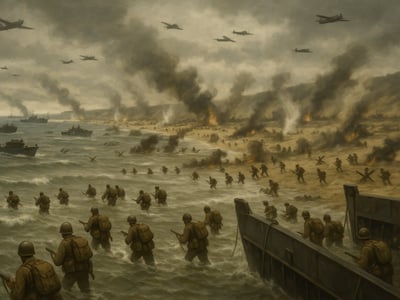
On 6 June 1944, Allied forces began the invasion of Normandy, opening the assault phase of Operation Overlord against German-occupied France. Before dawn, airborne units were dropped inland; soon after, large naval formations carried troops across the English Channel toward five assault sectors: Utah, Omaha, Gold, Juno, and Sword. It was one of the largest coordinated military operations of the war, and it depended on timing, weather, transport, and command decisions that had been debated until the last hours.
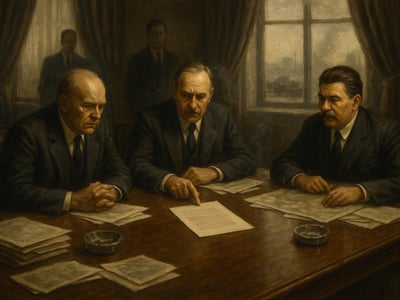
The immediate problem facing the Allied command was plain enough. Troops had to cross open water, approach defended shores, and establish a foothold before German forces could contain or crush the landings. But the decision to begin on that date was not straightforward. Bad weather had already complicated the schedule, and senior commanders had to weigh whether a short break in the conditions was sufficient. Once aircraft were dispatched and ships were committed, the operation could not easily be recalled. Dwight D. Eisenhower, as Supreme Commander, issued his Order of the Day for 6 June, framing the invasion as the opening of a broader campaign in western Europe.
The landings formed part of a longer effort to return Allied armies to the continent after the German occupation of France in 1940. Planning for Operation Overlord had intensified in 1943 and 1944, involving American, British, and Canadian forces as well as an enormous shipping, supply, and command structure. The assault on the Normandy coast was known as Operation Neptune, the initial phase of the larger campaign. That distinction matters because the events of 6 June were not an isolated action but the beginning of a sustained effort to secure ports, roads, bridges, and enough territory to support a much larger army in France.
Before the first main waves reached the beaches, airborne operations were already under way. Elements of the U.S. 82nd and 101st Airborne Divisions were dropped into Normandy in the early hours of 6 June. Their tasks included disrupting German defenses, creating confusion behind the coast, and helping secure routes leading inland from the landing areas. To the east, British 6th Airborne Division carried out operations beyond the Orne to secure bridges and crossings that were important to protecting the flank of the invasion. These airborne movements did not unfold neatly. Men landed in darkness, often scattered from intended drop zones, and units had to regroup in unfamiliar terrain under pressure.
At sea, the operation depended on a scale of movement that was difficult to conceal and even harder to coordinate. Ships carried assault troops, vehicles, engineers, and supplies across the Channel while naval forces bombarded coastal positions and teams worked to clear obstacles from the approaches to shore. The landings were organized across the five named sectors, each with its own geography, defenses, and objectives. The broad aim was shared: get ashore, survive the vulnerable opening hours, and push inland far enough that isolated lodgments could be reinforced rather than eliminated.
The experiences of the five beaches were not identical. At Utah, American forces benefited in part from circumstances that allowed them to move inland from a landing point slightly away from the original plan. At Omaha, the assault met especially severe resistance, and progress was slower and more costly. British and Canadian forces at Gold, Juno, and Sword also faced fortified positions and difficult ground, but they established beachheads that formed part of the larger Allied foothold by the end of the day. The names of those sectors later became central to national remembrance, but on 6 June they were practical designations within a tightly synchronized military timetable.
German defenders, under a command structure associated with figures such as Erwin Rommel and Gerd von Rundstedt, faced uncertainty of their own. Allied deception measures conducted before the invasion had encouraged German expectations that a major landing might come elsewhere, especially in the Pas-de-Calais region. Even once Normandy was under attack, questions remained about whether this was the main invasion or part of a larger diversion. That uncertainty did not remove the danger to the Allied forces on the beaches, but it formed part of the broader setting in which the invasion unfolded.
By the end of 6 June, the central test was not whether every objective had been reached exactly as planned. It was whether troops ashore and airborne units inland could hold long enough for the separate lodgments to connect and deepen. Some forces were pinned close to shore, while others had advanced beyond initial expectations. Roads, bridges, and exits from the beaches mattered as much as the shoreline itself. The day did not settle the battle for Normandy, but it created the necessary opening for subsequent operations toward places such as Caen and Cherbourg, and later for the breakout from Normandy.
Why it still matters
The Normandy landings remain an important case study because they brought together naval, air, and ground forces in a single operation whose success depended on coordination across all three. Historians and military planners still examine how commanders balanced weather risk, intelligence, logistics, deception, bombardment, airborne drops, and fixed beach objectives. The operation is often remembered through the drama of the beaches, but its enduring significance also lies in the less visible systems that made such a crossing possible.
It also shaped postwar thinking about coalition warfare. American, British, and Canadian forces operated within a common plan while pursuing linked objectives under shared command arrangements. That made the invasion a reference point for later military planning on amphibious assault and large-scale logistical support. The documentation left behind—orders, war diaries, unit reports, maps, and official histories—has given the event an unusual archival depth.
Public memory has preserved D-Day both as a military turning point in the European war and as a day of heavy loss. Memorials, museums, cemeteries, and annual commemorations in Normandy and beyond reflect that dual character. The invasion is studied not only for how it was executed, but also for what it demanded of the people who crossed the Channel, landed under fire, or dropped into darkness inland. That combination of strategic importance and personal testimony is one reason 6 June 1944 remains so present in the historical memory of the Second World War.
Timeline
- German occupation of France
- Planning for Operation Overlord
- Allied deception measures
- D-Day landings in Normandy
- Airborne drops in Normandy
- Naval bombardment and channel crossing
- Battle for Caen
- Capture of Cherbourg
- Breakout from Normandy
What you uncovered
Coordination Under Uncertainty
You didn't just… complete a picture; you traced a moment when an invasion depended on thousands of linked decisions across sea, air, and land.
D-Day is often remembered through the beaches, but the operation worked only if several systems held together at once. Airborne drops, naval transport, weather calls, bombardment, and fixed landing sectors all had to align closely enough for separate forces to support one another. That is why Normandy remains a major case study in coalition warfare and joint command, not only in battlefield courage.
Operation Neptune was the assault phase that launched the wider Overlord campaign on 6 June 1944.
FAQ
What happened on D-Day, 6 June 1944?
On 6 June 1944, Allied forces began Operation Neptune, the assault phase of Operation Overlord, by landing on the Normandy coast of German-occupied France. Airborne units were also dropped inland in the early hours of the day.
Which forces took part in the Normandy landings?
More than 150,000 American, British, and Canadian personnel were involved on 6 June 1944. They crossed the English Channel or arrived by air as part of the invasion.
Which beaches were used in the D-Day landings?
The seaborne landings were organized across five sectors: Utah, Omaha, Gold, Juno, and Sword. These were the main assault beaches in Normandy.
What did the airborne divisions do on D-Day?
Elements of the U.S. 82nd and 101st Airborne Divisions were dropped into Normandy in the early hours of 6 June 1944. British 6th Airborne Division operated east of the Orne to help secure key bridges and crossings.