
About this story
Treaty signed at Tordesillas in 1494 setting a demarcation line west of Cape Verde.
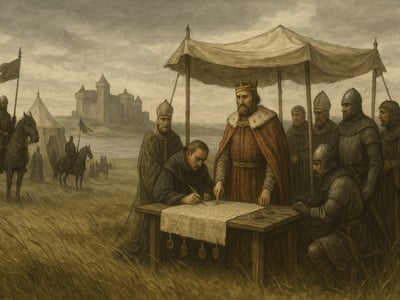
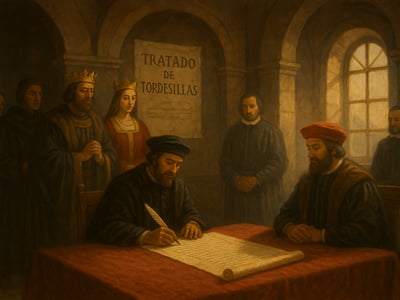
On June 7, 1494, representatives of the Crowns of Castile and Portugal signed the Treaty of Tordesillas in the town of Tordesillas, in what is now Spain. The agreement tried to settle a growing dispute over overseas claims by drawing a north-south line in the Atlantic, set 370 leagues west of the Cape Verde Islands. It was a diplomatic response to a new problem created by Atlantic voyages: how two expanding monarchies would define, in legal terms, where one crown's claims ended and the other's began.
The immediate background lay in the voyages of the late fifteenth century, especially those that linked Iberian competition to lands outside Europe. In 1493, Pope Alexander VI issued bulls including *Inter caetera*, which established an earlier line of demarcation for non-European territories claimed by Castile and Portugal. But that papal settlement did not end disagreement. Portugal, under John II, objected to the earlier arrangement and sought a boundary more favorable to its interests. Rather than leave the matter to papal wording alone, the two crowns entered direct negotiation.
That choice mattered. The treaty signed at Tordesillas did not simply repeat the papal decision; it revised it. By moving the line farther west, the negotiators replaced the earlier demarcation with a bilateral agreement between the two monarchies. In practical terms, the treaty was an attempt to prevent future conflict between Castile and Portugal as both pursued maritime expansion. It reflected a world in which law, diplomacy, navigation, and dynastic power were becoming closely connected.
The text itself was concise but consequential. It stated that the line of division would run 370 leagues west of the Cape Verde Islands. Lands discovered or to be discovered east of that line would belong to Portugal; those to the west would fall to Castile, according to the logic of the agreement. The treaty addressed claims outside Europe, not European territory itself, and it was framed as a way to regulate competing rights in regions reached by oceanic travel.
Even in its own time, however, such a line was easier to declare than to apply. Measuring long distances at sea was not simple in the fifteenth century, and the exact placement of the boundary could be difficult to determine. The treaty therefore belonged both to the world of legal theory and to the practical limits of contemporary navigation and cartography. It was a document of precision in wording, but one operating in a setting where exact global measurement remained uncertain.
The agreement also reveals how political authority worked at the end of the medieval period. Papal endorsement still mattered, and the 1493 bulls formed an essential part of the diplomatic background. Yet Tordesillas showed that monarchies could renegotiate such arrangements directly when their interests required it. The crowns of Castile and Portugal were not only accepting a religiously sanctioned order; they were reshaping it through treaty.
Ratification followed the signing later in 1494. Ferdinand II of Aragon and Isabella I of Castile ratified the treaty on July 2, while John II of Portugal ratified it on September 5. Those steps turned the settlement from a negotiated text into an accepted agreement between the parties. In the years that followed, the line at Tordesillas became part of a larger Iberian framework for asserting claims across oceans, and later diplomacy would seek corresponding arrangements elsewhere, including the Treaty of Zaragoza for the eastern side of the globe.
The treaty's later historical importance is often connected to the development of the Spanish and Portuguese overseas empires. It became one of the best-known attempts by European rulers to divide spheres of claim through law, religion, and negotiation. At the same time, its significance should be understood with care. The agreement was made by European powers without the participation or consent of the Indigenous peoples and other populations living in the regions being claimed. What appeared in Iberian diplomacy as a legal settlement was, for many affected societies, an external assertion imposed from afar.
Why it still matters
The Treaty of Tordesillas remains important because it shows how late medieval and early modern rulers tried to turn exploration into jurisdiction. Atlantic voyages had created uncertainty, and the treaty answered that uncertainty with a legal boundary, backed by monarchy, negotiation, and the authority associated with papal decisions. It demonstrates that imperial expansion was not only a matter of ships and conquests, but also of documents, definitions, and competing interpretations of lawful possession.
It also had a long afterlife in mapping, administration, and political argument. Even where the exact line was difficult to place, the treaty shaped how Iberian powers described their rights and organized claims in the Atlantic world and beyond. Historians continue to study it as a case of diplomacy under conditions of incomplete geographic knowledge.
Just as importantly, the treaty is now read not only as a milestone in European statecraft, but also as evidence of how sovereignty was asserted over distant lands without consulting the people who lived there. For that reason, it remains central to discussions of empire, legal history, and the unequal structures that accompanied overseas expansion.
Timeline
- Inter caetera issued
- Treaty of Tordesillas signed
- Ratification by Castile and Aragon
- Ratification by Portugal
What you uncovered
Lines, Law, and Empire
You didn't just… complete a date puzzle; you traced the moment when negotiation and mapmaking were turned into a framework for competing imperial claims.
The treaty matters not only because it drew a boundary, but because it showed how states could treat geography as something to be formalized through law, diplomacy, and authority. That helped create a language for later jurisdictional claims far beyond the original dispute. It also exposed a basic contradiction: European rulers could agree on paper about lands and seas where many other peoples already lived, traded, and governed themselves.
The treaty set its demarcation line 370 leagues west of the Cape Verde Islands, replacing the earlier boundary associated with Pope Alexander VI's 1493 bull Inter caetera.
FAQ
What happened on 7 June 1494 in Tordesillas?
Representatives acting for Castile and Portugal signed the Treaty of Tordesillas in Tordesillas. The agreement set a boundary for overseas claims outside Europe.
Who signed the Treaty of Tordesillas?
The treaty was signed by representatives acting for Isabella I of Castile, Ferdinand II of Aragon, and John II of Portugal. It was later ratified by Ferdinand and Isabella on 2 July 1494 and by John II on 5 September 1494.
What boundary did the treaty establish?
The treaty placed the line 370 leagues west of the Cape Verde Islands. It replaced the earlier line associated with Pope Alexander VI's 1493 bull Inter caetera.
Why did Spain and Portugal make this agreement?
Castile and Portugal needed a mutually agreed boundary after Atlantic voyages created competing claims to lands outside Europe. The treaty was meant to replace the earlier papal line with a bilateral settlement.