

About this story
Fire in Rome in 64 CE, reported to have begun near the Circus Maximus
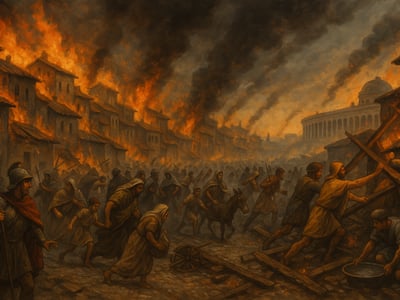
On 19 July 64 CE, a large fire broke out in Rome in the area of shops near the Circus Maximus, where flammable goods were stored and sold. In a city built densely with multi-story housing, workshops, warehouses, and narrow streets, a blaze could move faster than people or officials could control it. According to Tacitus, this one did. It spread through the imperial capital for days, crossed neighborhood boundaries, and turned a local emergency into one of the best-known urban disasters of the ancient world.
Rome was especially vulnerable to fire. Much of the city had grown over time rather than by a single plan. Streets could be tight and winding, buildings often stood close together, and many structures used wood extensively. Commercial activity mixed with housing, so a fire that began in one district could quickly threaten several others. The area around the Circus Maximus, lying between the Palatine and Aventine zones, was crowded and active, making it a dangerous place for any blaze to start.
Ancient accounts describe confusion from the beginning. Residents tried to save family members, possessions, and animals while also looking for routes out of the smoke and heat. Others attempted to stop the flames by tearing down nearby buildings or carrying water, but conditions worked against them. The fire advanced along streets, caught on vulnerable structures, and repeatedly escaped efforts at containment. In a city without modern firefighting methods, even organized response had clear limits.
Tacitus says that Nero was not in Rome when the fire began but at Antium, and that he returned as the scale of the disaster became clear. That detail matters because later memory of the fire became closely tied to Nero's reputation. Some ancient writers, especially those writing later or in more anecdotal styles, associated him more directly with the event. But the surviving evidence does not allow a simple statement of personal responsibility for starting the fire. What can be said with confidence is that his reign became inseparable from the catastrophe and from the rebuilding that followed it.
As the fire continued, the immediate problem was not only flames but displacement. Large numbers of people lost homes, goods, and local support networks. Tacitus reports that public spaces were opened for those driven out, including the Campus Martius, Agrippa's public buildings, and Nero's own gardens. Relief also involved bringing in supplies, especially food, for a city whose normal routines had been shattered. In any ancient capital, where population concentration depended on constant movement of grain and goods, such disruption could quickly become a wider crisis.
The scale of destruction was severe. Tacitus reports that of Rome's 14 districts, 3 were completely destroyed and 7 more were seriously damaged. Only a smaller portion escaped major harm. This was not just a matter of ruined buildings. Temples, houses, shops, streets, and neighborhood landmarks all formed part of how Romans organized daily life. When they burned, people lost orientation as well as property. The fire changed the physical map of the city and forced the state to confront the question of how Rome should be rebuilt.
That rebuilding became one of the most important legacies of the disaster. Tacitus describes new regulations meant to reduce future fire risk and improve control if another blaze occurred. Streets were made wider. Limits were placed on shared walls between structures. Stone was to be used more extensively in place of more combustible materials. Open spaces and more regular building lines were intended to make the city less vulnerable than before. Such measures show an imperial government trying to turn catastrophe into administrative reform.
Yet rebuilding also raised political questions. Fire creates space as well as ruin, and in a capital city, newly cleared land could become a source of suspicion. Later tradition connected the post-fire landscape to Nero's building ambitions, especially the Domus Aurea, or Golden House. That association helped shape the image of an emperor benefiting from destruction, even though the relationship between emergency rebuilding, private imperial projects, and hostile later interpretation must be handled carefully. The problem for historians is not only what happened in 64 CE, but how much of what later generations believed came through a limited set of literary sources.
Tacitus, Suetonius, and Cassius Dio are central to that problem. They do not tell the story in exactly the same way, and they wrote with different purposes and styles. Tacitus is often treated as the most careful narrative source among them, but he too was writing after the event, not as an eyewitness record made in the moment. Suetonius and Cassius Dio preserve important traditions, yet they also contribute to the more personalized and morally charged image of Nero that became influential for centuries. The Great Fire of Rome is therefore both an urban disaster and a lesson in how history survives through selective transmission.
Why it still matters
The fire of 64 CE still matters because it offers a clear example of the risks faced by dense cities. Fire spread through mixed commercial and residential zones, displaced residents on a large scale, and tested the ability of authorities to provide shelter, supplies, and order while destruction was still ongoing. Those are familiar urban problems, even if the tools available in antiquity were very different.
It also matters because the response did not end with relief. Rebuilding rules on street width, building separation, and construction materials show how governments can use disaster to impose new standards on the built environment. The event stands as an early and well-documented case of regulation emerging from crisis.
Finally, the Great Fire remains important because it demonstrates how historical memory is formed. A few surviving authors strongly shaped how later readers imagined Nero and the burning of Rome. For that reason, the event is not only about what burned, but about how reputations, policies, and dramatic stories become linked in the historical record.
The fire that began near the Circus Maximus on 19 July 64 CE did more than damage Rome. It exposed the vulnerabilities of one of the ancient world's largest cities and left behind a record in which disaster, government action, rebuilding, and reputation are difficult to separate. That combination helps explain why the event has remained so prominent in the history of Rome.
Timeline
- Nero at Antium
- Roman urban fire risk
- Emergency relief in Rome
- Post-fire rebuilding regulations
- Domus Aurea construction
- Ancient accounts of the fire
- Great Fire of Rome begins
What you uncovered
Fire, Memory, and Rebuilding
You didn't just complete a puzzle—you traced a moment when an urban fire became both a practical crisis for Rome and a lasting problem of historical memory.
The fire matters not only because of its scale, but because it sits at the intersection of infrastructure and narrative. In one direction, it exposed the risks of a dense city built with crowded streets and flammable commercial spaces; in another, it gave later writers a framework for judging Nero through the city’s destruction and rebuilding. That means the event survives as both a disaster history and a source history, where policy, reputation, and authorship are tightly connected.
Tacitus reports that rebuilding after the fire included wider streets, restrictions on shared walls, and more extensive use of stone in construction.
FAQ
When did the Great Fire of Rome begin?
It began on 19 July 64 CE. Ancient accounts place the outbreak in Rome during the reign of Nero.
Where did the fire start in Rome?
Tacitus places the outbreak in the shops containing flammable goods by the Circus Maximus in Rome.
Was Nero in Rome when the fire began?
According to Tacitus, Nero was at Antium when the fire started. He returned to Rome as the disaster spread.
How much of Rome was damaged by the fire?
Tacitus reports that 3 of Rome's 14 districts were destroyed and 7 more were seriously damaged.
What rebuilding measures followed the fire?
Tacitus says rebuilding included wider streets, limits on shared walls, and greater use of stone in construction.