
About this story
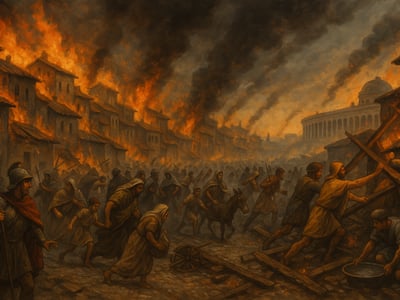
Santafé de Bogotá on 20 July 1810, as political unrest led to an open cabildo and junta.
On July 20, 1810, political unrest in Santafé de Bogotá, the capital of the Viceroyalty of New Granada, set off a chain of events that weakened viceregal authority and led to the formation of a local governing junta. In Colombian historical memory, the date stands as a foundational moment in the independence process. At the same time, historians usually distinguish it from later, more formal declarations of independence. What happened that day was not the final creation of a new nation, but a decisive transfer of political initiative at the city level during a wider imperial crisis.
That wider crisis had begun two years earlier. In 1808, Napoleon’s intervention in Spain disrupted the Spanish monarchy and raised urgent questions across the empire about who held legitimate authority. In Spanish America, cities, provinces, and political elites began to debate whether power should remain with officials appointed in the king’s name, or whether local institutions could act until legitimate royal authority was restored. Across the empire, juntas appeared as one answer to that problem. They claimed to govern in extraordinary circumstances, often using existing municipal forms to justify new political action.
In Santafé de Bogotá, the obstacle was substantial. Formal authority remained in the hands of the viceroy, Antonio José Amar y Borbón, along with the royal audiencia and the institutions of Spanish imperial rule. Any move to shift authority away from them risked being treated as sedition. A spontaneous protest alone might be dispersed. A private elite disagreement might go nowhere. For a transfer of power to succeed, local leaders needed both public pressure and a recognized political mechanism.
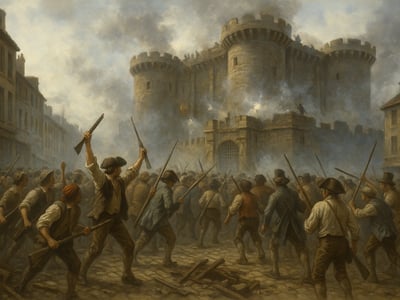
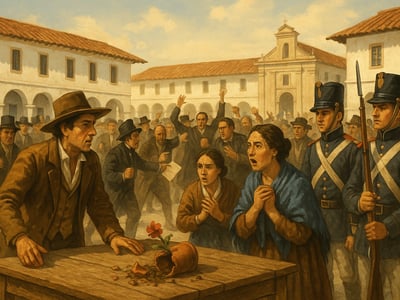
The day’s most famous spark involved the merchant José González Llorente. According to the tradition attached to the events of July 20, a dispute around him became the immediate trigger for wider mobilization in the city center. The incident has long been remembered through the story of the *Florero de Llorente*, though the larger political importance lies less in the object itself than in how the confrontation was used. What might otherwise have remained a local quarrel became part of a broader effort to bring people into the streets and force a political response.
As crowds gathered around the Plaza Mayor and nearby institutions, the atmosphere changed from social dispute to public crisis. Street pressure mattered, but it did not operate on its own. Municipal leaders and prominent local figures worked to channel that energy into an open cabildo, a public municipal assembly that could claim to speak for the city. In the political culture of the Spanish world, the cabildo was an established urban institution. By moving the conflict into that setting, the organizers sought legitimacy, not merely noise.
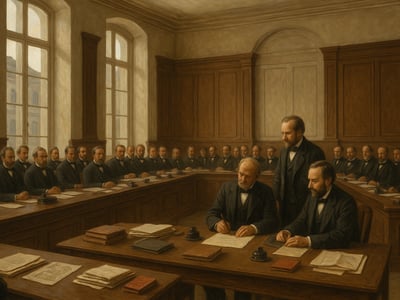
This was the central decision of the day. Rather than allowing the unrest to remain scattered or symbolic, local political actors tried to convert it into a formal act of government. Among the names associated with this effort are Camilo Torres Tenorio and José Acevedo y Gómez, figures linked to the push for municipal action. The open cabildo that met on July 20, 1810, gave structure to the crisis. It allowed arguments about authority, representation, and public order to be expressed through an institution that already had recognized standing in city life.
From those proceedings emerged a governing junta in Santafé de Bogotá. This did not instantly erase all existing hierarchies, nor did it settle the future of New Granada. But it marked a real shift in effective authority away from the viceregal administration. José Miguel Pey became a leading figure in the new arrangement, symbolizing the change from direct viceregal control toward locally organized governance. The event was therefore both improvised and institutional: improvised in its use of confrontation and crowd pressure, institutional in its reliance on the cabildo and written acts to justify the outcome.
The documentary record associated with the day, often referred to as the *Acta del 20 de Julio de 1810*, reflects that attempt to give political rupture a formal shape. This mattered in a world where legitimacy was still argued through legal language, municipal precedent, and claims about rightful authority. The leaders of July 20 were not simply rejecting one set of rulers in favor of disorder. They were asserting that, under extraordinary conditions, local bodies could reorganize power.
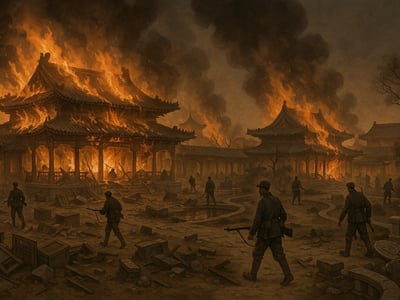
Yet the path ahead remained uncertain. The events in Bogotá did not produce immediate, unified, irreversible independence for all the territories that would later become Colombia. The years that followed brought competing political projects, regional divisions, further declarations, warfare, and eventually Spanish reconquest before independence was secured through later military and political developments. Seen in that longer timeline, July 20 was a beginning of a process rather than its conclusion.
Why it still matters
The events in Bogotá on July 20, 1810 still matter because they show how Spanish American independence movements often began not with a single declaration, but with arguments over legitimacy, representation, and emergency authority. The open cabildo and the junta were not improvised inventions from nowhere. They were municipal mechanisms used in a moment when imperial structures had become unstable. That helps explain why this episode is important beyond Colombian national history: it reveals how cities across the Spanish world adapted older institutions to new political purposes.
The date also remains central to Colombian public memory. It is commemorated nationally and taught as a foundational historical moment, not simply because of the drama associated with González Llorente, but because it marks the point when local political actors in Bogotá succeeded in forcing a break in the normal operation of colonial rule. The symbolism has endured precisely because the day combines street action, institutional maneuvering, and documentary record.
Finally, July 20 is a useful reminder that revolutions often unfold in stages. The uprising and junta formation in Santafé de Bogotá did not by themselves settle the constitutional future of New Granada, and they should not be confused with later independence documents. But without that rupture in authority, the later history of separation from Spanish rule would have taken a different course. The day’s significance lies in opening the process and showing how a local crisis in one city became part of a much broader transformation across Spanish America.
Timeline
- Napoleon intervenes in Spain
- Junta movements in Spanish America
- Political unrest in Santafé de Bogotá
- Act of Independence of Cartagena
- Declaration of Cundinamarca
- Spanish reconquest of New Granada
- Campaign culminating at Boyacá
What you uncovered
A City Turns Procedure into Power
You didn't just… complete a puzzle; you traced how political actors in Bogotá used a moment of public pressure to turn municipal procedure into a new claim to authority.
What makes 20 July 1810 notable is not only the confrontation in the street, but the way it was redirected into an open cabildo that could speak in an institutional voice. In Spanish America, city bodies were not revolutionary by definition, yet in moments of imperial uncertainty they could become tools for redefining who governed locally. That helps explain why the date matters historically even though it was an early rupture in a longer independence process, not the final legal endpoint.
The Acta del 20 de Julio de 1810 survives as a documentary record associated with the junta formation in Santafé de Bogotá on that date.
FAQ
What happened in Bogotá on 20 July 1810?
On 20 July 1810, political unrest in Santafé de Bogotá led to the formation of a governing junta and the weakening of viceregal authority. The events unfolded in the city center during a wider political crisis.
Who was José González Llorente?
José González Llorente was a merchant involved in the incident that became part of the day's political mobilization in Santafé de Bogotá. His name is closely linked to the events of 20 July 1810.
What role did the cabildo play on 20 July 1810?
An open cabildo met in Santafé de Bogotá on 20 July 1810 to address the political crisis. It helped turn public pressure into a formal political decision and opened the way for a governing junta.
Was Colombia independent immediately after 20 July 1810?
No. The events of 20 July 1810 marked an important political rupture, but later formal declarations and further संघर्ष were still part of the independence process. Historiography distinguishes the uprising and junta formation from later independence documents.
What is the Acta del 20 de Julio de 1810?
The Acta del 20 de Julio de 1810 is a documentary record associated with the events in Santafé de Bogotá on that date. It is part of the historical record of the crisis and the new governing arrangement.