
About this story
John T. Scopes trial opens in Dayton, Tennessee, on 10 July 1925.
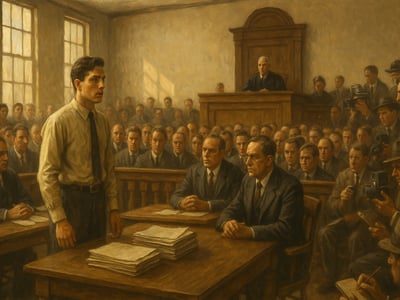
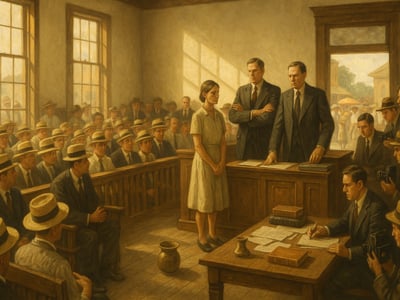
On July 10, 1925, proceedings opened in *State of Tennessee v. John Thomas Scopes* at the Rhea County Courthouse in Dayton, Tennessee. What began as a criminal case against a local high school teacher had already attracted unusual attention before the first arguments were heard. John T. Scopes was charged under the recently enacted Butler Act, a Tennessee law that barred public school teachers from presenting any theory that denied the Biblical account of human creation by teaching that humans descended from a lower order of animals. By the time court began, the case had become more than a local prosecution: it was a test of a new state law, a public argument about school instruction, and a media event watched far beyond Tennessee.
The legal background was recent and specific. On March 21, 1925, Governor Austin Peay signed the Butler Act. Its wording focused on what public school teachers could not teach about human origins. The law did not ban all discussion of science, but it placed a clear restriction on one highly visible subject in biology education. In a state where textbooks were approved for classroom use, that restriction immediately raised questions about what teachers could say, what students could be taught, and how such a law would be enforced.
Dayton did not become the site of the trial by accident. Local business leaders and civic boosters saw an opportunity in creating a test case around the new statute. George W. Rappleyea played a central role in encouraging the effort, and Scopes agreed to stand as the defendant. The arrangement reflected both legal calculation and local ambition. If the law were challenged in court, Dayton could become the center of a nationally noticed controversy. If it succeeded in attracting attention, the town would be placed on the map in a dramatic way.
A Rhea County grand jury indicted Scopes on May 5, 1925. He was accused of teaching human evolution from a state-approved biology textbook, commonly identified as George William Hunter's *Civic Biology*. The charge mattered because it turned an abstract statute into an actual prosecution. A law on the books could be debated in theory, but an indictment forced the issue into the courtroom. It also gave national organizations, lawyers, and journalists a concrete case around which to organize.
The lawyers who gathered in Dayton ensured that the trial would be followed as closely as any American courtroom proceeding of its time. William Jennings Bryan, one of the country's best-known political figures, joined the prosecution. Bryan had been a presidential candidate three times and was widely recognized as a public advocate on religious and civic questions. For the defense came Clarence Darrow, already famous as a trial lawyer, along with Dudley Field Malone and Arthur Garfield Hays. John R. Neal also had an important role in the defense effort. Their presence transformed the case from a county prosecution into a nationally staged confrontation between prominent public voices.
Even so, the trial's formal legal issue was narrow. The question before the court was not whether evolution as a scientific theory was true or false in a broad philosophical sense. The immediate issue was whether Scopes had violated Tennessee law as written. Yet that narrow question carried wider meaning because public schools stood at the center of the dispute. If a state legislature could define limits on instruction in this way, then classrooms became a place where law, religion, science, and public authority met directly.
As the proceedings began, Dayton filled with reporters, visitors, vendors, and observers. Newspapers across the United States and abroad covered the case. Modern mass media helped turn a local trial into a national spectacle. The courthouse, the attorneys, and the town itself became part of a story consumed by readers who were often as interested in what the case symbolized as in its legal details. The trial was therefore conducted on two levels at once: inside the courtroom, as a prosecution under state law, and outside it, as a public drama about modern education and American culture.
That dual character explains why the opening day mattered. It marked the point at which planning, publicity, and legal maneuvering gave way to a formal proceeding before Judge John T. Raulston. The court now had to manage a case that carried intense attention and competing expectations. For supporters of the Butler Act, the trial could affirm the state's power to regulate public school teaching. For critics, it offered a chance to challenge the law and to question whether legislation should settle scientific matters for the classroom.
The days that followed only deepened the trial's visibility. Bryan argued for the prosecution during the July proceedings, while Darrow, Malone, and Hays spoke for the defense. On July 21, 1925, the jury found Scopes guilty, and Judge Raulston imposed a $100 fine. The verdict settled the immediate criminal case at the trial level, but it did not end the broader dispute. The case continued into appeal, and the arguments surrounding it quickly moved beyond one teacher's conduct to the larger issue of who controls what is taught in public education.
Why it still matters
The Scopes trial remains a reference point because it brought several enduring questions into a single courtroom. One concerns the power of state law over school curricula. Public education is not only a matter of teaching methods and textbooks; it is also shaped by legislation, regulation, and judicial review. The case showed how quickly classroom content can become the subject of legal conflict when lawmakers define what schools may or may not present.
It also matters because it revealed how scientific subjects can become public controversies when they intersect with religious belief and civic authority. The trial did not create that tension, but it made it unusually visible. In Dayton, arguments about biology became arguments about the purpose of schools, the rights of communities, and the responsibilities of the state.
Finally, the case demonstrated the power of media to elevate a local event into a national cultural moment. The town, the lawyers, and the testimony were reported far beyond Tennessee, helping to shape how millions understood the dispute. That pattern has remained familiar ever since: a local controversy over education can rapidly become a national symbol.
For those reasons, the opening of the Scopes trial on July 10, 1925, is remembered not simply as the start of one prosecution, but as the beginning of a case whose meaning extended well beyond the courtroom in Dayton.
Timeline
- Tennessee passes the Butler Act
- John T. Scopes indicted in Dayton
- Scopes trial opens in Dayton, Tennessee
- Tennessee Supreme Court decision in Scopes v. State
What you uncovered
Who Shapes Classroom Knowledge
You didn't just… finish a puzzle; you traced the opening of a trial that turned a local prosecution into a wider dispute about law, education, and public belief.
What made the Scopes case last was not only the charge itself, but the way a deliberately organized local test case was amplified into a national cultural event. It showed that classroom content is not shaped by teachers or textbooks alone, but also by legislatures, courts, and public pressure. The trial still matters as an example of how disputes over knowledge often become disputes over authority.
The proceedings opened on 10 July 1925 at the Rhea County Courthouse in Dayton, Tennessee, before Judge John T. Raulston.
FAQ
What happened on 10 July 1925 in Dayton, Tennessee?
On 10 July 1925, proceedings in State of Tennessee v. John Thomas Scopes opened at the Rhea County Courthouse in Dayton, Tennessee. John T. Scopes, a local high school teacher, was on trial under Tennessee's Butler Act.
Why was John T. Scopes put on trial?
He was charged with violating the Butler Act by teaching human evolution from a state-approved biology textbook. The law banned public school teaching that denied the Biblical account of human creation by saying humans descended from lower animals.
Who were the main lawyers in the Scopes trial?
William Jennings Bryan joined the prosecution team. Clarence Darrow, Dudley Field Malone, and Arthur Garfield Hays appeared for the defense during the July 1925 trial in Dayton.
What was the verdict in the Scopes trial?
On 21 July 1925, the jury found Scopes guilty. Judge John T. Raulston imposed a $100 fine.