
About this story
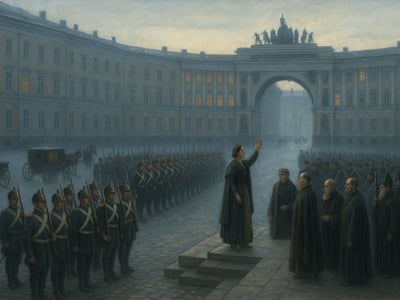
Catherine II's proclamation as empress in St. Petersburg on 9 July 1762.
On July 9, 1762, Catherine, the wife of Emperor Peter III, was proclaimed empress in St. Petersburg after winning the support of Guards regiments and influential allies at court. The event was not a formal succession in the ordinary dynastic sense, but a palace coup carried out in the capital of the Russian Empire during one of the most fragile moments of the eighteenth century. By the next day, Peter III had abdicated, and power had shifted decisively to Catherine's side.
The speed of the transfer can make it seem simple in retrospect, but it rested on a narrow and dangerous political calculation. Peter III had only recently become emperor, ascending the throne in early January 1762 after the death of Empress Elizabeth. A new reign always brought uncertainty, and Peter's short rule unfolded amid court rivalries, military interests, and doubts about personal loyalty. Catherine, though a prominent imperial figure, did not possess an automatic claim stronger than that of the reigning emperor. If she moved too early, or without enough backing, she risked arrest, confinement, or worse.
That is why the support of the Guards regiments mattered so much. In eighteenth-century Russia, elite military units stationed in or near the capital were not merely ceremonial forces. They were a political presence. In moments of crisis, their recognition could help decide who governed. A ruler might hold a dynastic title, but authority also depended on whether the capital's armed forces, court leaders, and major institutions accepted that rule in practice.
Catherine's allies understood this. Among the best-known were Grigory Orlov and Aleksey Orlov, figures closely associated with the movement that formed around her, along with other military and court supporters, including Kirill Razumovsky. Their task was urgent: act before Peter III could isolate Catherine, rally resistance, or reassert control over St. Petersburg. Standard accounts differ on some details of sequence and emphasis, but they agree on the essential point that Catherine's supporters moved quickly to secure the political center.
At some stage during these events, Catherine left the relative safety of private court life and made a public bid for power. That decision was one of the most consequential of her life. A conspiracy can remain hidden for only so long; once made public, it either gathers momentum or collapses. Catherine's appearance before supporters in St. Petersburg turned a court plot into an open contest over sovereignty.
Public acts of recognition were crucial. Sources describe Catherine participating in ceremonies that projected legitimacy in the capital, including appearances associated with places such as Kazan Cathedral and the Winter Palace, although the precise sequence can vary from one account to another. What mattered politically was not only where she went, but what those appearances signaled: the Guards were with her, leading figures were aligning behind her, and the imperial capital was beginning to treat her as ruler.
This was the heart of the coup. Legitimacy in an imperial monarchy was not established by military force alone, nor by inheritance rules alone. It also required visible acknowledgment. A proclamation, an oath, a ceremony, a procession, a blessing, or the occupation of a key palace could transform a claim into governing power. Catherine's supporters seem to have understood that every hour counted. If St. Petersburg recognized her first, Peter III's legal status as emperor could quickly become politically hollow.
Peter III, meanwhile, was away from central decision-making in St. Petersburg as the crisis unfolded. Many standard accounts place him at or near Peterhof when Catherine's supporters secured the capital, though historians are careful about the exact timing and movement of events. What is clear is that the balance shifted against him very quickly. Once the capital, key regiments, and influential political figures aligned with Catherine, his ability to organize effective resistance narrowed sharply.
A coup of this kind did not require every institution to be persuaded in advance. It required enough decisive actors to move first and enough public confirmation to make resistance seem futile. As news spread, uncertainty itself began to work in Catherine's favor. Courtiers, officers, clergy, and administrators had to judge not only what was lawful, but what was viable. In such moments, recognition can gather force simply because others see that recognition taking shape.
By July 10, 1762, Peter III abdicated. The outcome completed the immediate transfer of power, though it did not erase the ambiguities that surrounded it. Catherine had gained the throne through a combination of elite coordination, military backing, and public performance of legitimacy rather than through an uncontested hereditary passage. That fact shaped how contemporaries understood the event, and it has shaped how historians interpret it ever since.
Later in 1762, Catherine would be crowned in Moscow, reinforcing her position through the established ceremonial language of monarchy. But the decisive breakthrough had already happened in St. Petersburg. The capital had been won first; formal consolidation followed.
Why it still matters
Catherine's accession remains important because it reveals how power functioned in the Russian Empire beyond formal succession rules. The events of July 1762 show that control of the capital, the loyalty of Guards regiments, and public acts of recognition could determine who ruled. In a monarchy, legitimacy was not merely inherited; it had to be enacted and accepted.
The coup also helps explain the political structure of the later eighteenth century. Catherine II would go on to preside over a long reign that shaped Russian domestic administration, court culture, and foreign policy. To understand that era, it matters that her rule began in a contested transfer of power rather than in an unambiguous dynastic succession.
Finally, the episode is a reminder that short, fast-moving moments can redirect the history of a state. What happened in St. Petersburg on July 9, 1762, was not only a court intrigue. It was a struggle over who could command institutions, embody authority, and be recognized as sovereign in real time.
Timeline
- Guards regiments in Russian palace politics
- Orlov brothers involved in Catherine's rise
- Peter III's short reign and policy reversals
- Catherine II's coronation in Moscow
- Peter III becomes emperor of Russia
- Catherine proclaimed empress in St. Petersburg
- Peter III abdicates
What you uncovered
Power in the Capital
You didn't just… complete a puzzle; you traced how Catherine's rise depended on turning support in St. Petersburg into recognized authority before Peter III could recover control.
This coup highlights that succession in an imperial system was not settled by lineage alone. In practice, legitimacy depended on who could secure the capital, win the backing of key military forces, and stage convincing public recognition quickly enough to make resistance seem futile. That helps explain why palace politics and military alignment could shape state power as much as formal dynastic rules.
Peter III abdicated on 1762-07-10, one day after Catherine was proclaimed empress in St. Petersburg.
FAQ
What happened on 9 July 1762 in Russia?
On 9 July 1762, Catherine was proclaimed empress in St. Petersburg. The transfer of power took place during a palace coup in the Russian Empire.
Who helped Catherine II seize power?
Catherine secured support from Guards regiments and influential political backers in the capital. The Orlov brothers are among the key figures associated with her rise.
Where was Peter III during Catherine's coup?
During the coup, Peter III was away from central decision-making in St. Petersburg. Many standard accounts place him at or near Peterhof when Catherine's supporters secured the capital.
When did Peter III abdicate?
Peter III abdicated on 10 July 1762. By then, control of the capital had shifted to Catherine's side.