

About this story
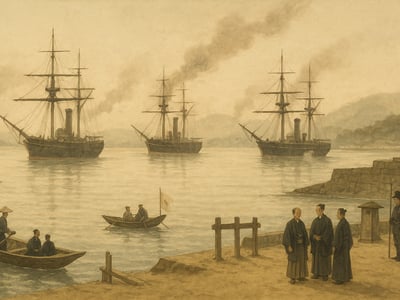
Perry's squadron at Edo Bay near Uraga during the 1853 letter mission
On July 8, 1853, Commodore Matthew C. Perry sailed into Edo Bay with four American warships and brought a diplomatic demand to the doorstep of the Tokugawa shogunate. He carried a letter from U.S. President Millard Fillmore addressed to Japanese authorities, asking for the opening of relations and practical support for American vessels. The act was presented as a formal mission, but it arrived backed by armed, steam-powered ships in waters leading toward Edo, the shogunate’s political center.
For Japan’s rulers, the moment was difficult not only because of what Perry wanted, but because of how he arrived. For many years, the Tokugawa government had tightly regulated foreign contact through limited and carefully managed channels. Outsiders were expected to follow established procedures, and local officials at entry points were meant to handle initial encounters. Perry did not accept that framework. By entering Edo Bay and refusing to leave the letter with lower-ranking officials, he challenged the system as well as the officials responsible for defending it.
The four vessels in Perry’s squadron were the *Mississippi*, *Susquehanna*, *Plymouth*, and *Saratoga*. Their presence near Uraga, at the entrance to the bay, created immediate pressure. Japanese authorities had to decide how to respond to a mission that combined diplomatic form with visible military strength. A refusal might preserve precedent, but it also risked escalation. A concession might avoid immediate conflict, but it could weaken the rules on which the shogunate’s foreign policy rested.
The American side had reasons of its own for seeking contact. In the mid-19th century, the United States was expanding its activity across the Pacific. American ships, including whalers and commercial vessels, needed provisions, water, and places of refuge. Fillmore’s letter asked for arrangements that would make such contact possible. Yet those practical requests were inseparable from the larger geopolitical reality of the time: maritime powers were pressing for access across Asia, and Japan’s restricted system was under increasing outside pressure.
Perry’s choices made that pressure unmistakable. He insisted on dealing with suitably senior representatives rather than passing through the ordinary chain of contact. This was a calculated gamble. He aimed to compel the shogunate to respond at a higher level without forcing an immediate armed clash. The risk was real. Japanese officials near Uraga were not only handling a foreign mission; they were managing a confrontation close to the route toward Edo itself.
Inside the Tokugawa government, the issue became one of protocol, authority, and time. Officials had to preserve as much dignity and control as possible while avoiding violence they were not prepared to invite. The problem was not solved by a simple yes or no. Instead, the shogunate sought a way to receive the letter through specially arranged proceedings. That approach allowed Japanese authorities to avoid treating Perry entirely according to the usual lower-level process, while also avoiding a full and immediate surrender of established principle.
This carefully staged reception mattered. It showed that both sides understood the encounter as more than a routine exchange. For Perry, successful delivery of the letter would establish that the United States could force a direct hearing. For the shogunate, the aim was to contain the situation, reduce immediate danger, and buy time for wider internal deliberation. Accepting the letter did not mean accepting all of its implications, but neither could the old system be said to remain untouched.
The 1853 visit ended without a final settlement. Perry departed, but the tension he had exposed remained. Japanese leaders had to weigh how far they could maintain long-standing restrictions in the face of foreign naval power. They also had to consider what any concession might mean within domestic politics. The question was no longer only how to manage one foreign squadron. It was how to defend sovereignty, preserve order, and respond to a changing international environment.
When Perry returned the following year, the unresolved issues of 1853 came back with greater force. On March 31, 1854, Perry and Tokugawa representatives signed the Convention of Kanagawa. The agreement established limited opening measures, including the opening of Shimoda and Hakodate. It did not immediately create broad equality in foreign relations, nor did it settle every dispute. But it marked a formal break in Japan’s long-standing system of tightly managed external contact.
The arrival in Edo Bay has often been remembered through the image of the “Black Ships,” a phrase that captured both the unfamiliar technology of steam warships and the sense of disruption they brought. That memory can sometimes simplify the event into a dramatic scene of opening and closure, but the historical reality was more procedural and more tense. The central issue in July 1853 was not a single declaration that Japan was “opened.” It was a contested process in which etiquette, rank, and the physical presence of armed ships were all part of the negotiation.
Why it still matters
Perry’s arrival remains important because it shows how diplomacy can be shaped by unequal power even when it is conducted through formal documents and ceremonies. A presidential letter was at the center of the mission, but the delivery of that letter depended on coercive pressure as well as protocol. The episode is therefore often studied as a clear example of how military presence can influence supposedly peaceful negotiation.
It also marks an early turning point in the weakening of the Tokugawa shogunate’s established foreign-contact system. The encounter did not by itself transform Japan overnight, but it set in motion decisions and pressures that would continue to grow. Later treaties, further foreign demands, and internal political strain all unfolded in the shadow of this moment.
More broadly, the event still offers a useful case study in sovereignty under pressure. Governments often rely on rules, rank, and procedure to define their authority. Perry’s entry into Edo Bay demonstrated how those structures can be tested when a stronger outside power insists on exceptional treatment. That tension—between formal equality and practical coercion—helps explain why the encounter at Uraga continues to be remembered as a major episode in 19th-century diplomacy.
Timeline
- Commodore Matthew C. Perry enters Edo Bay
- Convention of Kanagawa signed
What you uncovered
Protocol Under Pressure
You didn't just… place ships and names, you retraced a moment when a ceremonial delivery was shaped by the visible threat behind it.
What made this encounter significant was not only the message in the letter, but the way it was delivered. A diplomatic formality was carried into Edo Bay by armed steam-powered ships, making protocol itself part of the negotiation. The result shows how states can be pushed to treat procedure, rank, and access as matters of sovereignty when military pressure is present.
Perry's squadron entered Edo Bay in July 1853 with four U.S. ships: Mississippi, Susquehanna, Plymouth, and Saratoga.
FAQ
When did Commodore Perry arrive in Edo Bay?
He arrived on 1853-07-08. Perry came into Edo Bay with four U.S. vessels.
Why did Commodore Perry go to Japan in 1853?
He carried a letter from U.S. President Millard Fillmore to Japanese authorities. The letter requested the opening of relations and provisions for American ships.
Where was Uraga in Perry's arrival?
Uraga was at the entrance to Edo Bay. It was the gateway area where Japanese officials first handled the encounter.
How did the Tokugawa shogunate respond to Perry's demand?
Japanese officials agreed to receive the U.S. president's letter through specially arranged proceedings. They did not use the usual lower-level channels.
Did Perry open Japan immediately in 1853?
No. The 1853 visit led to a later agreement. On 1854-03-31, Perry and Tokugawa representatives signed the Convention of Kanagawa, which included limited opening measures.