
About this story
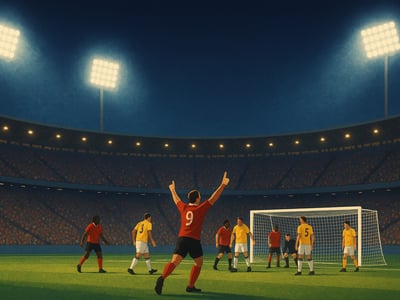
1998 World Cup Final at Stade de France, where France beat Brazil 3–0.
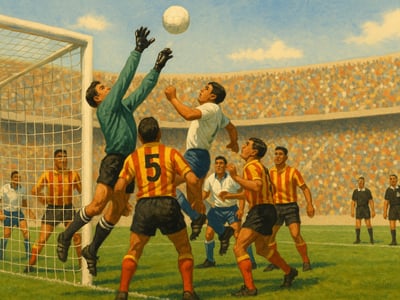
On July 12, 1998, France defeated Brazil 3–0 in the FIFA World Cup Final at the Stade de France in Saint-Denis, just north of Paris. The result gave the host nation its first men’s World Cup title at the end of a tournament that had run from June 10 to July 12 and, for the first time, featured 32 teams. In a match defined by set pieces, defensive control, and the pressure of a home final, Zinédine Zidane scored twice before halftime and Emmanuel Petit added a third goal in stoppage time.
The setting mattered almost as much as the score. The Stade de France had been built for the tournament cycle and stood as the centerpiece of France’s hosting effort. By the time the final arrived, it had already staged matches involving leading teams from different continents, but this was the occasion it had been created to hold: the closing match of the world’s largest football competition, with the host country still alive.
France and Brazil came into the final carrying different kinds of expectation. Brazil were the defending champions and one of the most established powers in the history of the tournament. Their place in the final did not surprise many observers. France, by contrast, had never before won the men’s World Cup. Hosting can bring advantages, but it also sharpens pressure. Every tactical choice, every lineup decision, and every mistake is watched more closely when the final is at home.
That tension shaped the opening period. A final is often cautious in its early minutes, with both sides testing space and tempo rather than committing fully. France needed to balance ambition with discipline against a Brazilian side that could punish openings quickly. Under coach Aimé Jacquet and captain Didier Deschamps, the French side kept its structure and looked for moments from dead-ball situations as well as controlled attacks.
The breakthrough came in the 27th minute. Zidane scored France’s first goal from a corner, giving the hosts a lead that changed the atmosphere of the stadium and the rhythm of the game. Instead of chasing too early or becoming stretched, France were able to settle into the kind of match they wanted: organized, compact, and increasingly confident.
Brazil still had time to recover, and with players such as Ronaldo in the side, no one could assume that a single-goal lead would hold. That uncertainty is part of what makes a World Cup final distinct from earlier rounds. A team can dominate long stretches of a tournament and still be undone in one evening. France therefore needed not just one strong moment but sustained concentration.
The second French goal arrived at a decisive time. In the 45th minute, again before the halftime whistle, Zidane scored his second of the match. A two-goal lead at the break did more than improve France’s position on the scoreboard. It forced Brazil to confront the need for a major second-half response while allowing France to approach the remainder of the match with greater tactical clarity.
From there, the task became one of control. Finals are rarely won by emotion alone; they are won by managing phases of the game, limiting risk, and understanding what the score requires. France did not need to turn the match into an open contest. They needed to deny Brazil momentum and preserve the advantage they had built. The defensive side of the performance became as important as the goals that had created the lead.
As time passed, the possibility of a French title became less abstract and more immediate. The crowd at Saint-Denis was watching not simply a favorable scoreline but the final minutes of a long pursuit. France had reached the decisive match and, unlike in every previous edition of the men’s tournament, were now in position to finish first.
The final goal came in stoppage time, when Emmanuel Petit scored to make it 3–0. By then, the result was effectively settled, but the third goal fixed the margin and gave the scoreline the clarity with which the match is still remembered. France had not merely edged past Brazil; it had won by three goals in a World Cup final.
When the match ended, the outcome was historically straightforward even if the emotions around it were not. France were champions of the 1998 FIFA World Cup. The host nation had completed the tournament by beating the defending champions in the final at the country’s national stadium. Zidane’s two goals in the 27th and 45th minutes and Petit’s stoppage-time finish became the permanent markers of the evening.
Why it still matters
The 1998 final remains a standard point of reference in World Cup history because it brought together several durable themes in one match. It was a final between a host nation and the defending champion. It was the conclusion of the first men’s World Cup to use a 32-team format, an expansion that shaped the modern tournament. And it produced a clear, memorable scoreline in a championship match watched around the world.
It also endures because of the way football history is often told through a small number of decisive games. For France, this was the first men’s World Cup title, which gives the match a fixed place in the country’s sporting record. For players such as Zidane, it became central to later discussions of career legacy. For the tournament itself, it remains one of the finals most frequently revisited in reporting, documentaries, and retrospective coverage.
The match is also a reminder that major sporting events are remembered not only for winners and losers, but for the way they connect venue, host country, tournament format, and individual performance. On one night in Saint-Denis, all of those elements came together in a result that still stands as one of the defining finals of the modern World Cup era.
Timeline
- 1998 FIFA World Cup opening match
- 1998 FIFA World Cup Final
What you uncovered
More Than a Final Score
You didn't just… complete a sports puzzle; you reconstructed a match that became a lasting reference point in World Cup history.
This final is often remembered not only for the scoreline, but for how many larger threads met in one event: a host nation, a new 32-team format, a major stadium, and defining player reputations. That helps explain why it returns so often in later coverage of World Cups and football history. The match works as a compact record of how a single championship game can absorb meanings that go beyond the 90 minutes themselves.
The 1998 tournament was the first men's FIFA World Cup to feature 32 teams.
FAQ
When was the 1998 FIFA World Cup Final played?
The final was played on 1998-07-12. It decided the championship of the 1998 FIFA World Cup.
Where was the 1998 FIFA World Cup Final held?
It was held at Stade de France in Saint-Denis, north of Paris, France.
Who scored for France in the 1998 World Cup Final?
Zinédine Zidane scored twice, in the 27th and 45th minutes. Emmanuel Petit added France's third goal in stoppage time.
Why was the 1998 World Cup Final important for France?
France beat Brazil 3–0 to win its first FIFA World Cup title. The tournament was hosted by France and ran from 1998-06-10 to 1998-07-12.