
About this story
On 13 July 1960, John F. Kennedy won the Democratic presidential nomination in Los Angeles. The victory set up his general-election campaign and became a defining moment of the 1960 U.S. election.
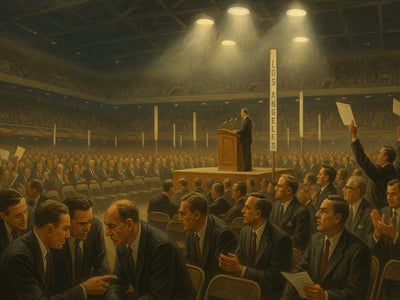
John F. Kennedy after winning the Democratic presidential nomination in Los Angeles, 1960.
On July 13, 1960, Senator John F. Kennedy of Massachusetts won the Democratic nomination for president at the party's national convention in Los Angeles, California. The decision came at the Los Angeles Memorial Sports Arena, where delegates gathered to choose the candidate who would lead the party into the general election. Kennedy secured the nomination on the first ballot with 806 delegate votes, clearing the required threshold and ending the main contest in a single round.
That result was important not just because Kennedy became the Democratic nominee, but because it showed that months of delegate organizing had held together when it mattered most. National conventions in that era were still places where uncertainty could remain until the final vote. Candidates arrived with estimates, commitments, and expectations, but a convention floor could still produce shifts, bargaining, and second thoughts. Kennedy's task was therefore not only to appear strong before the convention opened, but to convert support into a confirmed majority once delegates actually voted.
The 1960 Democratic National Convention had opened in Los Angeles on July 11. Kennedy entered it as a leading contender, but not in a political environment free of risk. He was a comparatively young senator, and rivals remained in the picture. Among the notable figures associated with the contest were Lyndon B. Johnson, Adlai Stevenson II, and Stuart Symington. Their presence reflected the range of options still available to delegates if Kennedy failed to win quickly. A first-ballot victory would demonstrate command of the party; anything less could invite negotiations, realignment, and a longer struggle.
That was the central tension of the convention. Delegates had to decide whether to settle the nomination immediately or leave the door open to additional ballots. In convention politics, delay can change everything. A candidate who falls short on the first vote may look weaker on the second. Supporters may begin to bargain. Favorite sons and regional leaders may test their leverage. Rivals who seemed to be fading can regain momentum simply because the outcome is no longer certain. Kennedy's campaign therefore needed not just broad popularity, but disciplined vote counting.
When the presidential ballot took place on July 13, that discipline paid off. Kennedy's 806 votes gave him an outright victory. The first-ballot result mattered symbolically as well as procedurally. It presented him as the clear choice of the convention rather than the accidental survivor of a deadlock. In party politics, that distinction can shape the mood that follows. A rapid nomination usually helps a convention move from internal competition to outward-facing unity. For the Democrats in 1960, that transition was especially important because the general election ahead would be closely watched at home and abroad.
The convention setting itself underlined the scale of the moment. Thousands of delegates, party officials, journalists, and observers were gathered in Los Angeles, one of the country's major media centers. The convention was not simply an internal meeting. It was a staged national event, watched for signs of strength, division, and momentum. Every speech, endorsement, and vote was part of a process by which a party tried to define itself before the electorate. Kennedy's victory gave the Democrats a nominee whose public image, political style, and campaign strategy would soon become central to the election of 1960.
Yet the nomination was only one part of the convention's work. A national ticket also required a vice-presidential nominee, and that decision would become another key moment. On July 14, the convention nominated Lyndon B. Johnson as the Democratic candidate for vice president. Johnson was a major political figure in his own right, and his selection showed how a convention victory could be followed by coalition-building within the party. Presidential nominees do not merely win ballots; they also assemble governing and electoral partnerships.
In that sense, Kennedy's nomination was both a conclusion and a beginning. It concluded the immediate struggle for delegates at the convention. At the same time, it began the next phase: presenting a balanced ticket, unifying party factions, and preparing for a national campaign against Republican nominee Richard Nixon. The Democrats left Los Angeles with their presidential and vice-presidential nominees in place, and the contest shifted from convention arithmetic to the demands of a general election.
That election would end on November 8, 1960, when Kennedy defeated Nixon. But the outcome in November rested in part on what had been achieved in July. A party that emerges from its convention with a clear nominee and a workable coalition starts the general campaign from a stronger position than one weakened by internal confusion. The Los Angeles convention therefore mattered not only as a ceremonial step in American politics, but as a practical test of organization and party management.
Why it still matters
Kennedy's nomination remains useful for understanding how party conventions turn internal competition into a national governing ticket. The event shows that delegate systems are not just formal procedures; they are mechanisms for measuring loyalty, organization, and coalition strength. By the time delegates cast their ballots, a campaign's success depends on preparation that may have taken months.
The 1960 convention also mattered because the person chosen there would soon lead one of the world's principal Cold War powers. In that context, the nomination of a major-party candidate in the United States was never only a domestic ritual. It was part of the process by which leadership was selected in a nuclear-armed superpower, and it was followed closely because of the international consequences of American elections.
Finally, the Kennedy-Johnson ticket illustrates a recurring feature of presidential politics: the use of a vice-presidential choice to broaden support within a party. The convention did not simply identify one leader. It produced a two-person ticket designed to compete nationally and hold together a coalition large enough to win. That combination of delegate math, public presentation, and alliance-building is one reason the events in Los Angeles still offer a clear window into how modern presidential politics works.
Timeline
- 1960 Democratic National Convention opens
- Democratic presidential nomination
- Democratic vice-presidential nomination
- United States presidential election
What you uncovered
Convention Math and Coalition
You didn't just…complete a puzzle; you retraced the moment when delegate counts, floor strategy, and party decisions placed Kennedy at the top of the Democratic ticket.
A convention victory is not only a measure of popularity but also a test of whether support can be organized into a durable coalition. In 1960, the first-ballot result mattered because it limited bargaining that might have weakened the nominee before the general election. The next step was just as important: turning delegate arithmetic into a ticket that could hold together different parts of the party. That helps explain why vice-presidential selection was part of the governing equation, not just campaign symbolism.
Kennedy received 806 delegate votes on the 1960 Democratic presidential nomination ballot, enough to secure the nomination on the first ballot.
FAQ
What happened on 13 July 1960 at the Democratic convention?
John F. Kennedy won the Democratic presidential nomination on the first ballot at the Los Angeles Memorial Sports Arena in Los Angeles, California. He received enough delegate votes to secure the nomination.
How many delegate votes did John F. Kennedy receive?
Kennedy received 806 delegate votes on the 13 July 1960 presidential nomination ballot. That total exceeded the number required for nomination.
Where was Kennedy nominated for president in 1960?
He was nominated at the Democratic National Convention in Los Angeles, California. The presidential ballot was taken at the Los Angeles Memorial Sports Arena.
Why was a first-ballot victory important for Kennedy?
A first-ballot victory meant he secured the nomination immediately at the convention. If he had fallen short, additional rounds of voting could have changed delegate alliances and complicated the party’s momentum.