
About this story
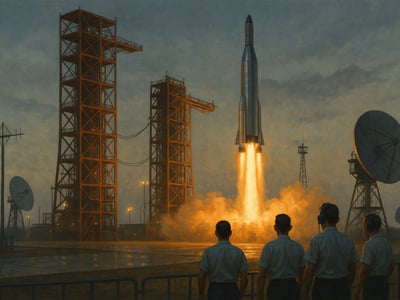
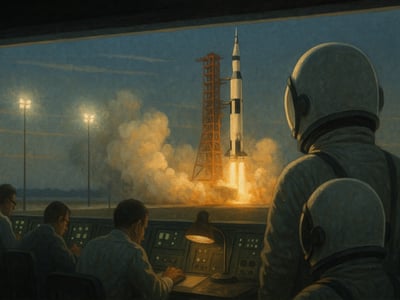
Gemini X mission of July 1966, launched from Cape Kennedy with Young and Collins.
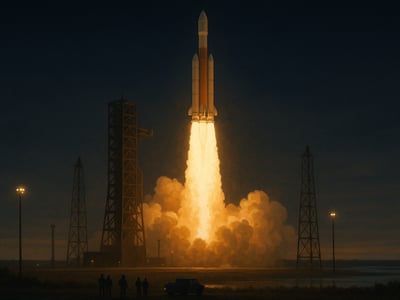
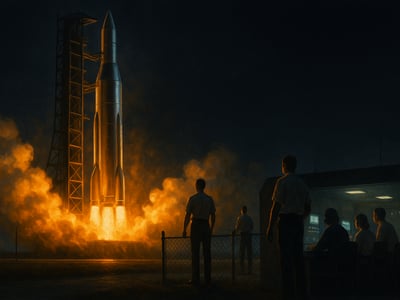
On 18 July 1966, NASA launched Gemini X from Launch Complex 19 at Cape Kennedy, Florida, sending astronauts John W. Young and Michael Collins into low Earth orbit aboard a Titan II rocket. The flight was part of the Gemini program, the crucial series of missions that stood between the early Mercury flights and the later Apollo lunar missions. By the time Gemini X lifted off, NASA was no longer simply trying to keep astronauts alive in orbit. It was working through a set of precise operational problems that had to be solved before more ambitious missions could be attempted.
Gemini X was designed around a demanding sequence. The spacecraft had to reach orbit accurately, meet another vehicle already in space, dock with it, use that combined system for orbital maneuvers, and support extravehicular activity. Each part depended on the others. If the launch insertion was off, the rendezvous could become more difficult. If fuel was used inefficiently, later objectives might have to be reduced. If spacewalking procedures did not work as planned, a key area of astronaut training would remain uncertain. The mission was therefore less about one spectacular moment than about proving that several difficult techniques could be carried out in order, under real conditions, with little margin for error.
That challenge helps explain the structure of the Gemini program itself. NASA had been building experience step by step. Earlier Gemini missions had tested endurance, maneuvering, and basic rendezvous procedures. With Gemini X, the aim was to add another layer of operational confidence. Rendezvous and docking were not abstract engineering exercises. Future crewed missions would depend on spacecraft finding each other in orbit, approaching safely, and functioning as a coordinated system once connected. In the 1960s, this was still a relatively new skill, one that had to be practiced and measured in flight.
John W. Young served as command pilot, with Michael Collins as pilot. Both men were part of a generation of astronauts asked to carry out increasingly technical assignments as the United States accelerated its spaceflight capabilities. Their job on Gemini X required not only flying the spacecraft but managing a tightly timed mission profile in which navigation, fuel use, and crew procedures all mattered. Space missions often appeared simple in public summaries, but in practice they depended on a long chain of calculations and decisions made before launch and adjusted during flight.
On 19 July 1966, Gemini X rendezvoused and docked with the Agena target vehicle launched for the mission. Agena target vehicles were central tools in the Gemini program because they gave crews a realistic object to chase, approach, and connect with in orbit. Docking was a major technical milestone not because it looked dramatic, but because it proved that pilots, guidance systems, and mission planners could work together with enough precision to bring two independent spacecraft into a controlled mechanical link while circling Earth at high speed.
Once docked, Gemini X used the Agena vehicle for orbital maneuvers. That, too, was an important step. A docked pair was not just a symbolic success. It could become a working system, with one vehicle helping alter the orbit of the other. Such operations expanded the mission from simple meeting and contact into coordinated spacecraft handling. They provided practical experience in the kind of orbital operations that later missions would need in more complex forms.
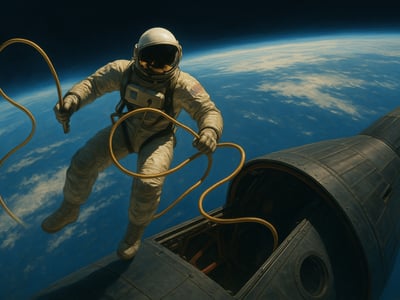
The flight also included extravehicular activity, another area where NASA was still learning through experience. On 21 July 1966, Michael Collins carried out an EVA during the mission. Spacewalking in the Gemini era was physically demanding and often more difficult than planners expected. Astronauts had to work in a harsh environment while controlling their bodies, managing equipment, and conserving energy. Procedures that looked manageable on paper could become exhausting in orbit. Every EVA therefore supplied evidence about training, restraint systems, task design, and the limits of human performance outside a spacecraft.
Gemini X did not stand alone as a dramatic turning point with a single easily named achievement. Its significance lay in the way multiple mission elements were brought together. Launch accuracy, rendezvous, docking, orbital maneuvering, and EVA all had to function as parts of a larger system. That was exactly the kind of integrated experience NASA needed in the middle of the Gemini program. The mission added not just isolated results, but operational understanding.
The careers of the crew also connect Gemini X to the broader history of American spaceflight. John Young would go on to play major roles in later NASA programs, and Michael Collins would become widely known for his service in the Apollo era. But in July 1966, their task was focused and immediate: to help turn a set of difficult orbital techniques into practiced procedure.
Why it still matters
Gemini X still matters because it shows how major achievements in spaceflight are often built through disciplined intermediate missions rather than sudden leaps. Before later crews could attempt more complex operations, NASA needed reliable methods for orbital rendezvous, docking, and coordinated spacecraft control. Gemini X added to that body of operational knowledge.
It also contributed to the growing experience base around EVA. Early spacewalking was not yet routine, and each mission exposed practical challenges that engineers and planners had to address. The lessons were not only about astronaut skill, but about spacecraft design, timelines, equipment arrangement, and how much work could realistically be done in orbit.
More broadly, Gemini X is a useful example of how technical capability develops. It was a mid-program mission, not the first crewed launch and not a lunar flight, yet it helped connect those stages. Its value lay in demonstrating that several hard tasks could be performed in sequence and under control. In that sense, Gemini X was part of the groundwork that made later crewed exploration possible.
Timeline
- Gemini X launch
- Gemini X rendezvous and docking
- Gemini X extravehicular activity
What you uncovered
A Mission of Linked Steps
You didn't just… complete a space-history puzzle; you traced a mission built around getting several difficult operations to work in sequence under tight limits.
Gemini X is easiest to remember as a launch, a docking, or a spacewalk, but its deeper importance lies in how those tasks depended on one another. The mission tested whether precision at launch, control in orbit, and crew activity outside the spacecraft could be managed as parts of a single operational system. That kind of coordination was essential for later crewed missions, where success depended less on one dramatic moment than on many connected procedures working reliably.
Gemini X rendezvoused and docked with its Agena target vehicle on 19 July 1966, one day after launch.
FAQ
When did Gemini X launch, and from where?
Gemini X launched on 18 July 1966 from Launch Complex 19 at Cape Kennedy, Florida. It began its mission aboard a Titan II launch vehicle.
Who were the astronauts on Gemini X?
The crew consisted of command pilot John W. Young and pilot Michael Collins. They flew the mission together in low Earth orbit.
What was Gemini X meant to do?
Gemini X was focused on rendezvous and docking with an Agena target vehicle. It also included orbital maneuvers and extravehicular activity as part of the Gemini program.
What did Michael Collins do during Gemini X?
On 21 July 1966, Michael Collins carried out an extravehicular activity during the mission. This was one of the flight's key objectives.
Why did Gemini X matter for later missions?
The mission added operational data for rendezvous, docking, and EVA procedures. Those techniques were important for later crewed spaceflight programs.