
About this story
Disneyland's invitation-only opening day in Anaheim on 17 July 1955
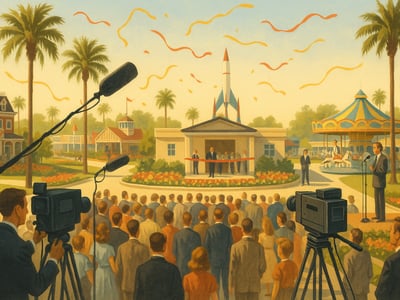
On July 17, 1955, Disneyland opened in Anaheim, California, for invited guests and the press in an event that was also carried live on ABC television. The date marked not the first ordinary day of business, but a carefully staged debut before a national audience. For Walt Disney and the company behind the park, the opening was more than a ribbon-cutting. It was a public test of whether a large, themed amusement destination—planned as a unified environment rather than a collection of separate rides—could work at full scale.
The idea had taken shape during the early 1950s, when Walt Disney pursued a permanent park in Southern California. He was not simply adding another attraction to an existing fairground. The aim was to build a place with a controlled visual identity, distinct themed areas, and a close connection to Disney's storytelling style. That ambition required land, capital, and a willingness to commit to a format that had few direct precedents in the United States.
Financing was one of the central challenges. Disneyland was expensive to build, and its backers needed more than ticket sales to support the venture. A key element in making the park possible was Disney's partnership with ABC. Television support helped provide financing, but it also created a new obligation. The park's opening would not unfold quietly. Instead, it would be presented to viewers across the country in real time, tying the success of the physical site to the success of a broadcast event.
That arrangement raised the stakes considerably. In effect, Disneyland had to open as both a functioning destination and a national media production. There had been no true full-capacity public rehearsal. Yet a fixed opening date had been set, and by the summer of 1955 construction moved toward that deadline. The park had been built in 1954 and 1955, and much of the pressure came from the need to transform an ambitious concept into an operating environment quickly enough for a widely advertised debut.
When the invitation-only opening day arrived, visitors entered a park organized into themed lands that established the basic structure still associated with Disneyland history: Main Street, U.S.A., Adventureland, Frontierland, Fantasyland, and Tomorrowland. This arrangement mattered because it framed the visit as a sequence of designed worlds. Rather than presenting attractions as isolated features, the park encouraged guests to move through a planned setting in which architecture, landscaping, pathways, and entertainment were meant to support a larger illusion of place.
The live ABC special made that structure visible to millions who were not there in person. Walt Disney appeared on the broadcast and addressed viewers from the park. The program also featured hosts Art Linkletter, Ronald Reagan, and Bob Cummings, who guided television audiences through different parts of the property. The opening therefore worked on two levels at once. Guests experienced the site directly, while viewers encountered Disneyland as a mediated national event shaped by camera placement, commentary, and live scheduling.
This combination of spectacle and risk was central to the day. A local opening could have absorbed minor confusion without much lasting national consequence. A televised opening could not. Every crowd movement, delay, and unfinished detail carried greater weight when seen as part of a live launch. The human decision behind the event was clear: Walt Disney and his collaborators chose to present the park before the country before the concept had been proven under real opening-day conditions.
That decision reflected confidence, but also necessity. The television partnership was not merely a publicity tool added at the end. It had become part of the business model that made the project possible. In that sense, the opening day was not only about entertainment. It was also about whether production, finance, land development, and mass media could be integrated into one commercial system. Disneyland was expected to function as a place people could visit, a program people could watch, and a branded environment people could recognize immediately.
The distinction between July 17 and July 18 is important. July 17 was the invitation-only opening day, intended for invited guests and the press and shaped by the live broadcast. The general public was admitted the following day, July 18, 1955. Keeping those dates separate helps explain why the first day occupies such a large place in historical memory: it was designed as a public unveiling, but not yet as a normal operating day for all visitors.
Even in its earliest form, Disneyland suggested a model that would extend far beyond Anaheim. The opening-day lands offered familiar historical and imaginative settings, but they did so within a tightly managed commercial environment. Visitors were not just attending rides. They were entering a destination whose overall design sought to organize movement, mood, and attention. That approach would become one of the defining features of the modern theme park.
Why it still matters
Disneyland's opening still matters because it demonstrated a durable way of combining media and place. The park was financed in part through a television relationship, introduced to the public through a live national broadcast, and built as a destination with a strong branded identity. Those elements reinforced one another. Entertainment production promoted the site; the site strengthened the brand; the brand supported further business growth.
The opening also helped establish the themed park as a standard form of leisure design. Its lands showed how storytelling, architecture, and circulation could be coordinated into a unified visitor experience. Later parks in the United States and abroad would adapt this logic, even when their themes and owners differed.
Finally, the events of July 17, 1955, remain a useful case study in launch culture. Disneyland opened under intense visibility, with little room to separate operational testing from public presentation. That combination of media exposure and physical experience is now common in many industries, but Disneyland showed it early and at scale. Its debut in Anaheim was therefore not only the start of a park. It was also a demonstration of how modern entertainment businesses could build audiences before, during, and after the opening of a place.
Timeline
- Disneyland construction period begins
- Disneyland opening day in Anaheim
- Disneyland public opening
What you uncovered
A Park Built for Broadcast
You didn't just…reassemble an opening-day scene; you traced the moment a new kind of entertainment business was tested in public.
Disneyland's debut mattered not only because a park opened, but because it showed how media, financing, and physical space could be coordinated as one system. Television did more than advertise the attraction: it helped fund it, frame it for a national audience, and turn the opening itself into part of the product. That combination became a durable model for branded destinations designed as much for circulation through media as for the people walking through them.
The invitation-only opening on July 17, 1955 was followed by Disneyland's public opening the next day, on July 18.
FAQ
When did Disneyland open in Anaheim?
Disneyland opened on 17 July 1955 in Anaheim, California. The opening day was invitation-only and also carried on ABC television.
Who appeared on Disneyland's opening-day broadcast?
Walt Disney appeared on the opening-day broadcast and addressed viewers from Disneyland. The live ABC special was hosted by Art Linkletter, Ronald Reagan, and Bob Cummings.
What lands were open at Disneyland on opening day?
The park debuted with Main Street, U.S.A., Adventureland, Frontierland, Fantasyland, and Tomorrowland. These were the initial themed lands open on 17 July 1955.
Why was ABC involved in Disneyland's opening?
ABC was involved because the opening was broadcast as a live television special on 17 July 1955. The network partnership helped turn the debut into a high-profile event.