
About this story
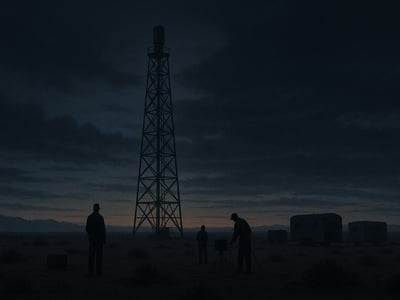
Trinity test site in New Mexico, where the first nuclear explosion occurred in 1945.
On July 16, 1945, before dawn in the New Mexico desert, the United States detonated the device known as the Trinity test. Conducted at the Trinity Site on the Alamogordo Bombing Range, the explosion was the first nuclear detonation in history. It was the product of the Manhattan Project, the wartime research effort that had brought together scientists, engineers, soldiers, and industrial planners in a race to turn nuclear theory into a working weapon.
By that point in World War II, the project had already passed through several major technical and organizational phases. Work at Los Alamos Laboratory had narrowed toward two different bomb designs. One, a gun-type weapon, was considered suitable for uranium. The other, built around plutonium, posed a much harder problem. Earlier research had shown that plutonium could not reliably be used in the simpler gun-type approach. That forced the laboratory to pursue implosion: a method that depended on carefully shaped conventional explosives compressing a plutonium core inward with extraordinary precision.
That challenge made Trinity more than a routine field trial. The device being tested, nicknamed "the Gadget," was an implosion-type plutonium bomb assembled as a full-scale proof of concept. If the explosive lenses fired out of sequence or the compression was uneven, the result might be a partial detonation, or "fizzle," rather than the expected blast. After years of calculations, experiments, and small-scale tests, the Manhattan Project still faced a basic question that could only be answered once: would the design work outside the laboratory?
The site chosen for that answer was remote. In central New Mexico, project staff prepared a test area far from major population centers, yet close enough to Los Alamos for planning and logistics. The Gadget was raised to the top of a 100-foot steel tower, a choice meant to simulate how the device would behave if exploded above the ground. Around the tower, teams installed instruments to record the flash, blast pressure, heat, radiation, and other effects. The shot was not only about creating an explosion. It was also about collecting measurements that could show whether the weapon had functioned as designed.
Senior figures of the Manhattan Project watched the final preparations with different responsibilities in mind. J. Robert Oppenheimer, the scientific leader at Los Alamos, had spent months directing the work that led to the implosion design. General Leslie R. Groves, the military head of the Manhattan Project, had overseen the broader effort that linked science, security, production, and wartime planning. Kenneth Bainbridge, the test director, was responsible for the Trinity shot itself, including the site, the timing, and the practical execution of a highly uncertain operation.
Even at the last moment, nature added another layer of difficulty. Weather conditions before dawn caused delays. Storms and poor visibility threatened observation and raised the possibility that some of the carefully arranged measurements might be compromised. For a test that had to provide clear technical evidence, this mattered greatly. The Manhattan Project did not simply need a dramatic event; it needed usable results. A successful explosion without reliable data would still leave important questions unanswered.
When the countdown resumed, the test team had little room for correction. The Gadget sat on its tower as a one-shot experiment years in the making. Observers waited at varying distances. Instruments had to survive long enough to record what happened. The firing system had to work properly. The implosion itself had to occur in near-perfect synchronization. At that stage, the project could no longer improve the design by theory alone.
The device detonated before dawn on July 16, 1945. Historical accounts commonly describe the yield as about 21 kilotons of TNT equivalent, though some summaries round the figure somewhat differently. What mattered immediately to those present was that the implosion concept had worked. The blast and its effects showed that the plutonium design was not only mathematically plausible but practically achievable. Just as important, the test produced observations and measurements that project leaders could use in assessing the weapon's reliability.
For Oppenheimer, Groves, Bainbridge, and the other observers, the moment carried several meanings at once. It confirmed a difficult technical solution that had emerged after earlier setbacks in bomb design. It validated the choice to pursue a full-scale test before wartime use of a plutonium weapon. And it marked the transition from research and development to operational capability. In a matter of hours, a question that had dominated a major secret project was settled by physical evidence.
That evidence mattered because Trinity was not an isolated scientific event. It took place less than a month before the end of the war in the Pacific and just weeks before the United States used atomic bombs against Hiroshima and Nagasaki in August 1945. The New Mexico test did not settle later debates about those bombings, their necessity, or their human consequences. But it did provide the confidence that the plutonium implosion design could be deployed as a working weapon within wartime military planning.
Why it still matters
Trinity is often described as the beginning of the nuclear age because it was the first demonstration that a nuclear weapon could function in practice. Before July 16, 1945, an implosion-type plutonium bomb was still an extremely difficult idea being tested under pressure. After Trinity, it became a demonstrated capability. That shift changed the relationship between scientific research, military power, and state policy.
The test also helped establish patterns that shaped the decades that followed. It linked weapons development to large technical systems of measurement, secrecy, industrial production, and government control. It accelerated the movement from wartime experimentation to a permanent nuclear arsenal. In the years after 1945, nuclear testing, strategic deterrence, and arms control would all develop in the shadow of what Trinity had made possible.
Its significance remains historical as well as political. Trinity stands at the point where abstract work in physics became a force capable of altering warfare and diplomacy on a global scale. Remembering it requires attention not only to scientific ingenuity or military organization, but also to the long consequences of creating weapons whose effects extended far beyond the test site itself.
In that sense, the Trinity test is still studied not simply because it was first, but because it changed what governments knew they could build, what wars might become, and what risks humanity would have to manage from then on.
Timeline
- Beginning of Manhattan Project-related research
- Los Alamos plutonium implosion design work
- Trinity test
- Trinity Site test preparations and weather delays
- Atomic bombing of Hiroshima
- Atomic bombing of Nagasaki
- Postwar nuclear weapons testing and arms control
What you uncovered
Measuring the Atomic Age
You didn't just…complete a puzzle; you traced the moment when scientists and military planners sought proof that a theoretical design would work in the world they were about to change.
Trinity mattered not only because a bomb exploded, but because the test turned uncertainty into usable evidence. The blast had to be observed, timed, and measured well enough to show that the implosion design was reliable outside calculations and laboratory work. That link between detonation and data helped move nuclear weapons from research into organized military capability, shaping later testing and deterrence systems.
The Trinity device, nicknamed "the Gadget," was placed atop a 100-foot steel tower before it was detonated on July 16, 1945.
FAQ
What happened at the Trinity test on July 16, 1945?
On 1945-07-16, the United States detonated the Trinity device at the Trinity Site on the Alamogordo Bombing Range in New Mexico. It was the first nuclear explosion.
Who directed the Trinity test?
Kenneth Bainbridge served as the test director for the Trinity shot. General Leslie R. Groves and J. Robert Oppenheimer were senior leaders of the Manhattan Project at the time.
What was the Gadget at Trinity?
The Gadget was an implosion-type plutonium bomb tested on 1945-07-16. It was placed on a 100-foot steel tower before detonation.
Where was the Trinity Site located?
The Trinity Site was on the Alamogordo Bombing Range in New Mexico. The detonation took place before dawn in a remote desert area near present-day White Sands Missile Range.
Why is the Trinity test considered so important?
It was the first demonstration that a plutonium implosion design could work in practice, not just in theory. It also marked the start of the nuclear age and helped shape later weapons policy and arms control debates.