
About this story
John T. Scopes during the 1925 Dayton trial that ended with a guilty verdict.
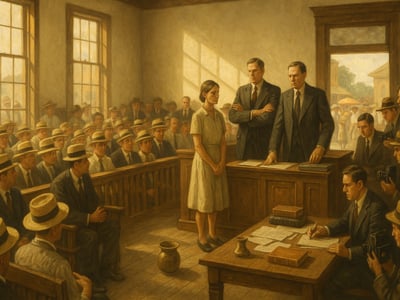
On July 21, 1925, a jury in Dayton, Tennessee, found high school teacher John T. Scopes guilty of violating the state’s Butler Act, a law that barred public school teachers from teaching human evolution in a way that contradicted the Biblical account of creation. In the Rhea County Courthouse, Judge John T. Raulston announced a $100 fine. The verdict ended one of the most closely watched American trials of its time, a local prosecution that had quickly become a national event.
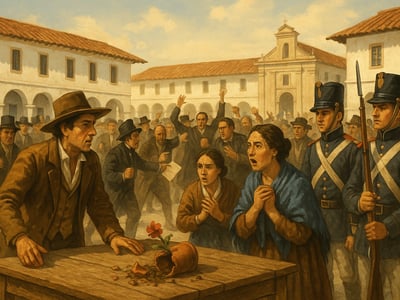
The case, formally titled *State of Tennessee v. John Thomas Scopes*, did not arise by accident. Earlier that year, on March 21, 1925, Tennessee had enacted the Butler Act. Its language prohibited teachers in the state’s public schools from teaching any theory that denied the divine creation of man as taught in the Bible and taught instead that man descended from a lower order of animals. The law immediately raised questions about what public school teachers could say in class and how far a state legislature could go in defining curriculum.
In Dayton, local civic leaders and businessmen discussed creating a test case that could bring attention to the town while also challenging the new statute in court. Scopes, a young teacher, was charged in May 1925 in Rhea County. The aim was not simply to resolve a classroom dispute. It was to put the Butler Act itself under legal scrutiny through a criminal prosecution that could be appealed.
That choice transformed a county courtroom into a stage for a much wider public argument. When the trial opened on July 10, 1925, it drew intense press attention from across the United States and abroad. Reporters, observers, and commentators treated the proceedings as more than a local legal matter. They saw in it a conflict over public education, the authority of legislatures, and the place of modern science in school instruction.
The people gathered in Dayton also made the trial unusually visible. William Jennings Bryan, a nationally known political figure, served as counsel for the prosecution. Clarence Darrow, one of the country’s best-known defense attorneys, joined the defense. Their presence gave the proceedings a prominence that few state criminal cases could have achieved on their own. What might otherwise have remained a narrow dispute over one state law became a public debate followed far beyond Tennessee.
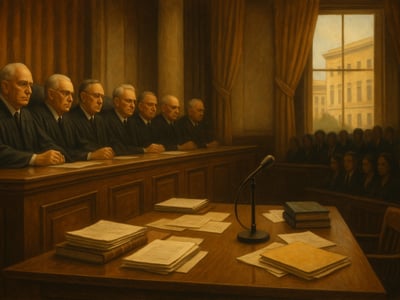
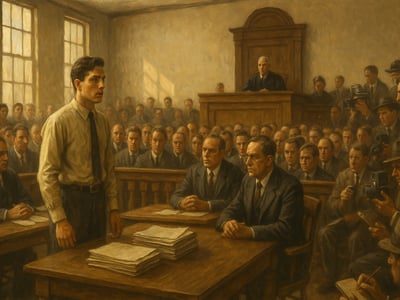
Yet the legal question before the jury was comparatively narrow: had Scopes violated the Butler Act? That question became even more central because of the trial judge’s rulings. On July 20, Judge Raulston excluded most of the defense’s expert testimony on evolutionary science from the jury’s consideration. The defense had sought to introduce scientific specialists to discuss evolution and to challenge the broader basis of the law. With that testimony largely limited, the courtroom argument focused less on scientific detail than on the statute itself and on whether Scopes had acted contrary to it.
The trial is often remembered for its dramatic exchanges, especially the examination of Bryan by Darrow, but the verdict turned on the structure of the case as it stood before the court. If the law was valid and if Scopes had taught material covered by it, the jury had little room to maneuver. By the time the case went to the jury on July 21, the defense was confronting not only a controversial statute but also a courtroom process that had narrowed what evidence jurors could weigh.
The guilty verdict therefore reflected both the wording of the Butler Act and the limited legal path available inside the trial court. Scopes was convicted, and the fine was set at $100. For supporters of the prosecution, the result affirmed Tennessee’s authority to regulate public school teaching through statute. For the defense, the verdict was also part of the strategy: a conviction would create a record for appeal and keep the constitutional and legal arguments alive beyond Dayton.
That appeal mattered. The trial had always been more than a local dispute over one lesson in one classroom. It was a test case designed to move upward through the courts. In 1927, the Tennessee Supreme Court, in *Scopes v. State*, set aside the conviction on a technical ground involving the fine, while leaving the Butler Act itself in place. That outcome showed how the case could produce a famous verdict without immediately settling the larger legal and educational questions around it.
Why it still matters
The Scopes verdict remains a reference point because it brought several kinds of authority into one courtroom: a legislature writing curriculum rules, a trial judge managing what evidence a jury could hear, and a public school teacher becoming the defendant in a test case. The questions raised in Dayton did not end with the $100 fine. They continued in later disputes over who sets the boundaries of public education and how courts review those boundaries.
The case also shows how a local controversy can become a national argument when law, schools, and media attention intersect. Dayton’s leaders helped create a prosecution that they knew might attract notice, but the response went far beyond local expectations. The trial became a model of how legal test cases can elevate a specific dispute into a broader public conversation without changing the basic fact that a courtroom still has to rule on the statute before it.
Its record is still cited when people discuss the teaching of scientific subjects in schools and the legal power of states to shape curriculum. That continued relevance does not depend on treating the case as a simple contest between faith and science. Historically, it is more precise to see the July 21 verdict as the outcome of a particular law, a carefully arranged test case, and a courtroom process that gave one Tennessee prosecution an unusually long public afterlife.
Timeline
- Butler Act enacted
- Scopes Trial opens
- Defense expert testimony limited
- Scopes Trial verdict
- Scopes v. State decision
What you uncovered
A Local Case, National Debate
You didn't just…finish a puzzle; you traced the moment a local Tennessee prosecution became a national argument over what public schools could teach.
The trial's lasting significance lies not only in the verdict, but in how several systems met in one courtroom: state law, school curriculum, and mass publicity. What might have remained a local legal test instead became a widely watched dispute because the case was structured to challenge a statute and then amplified by intense press coverage. That combination helps explain why the Scopes Trial still surfaces whenever people argue over who decides what belongs in classrooms.
The trial opened on July 10, 1925, and the guilty verdict was returned eleven days later in the Rhea County Courthouse in Dayton, Tennessee.
FAQ
Why was John T. Scopes found guilty on July 21, 1925?
A Tennessee jury in Dayton found John T. Scopes guilty because he was charged with violating the Butler Act by teaching human evolution in a public school classroom. The verdict was announced at the end of State of Tennessee v. John Thomas Scopes in the Rhea County Courthouse.
What did the Butler Act ban in Tennessee public schools?
The Butler Act barred public school teachers from teaching any theory that denied the divine creation of man as taught in the Bible, and it also barred teaching that humans descended from a lower order of animals. It was enacted in Tennessee on March 21, 1925.
Where did the Scopes Trial take place?
State of Tennessee v. John Thomas Scopes opened in Dayton, Tennessee, on July 10, 1925. The trial took place in the Rhea County Courthouse.
Why did Judge John T. Raulston limit defense testimony?
On July 20, 1925, Judge John T. Raulston excluded most expert testimony offered by the defense on evolutionary science from the jury's consideration. The jury was then asked to decide the case based on the evidence allowed in court.