
About this story
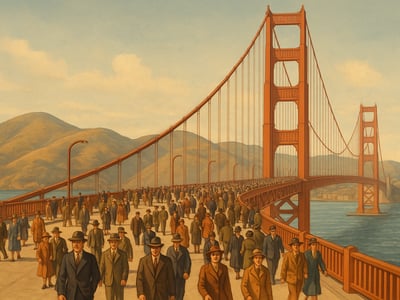
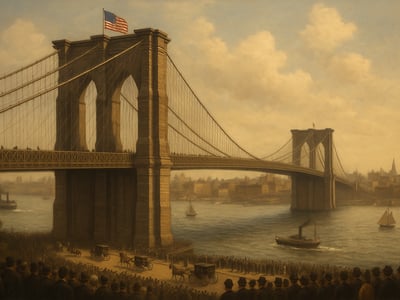
Brooklyn Bridge opening in New York City on May 24, 1883.
Video puzzle
On May 24, 1883, the Brooklyn Bridge opened to traffic in New York City, linking Manhattan and Brooklyn across the East River with a structure that had taken more than a decade to complete. By the time the first official parties crossed, the bridge was already known as an engineering landmark: its main span measured 1,595.5 feet, making it the longest suspension-bridge main span in the world at the moment it opened. But the ceremony marked more than the debut of a new crossing. It was the public conclusion of a difficult project that had survived death, illness, technical risk, and years of uncertainty.
The bridge had begun as the vision of John A. Roebling, an engineer already associated with major suspension bridges. A fixed span over the East River promised a more dependable connection than ferries, which had long carried people and goods between the separate cities of New York and Brooklyn. Such a bridge, however, posed serious challenges. It would need massive masonry towers, foundations sunk in difficult underwater conditions, and cables strong enough to support a roadway high above one of the country's busiest waterways.
Before the project could fully take shape, its original designer was lost. John A. Roebling died on July 22, 1869, after an accident connected to early site work for the bridge. His death might have ended confidence in the plan. Instead, responsibility passed to his son, Washington Roebling, who became chief engineer. Construction formally began on January 3, 1870, under the New York Bridge Company, and the younger Roebling took on the task of turning the elder Roebling's design into a finished structure.
The years that followed were defined by work that was both innovative and dangerous. Building the foundations required caissons, large pressurized chambers sunk beneath the water so workers could excavate down to stable ground. This made the towers possible, but it also exposed laborers and supervisors to serious health hazards. Washington Roebling himself became ill during the construction period, a condition widely associated with caisson work and pressure changes. His illness limited his ability to remain continually on site and threatened to slow or disrupt the entire undertaking.
At that point, the bridge depended not on a single heroic figure but on a chain of communication and management. Washington Roebling continued to direct the project during the 1870s, while Emily Warren Roebling took on a central coordinating role in relaying engineering information, instructions, and updates between him and the people carrying out the work. Her position did not replace the formal responsibilities of engineers, builders, or public authorities, but it was vital to keeping the project moving. The bridge's completion depended on this distributed form of supervision: decisions had to be communicated accurately, technical issues had to be tracked, and confidence had to be maintained over a long timeline.
Meanwhile, the structure itself rose into view. The masonry towers became part of the skyline, and the great steel-wire cables were eventually carried across the river. The bridge combined suspension principles with a scale that drew attention well beyond New York. It had to function as infrastructure first, not as a monument. The roadway needed to carry regular traffic, the span needed to clear river movement below, and the whole system had to convince a skeptical public that it was safe and durable.
By opening day, that long effort was ready for its public test. On May 24, 1883, President Chester A. Arthur took part in the ceremonies, along with New York City Mayor Franklin Edson and Brooklyn Mayor Seth Low. Their presence reflected the political meaning of the bridge as well as its technical one. This was a structure that joined two neighboring cities with distinct governments, economies, and civic identities. To open it was to acknowledge that transportation could reshape the relationship between them.
For ordinary users, the bridge changed movement in practical terms. It offered a direct, fixed route where people had previously depended heavily on boats and weather-sensitive crossings. That mattered for commuters, merchants, and city services alike. A bridge is often described as a symbol, but on its first day the Brooklyn Bridge was valuable because it solved a daily problem of urban connection.
Its opening also represented a change in scale. Nineteenth-century American cities were growing quickly, and they needed infrastructure that could match that growth. The Brooklyn Bridge showed that public works could be ambitious, technically complex, and intended not just for immediate demand but for a broader metropolitan future. The crossing did not erase the separate identities of Manhattan and Brooklyn overnight, yet it made their connection more constant and more visible.
Why it still matters
The Brooklyn Bridge still matters because it is a clear example of how infrastructure can reorganize urban life. By creating a permanent link between Manhattan and Brooklyn, it improved transportation between neighboring jurisdictions and helped support the larger integration of the area into a single metropolitan system. Later changes in New York's political geography would have many causes, but reliable physical connection was one important part of that story.
It also remains a reference point in the history of bridge engineering. Its record-setting main span and its use of steel-wire suspension design placed it among the defining long-span bridges of its era. For historians of technology, it marks a moment when engineering ambition, new materials, and urban demand met in a form that proved durable enough to become part of everyday city life.
Just as important, the project is remembered for the way it was managed across adversity. John A. Roebling did not live to see the bridge built. Washington Roebling led the work while dealing with illness. Emily Warren Roebling played a crucial role in communication and coordination. Public officials, engineers, and workers all formed part of the process. That makes the bridge useful not only as an engineering achievement but also as a case study in how large public works are sustained over many years.
When people look at the Brooklyn Bridge now, they often see a familiar landmark. On its opening day in 1883, however, it was something more immediate: proof that a difficult project, stretched across years of risk and adjustment, could finally carry a city across the river.
Timeline
- John A. Roebling dies
- Construction of the Brooklyn Bridge begins
- Brooklyn Bridge opens to traffic
- Opening ceremonies for the Brooklyn Bridge
What you uncovered
Infrastructure Beyond One Builder
You didn't just… complete a puzzle; you traced a historic moment shaped by persistence, delegated expertise, and years of coordinated work across the East River.
The bridge's opening is often remembered as a dramatic debut, but the more revealing story is how the project endured through disruption. Leadership changed, responsibilities were redistributed, and technical decisions had to keep moving across a long timeline. That makes the Brooklyn Bridge more than a landmark of design: it is also a case study in how major public works depend on systems of communication and continuity rather than on one person alone.
At its opening on 1883-05-24, the Brooklyn Bridge's 1,595.5-foot main span was the longest suspension-bridge main span in the world.
FAQ
When did the Brooklyn Bridge open to traffic?
The Brooklyn Bridge opened to traffic on 1883-05-24 in New York City. It connected Manhattan and Brooklyn across the East River.
Who designed the Brooklyn Bridge?
The bridge was designed by John A. Roebling. After his death, Washington Roebling oversaw the project during the 1870s.
Why was Emily Warren Roebling important to the bridge's construction?
Emily Warren Roebling served in a central on-site coordinating role during construction. She helped relay engineering information while Washington Roebling was limited by illness.
How long was the Brooklyn Bridge's main span in 1883?
Its main span measured 1,595.5 feet. At the time it opened, it was the longest suspension-bridge main span in the world.