
About this story
Star Wars opens in U.S. theaters on 25 May 1977, including Hollywood venues
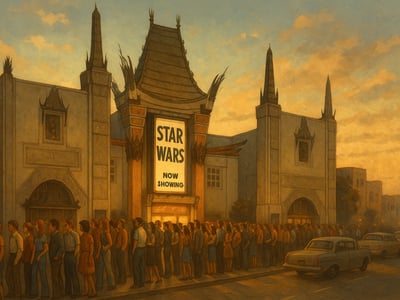
On May 25, 1977, *Star Wars* opened in U.S. theaters, beginning a theatrical run that would soon become one of the most discussed in modern film history. Directed by George Lucas and released by 20th Century-Fox, the film did not arrive everywhere at once. Its initial U.S. release was limited to 32 theaters, including Grauman's Chinese Theatre in Hollywood, with broader expansion following as audience demand became clear.
That limited opening is an important part of the story. In later decades, major studio films often arrived in thousands of theaters on the same weekend, supported by large national advertising campaigns. *Star Wars* began differently. It entered the market in a relatively restrained way, leaving its future to depend on early audience response, critical attention, and the willingness of theaters to add more screens. The release was not yet framed by the certainty that it would become a defining commercial success.
By the time it reached theaters, the project had already required unusual commitment. George Lucas had developed a space-fantasy film that did not fit neatly into the most established commercial categories of the mid-1970s. Science fiction existed in Hollywood, but a fast-moving adventure built around invented planets, mythic conflict, robots, spacecraft, and dense world-building posed practical and financial risks. The production also depended on visual effects work that pushed beyond routine studio methods.
That need helped lead to the creation of Industrial Light & Magic during production, a development that became significant not only for *Star Wars* but for later film production more broadly. The effects were not merely decorative additions. They were central to whether the film's setting and action could appear convincing enough for audiences to accept its world. If that work failed, the film's tone could easily have collapsed into something awkward or unpersuasive.
The backing of 20th Century-Fox was therefore crucial, as was the role of executives willing to continue supporting the project through uncertainty. Alan Ladd Jr. is often identified as a key figure in that process. Producer Gary Kurtz also helped bring the film to completion. By opening day, the cast—including Mark Hamill, Harrison Ford, and Carrie Fisher—appeared in a film that was introducing a new fictional setting rather than extending a known screen property with an established mass audience.
Even the title on opening day now requires a small historical clarification. In its original 1977 theatrical opening, the film was released simply as *Star Wars*. The later subtitle, *Episode IV – A New Hope*, was not part of the original opening title. That detail matters because it shows how the film's place within a larger saga was clarified and standardized over time, after the success of the original release had changed the scale of what the property could become.
At first, nothing about the release guaranteed that scale. A 32-theater launch meant that commercial momentum had to be built. Strong box-office response in the opening venues encouraged further bookings, and the film expanded nationally over the following weeks. This kind of rollout made audience reaction especially important. Instead of peaking immediately and fading, a film in limited initial release could gather strength as demand spread from one market and theater circuit to another.
That process also affected how people experienced the film as an event. Reports of long lines and repeat viewings became part of its early public identity. Theaters were not merely showing a new release; in some places they were becoming sites of visible audience enthusiasm that signaled to distributors and exhibitors that the film could support a much larger run. In this sense, the opening was both a test and a trigger. The first engagements measured interest, and the results shaped the expansion.
The success of *Star Wars* quickly reached beyond ticket sales. Its growing popularity gave greater importance to licensing, merchandise, and future sequel planning. These developments are sometimes discussed as if they were inevitable, but they depended first on the film working as a theatrical attraction. Had the initial release stalled, the later history of the series—and of related commercial strategies in Hollywood—would have looked very different.
Why it still matters
The original U.S. opening of *Star Wars* remains a useful reference point because it sits at the intersection of several changes in the film business. One is distribution strategy. The 1977 release is often used to discuss platform expansion: a film opens in a limited number of theaters, proves demand, and then expands. Although this was not a universal model, the *Star Wars* case became one of the best-known examples of how an initially limited run could become a national phenomenon.
Another reason it still matters is franchising. The film's success helped demonstrate how a movie could support not only sequels but a larger commercial system involving licensing, merchandising, and eventually cross-media storytelling. Later franchise planning across Hollywood would become far more structured, but *Star Wars* is routinely cited as a major historical turning point in that evolution.
The release also matters in production history. The making and rollout of *Star Wars* are closely tied to discussions of late-1970s visual-effects systems, especially the growth of specialized effects work as a core industrial function rather than a marginal technical service. In that sense, the opening date marks not just the arrival of a film, but the visible beginning of a production model that would have lasting consequences.
Looking back at May 25, 1977, the most striking fact may be how much depended on an uncertain first step. *Star Wars* did not enter theaters as a fully secure cultural institution. It opened as a new film on 32 U.S. screens, carrying technical ambition, commercial risk, and a story world unfamiliar to most viewers. Its later status can make that beginning seem obvious in retrospect. It was not obvious at the time, and that is precisely why the opening still holds historical interest.
Timeline
What you uncovered
From Opening to Empire
You didn't just… piece together a film release; you reconstructed the moment when a limited opening began to change how studios thought about audience scale, technology, and long-term value.
What stands out is not only that the film became successful, but that its rollout showed how growth could be staged rather than immediate. A 32-theater opening, followed by expansion, became part of a larger pattern in which exhibition strategy, effects production, and licensing were no longer separate concerns. In that sense, the release is often remembered as an early example of how a film could function as the center of a broader commercial system, not just a single theatrical event.
At its 1977 U.S. opening, the film was released simply as "Star Wars," without the later subtitle "Episode IV – A New Hope".
FAQ
When did Star Wars first open in U.S. theaters?
Star Wars began its original U.S. theatrical run on 1977-05-25. It opened in the United States before expanding to more theaters over the following weeks.
How many theaters showed Star Wars at its first release?
The film’s initial U.S. release was limited to 32 theaters. Grauman's Chinese Theatre in Hollywood was one of the opening venues.
Was the 1977 release called Star Wars or A New Hope?
The original 1977 theatrical release was titled Star Wars. The subtitle Episode IV – A New Hope was not part of that opening title.
Who directed and distributed the original Star Wars release?
George Lucas directed Star Wars, and it was released by 20th Century-Fox in 1977. The film opened in the United States on 1977-05-25.