
About this story
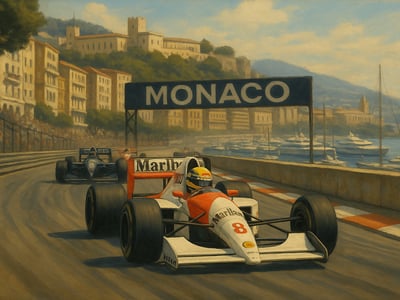
Ayrton Senna at Monaco in 1993, en route to his sixth Grand Prix win there.
On 23 May 1993, Ayrton Senna won the Monaco Grand Prix at the Circuit de Monaco in Monte Carlo, adding another chapter to one of Formula One’s most closely watched driver-circuit associations. Driving a McLaren-Ford over 78 laps on the narrow street course, he finished ahead of Damon Hill’s Williams-Renault and Jean Alesi’s Ferrari. The result gave Senna his sixth victory in the Monaco Grand Prix, a total that stood out immediately in the record of the event.
Monaco has long occupied a particular place in Formula One. Unlike many permanent racing circuits, it runs through the streets of the principality, with barriers close to the track, little margin for error, and few realistic overtaking opportunities. That means races there are shaped not only by outright speed but by precision, concentration, and the ability to manage traffic and rhythm over a long afternoon. A strong position can be difficult to gain, but once secured it can be just as difficult to challenge.
That setting helps explain why repeat success at Monaco has always drawn attention. To win there once requires accuracy and control. To win there repeatedly suggests a sustained ability to adapt to the same demanding conditions year after year, even as cars, competitors, and championship circumstances change. By 1993, Senna had already become strongly associated with the race through his earlier victories, and each return to Monaco added to that connection.
The 1993 season provided its own context. Formula One was in a period of intense technical competition, and McLaren was no longer operating from the same position of clear advantage it had enjoyed in some earlier years. Senna remained one of the leading figures in the championship, but the field around him was formidable. In Monaco, however, the special characteristics of the circuit often compressed differences and made race management especially important. Mechanical reliability, tire care, clean passage through traffic, and absolute consistency could matter as much as raw pace.
From the start of the 78-lap race, those familiar Monaco demands were in place. Drivers had to measure risk carefully. On a street circuit, a minor mistake can end a race instantly, while an overambitious move can damage a car or cost track position that may be impossible to recover. For the leader, the challenge is slightly different but no less exacting: maintaining a pace quick enough to stay in control while preserving the car and avoiding trouble with backmarkers and lapped traffic.
Senna’s drive on that day followed the pattern of many successful Monaco performances: disciplined, controlled, and free of the errors that the circuit punishes so quickly. The race distance itself was part of the test. Seventy-eight laps around Monaco mean repeated braking, constant steering input, and unbroken attention through corners that arrive one after another with almost no pause. Unlike circuits with wider run-off areas or longer straights, Monaco allows little time to reset. A driver must stay precise from opening laps to checkered flag.
Behind Senna, Damon Hill finished second, giving Williams-Renault another strong result in a season in which the team remained central to the championship picture. Hill was still in the early phase of his Formula One career, and a podium in Monaco was a significant finish at one of the calendar’s most technical venues. Jean Alesi took third for Ferrari, completing a podium made up of three prominent names from the period and underlining the competitive depth of the field.
Yet the defining fact of the afternoon was Senna’s total. A sixth Monaco win was more than another entry in a seasonal results table. It reinforced the sense that some drivers become linked with particular places in a way that goes beyond a single race result. Monaco, with its visibility, history, and unusual demands, has often served as a stage for that kind of connection. Senna’s performance there in 1993 strengthened an association already familiar to followers of the sport.
It is also important to note what such a result did and did not mean. It did not make Monaco an easy race for him, nor did it reduce the event to a matter of reputation. The circuit remained hazardous and exacting, and any mechanical problem, driving error, or loss of position could have changed the outcome. What the victory showed was that over time Senna repeatedly met the same challenge successfully in conditions where repetition is difficult to achieve.
In Formula One history, records are often discussed in terms of world championships, total wins, poles, or fastest laps. But some of the sport’s most enduring statistics are narrower and more place-specific. Repeated victories at a single Grand Prix can reveal something distinctive about the interaction between a driver’s style and a circuit’s character. Monaco has always been one of the clearest examples because its demands are so recognizable and so resistant to simplification.
Why it still matters
Senna’s win on 23 May 1993 still matters because it remains part of how Formula One measures repeated success at one venue. The Monaco Grand Prix continues to be cited in discussions of track position, precision driving, and race management on street circuits, and this result is one of the standard reference points in that history.
It also helps explain why certain driver-venue pairings endure in motorsport memory. Fans, broadcasters, statisticians, and historians often return to Monaco when discussing what separates a merely fast lap from a complete race performance. The 1993 result is part of that conversation not because it stands alone, but because it confirmed a pattern.
For that reason, the race remains easy to place in the wider record of the sport. Senna in a McLaren-Ford, Monaco’s 78 laps, Hill second, Alesi third, and a sixth win at the same Grand Prix: those facts are straightforward, but together they show how a single afternoon can strengthen a legacy already in formation. In Formula One, where context matters almost as much as the finishing order, Monaco in 1993 remains one of the clearest examples.
Timeline
- 1993 Formula One World Championship
- Monaco Grand Prix
What you uncovered
Why Monaco Wins Stand Apart
You didn't just…complete a racing result; you reconstructed a moment that helped define how Formula One measures mastery at Monaco.
At Monaco, a win is often read as more than raw speed because the circuit gives drivers so few chances to recover from small mistakes or lost track position. On a narrow street layout with limited overtaking, precision, timing, and control over traffic can matter as much as outright pace. That is why repeat success there carries a distinct meaning in Formula One history. It becomes part of how the sport talks about driver-circuit relationships, not just season results.
Senna's win on 23 May 1993 was his sixth victory in the Monaco Grand Prix, all recorded within the Formula One World Championship.
FAQ
What happened at the Monaco Grand Prix on 23 May 1993?
On 23 May 1993, the Monaco Grand Prix was held at Circuit de Monaco as part of the 1993 Formula One World Championship. Ayrton Senna won the 78-lap race in a McLaren-Ford.
How many times did Ayrton Senna win Monaco?
Senna's win on 23 May 1993 was his sixth victory in the Monaco Grand Prix. That result added to his record of success at the circuit.
Who finished on the podium in Monaco in 1993?
Ayrton Senna finished first, Damon Hill finished second for Williams-Renault, and Jean Alesi finished third for Ferrari. Those were the top three finishers in the race.
Where was the 1993 Monaco Grand Prix held?
The race was held at Circuit de Monaco in Monte Carlo, Monaco. It took place on the narrow street circuit used for the Monaco Grand Prix.