
About this story
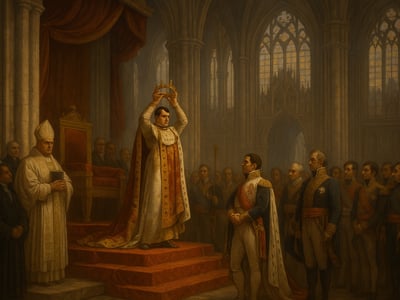
Napoleon Bonaparte's coronation in Milan Cathedral, 26 May 1805.
On 26 May 1805, Napoleon Bonaparte was crowned King of Italy in Milan Cathedral, in a ceremony meant to give public form and symbolic weight to a political change already made on paper. Two months earlier, on 17 March 1805, the Italian Republic had been transformed into the Kingdom of Italy, placing northern Italy under a new monarchical structure tied directly to Napoleon's wider imperial system. The coronation in Milan did not create that state by itself, but it made the new arrangement visible through ritual, place, and regalia.
The choice of Milan mattered. It was the capital of the Napoleonic Kingdom of Italy and the political center of the territory Napoleon controlled there. Holding the ceremony in Milan Cathedral linked the new kingdom to one of the most prominent public spaces in the region. At a time when the Napoleonic Wars were reshaping European borders and institutions, ceremony was not a decorative extra. It was one way of presenting military power as settled government.
That was the central challenge Napoleon faced in Italy in 1805. French victories and influence had already remade the political map of northern Italy, but conquest alone did not automatically produce a durable state. A republic established under French influence could be reorganized by decree, yet a kingdom required its own language of authority, hierarchy, and continuity. The new crown needed to look established, not improvised.
For that reason, the coronation drew on older symbols as well as new institutions. The best known of those symbols was the Iron Crown of Lombardy, used in the ceremony at Milan. Its presence connected the new kingdom to a much older tradition of rule in the region. Napoleon was not simply announcing a constitutional adjustment; he was presenting himself as the holder of a crown with historical resonance in northern Italy. In this way, the ceremony joined recent political transformation to inherited royal symbolism.
The event also echoed, but did not duplicate, Napoleon's imperial coronation in Paris on 2 December 1804. In Paris, Pope Pius VII was present when Napoleon was crowned Emperor of the French. In Milan, however, the pope was not the crowning figure. The Italian coronation therefore emphasized a different balance of authority. It was not centered on papal action, but on Napoleon's own claim to rule and on the political order he had constructed.
That distinction mattered because Napoleon's authority in Italy rested on several layers at once. There was the reality of French military predominance. There was the constitutional transformation of the Italian Republic into a kingdom. And there was the effort to express all of that in a public ceremony that suggested legitimacy, continuity, and permanence. By assuming the Italian crown personally in Milan rather than delegating the role or leaving the new kingdom under a more distant arrangement, Napoleon fused those layers into a single image: conqueror, monarch, and lawgiver at once.
Yet the coronation did not solve every problem. Ceremonial legitimacy could strengthen a regime, but it could not by itself guarantee local acceptance or administrative effectiveness. The Kingdom of Italy had to be governed, staffed, taxed, and defended. It needed functioning institutions as much as impressive symbols. This was one reason why the settlement of power continued after the ceremony. On 7 June 1805, Eugène de Beauharnais was appointed viceroy of the Kingdom of Italy, helping to manage the new state in Napoleon's name.
That appointment showed how the kingdom was meant to work in practice. Napoleon would remain the central source of authority, but the day-to-day demands of rule required trusted intermediaries and a more stable administrative framework. The new kingdom was therefore both dynastic and bureaucratic: a monarchy presented through old regalia and public ritual, but also a state shaped by Napoleonic governance. Northern Italy under this system saw reforms in administration and law that reflected the broader Napoleonic pattern of centralization.
Even so, it is important not to confuse ceremony with consent. The coronation gave Napoleon's rule a formal and historical appearance, but it rested within a wider context of French dominance during wartime. For contemporaries, the event could be read in different ways: as the founding act of a reorganized state, as a practical assertion of control, or as another stage in imperial expansion. Those interpretations have remained part of the historical discussion ever since.
Why it still matters
Napoleon's coronation as King of Italy remains important because it shows how power in early nineteenth-century Europe was often consolidated. Military success alone rarely seemed sufficient. Rulers also sought constitutions, titles, ceremonies, and recognizable symbols to turn victory into government. The Milan coronation is a clear example of that process.
It also helps explain how older traditions could be used to support new political structures. By employing the Iron Crown of Lombardy, Napoleon attached a recently created kingdom to a longer regional past. This did not erase the novelty of the regime, but it made the new order easier to present as legitimate and intelligible. Across Europe, Napoleonic rule frequently combined innovation with appropriation of existing institutions and symbols.
Finally, the event matters because it forms part of the wider reorganization of northern Italy under Napoleonic rule. The Kingdom of Italy was not simply a title added to Napoleon's list. It was a state with its own administration, its own governing framework, and its own place in the changing political landscape of the Napoleonic Wars. Although that kingdom did not survive the collapse of Napoleon's power after 1814, the structures and precedents of the period left a lasting mark on the history of the region.
The ceremony in Milan Cathedral on 26 May 1805 therefore stands as more than a royal spectacle. It was a carefully staged moment in which conquest, symbolism, and administration were brought together to define a new political order in Italy.
Timeline
What you uncovered
Symbols of a New Kingdom
You didn't just…complete a history puzzle; you traced how Napoleon turned military control in northern Italy into a public display of political legitimacy.
The coronation mattered not only because a crown was placed on Napoleon's head, but because the ceremony borrowed the authority of older Lombard kings for a state that had only just been created. Using familiar regalia helped present institutional change as continuity rather than rupture. That pattern appears often in state-building: new regimes rarely rely on force alone when they can also claim inherited symbols, laws, and ceremonies. In northern Italy, this helped connect Napoleonic rule to a broader administrative and legal reordering that outlasted the ceremony itself.
On 7 June 1805, Eugène de Beauharnais was appointed viceroy of the Kingdom of Italy to govern there in Napoleon's name.
FAQ
What happened in Milan on 26 May 1805?
On 26 May 1805, Napoleon Bonaparte was crowned King of Italy in Milan Cathedral in Milan. The ceremony marked the formal start of the Napoleonic Kingdom of Italy.
Where was Napoleon crowned King of Italy?
He was crowned in Milan Cathedral in Milan, which was the capital of the Napoleonic Kingdom of Italy. The ceremony took place there on 26 May 1805.
What was the Iron Crown of Lombardy used for?
The Iron Crown of Lombardy was used in Napoleon’s coronation as King of Italy. Its use linked the new kingdom to older Lombard royal symbolism.
Did Napoleon crown himself King of Italy?
Yes. On 26 May 1805, Napoleon Bonaparte personally took the crown in Milan Cathedral rather than having another crowning figure do it for him.
What changed after the coronation?
The Kingdom of Italy had already been created on 17 March 1805, and the coronation gave it ceremonial legitimacy. Eugène de Beauharnais was appointed viceroy on 7 June 1805 to help govern it in Napoleon’s name.