
About this story
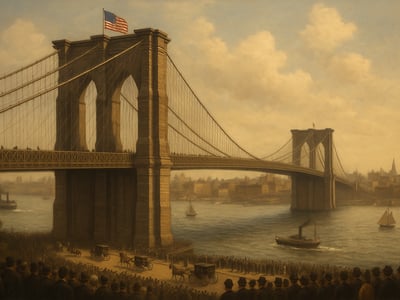
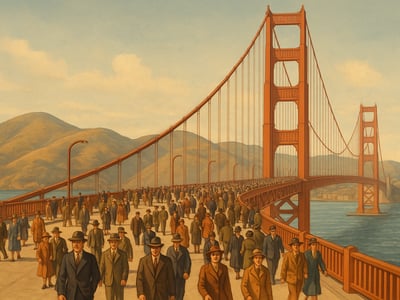
Golden Gate Bridge at its public opening in San Francisco, 27 May 1937
Video puzzle
On May 27, 1937, the Golden Gate Bridge opened to the public for a full day of pedestrian crossings in San Francisco, California, one day before regular motor traffic began. For years the project had been argued over, financed with difficulty, and built under demanding conditions at the Golden Gate strait. When the bridge finally welcomed people on foot, it marked more than the completion of a structure: it was the moment a debated engineering project became a shared public reality.
The bridge linked San Francisco and Marin County across a stretch of water known for wind, fog, currents, and constant marine movement. These conditions had long made the idea of a fixed crossing seem formidable. Ferries had provided the main connection, but the growth of the region kept the question alive: could a permanent link be built across one of the most difficult gateways on the California coast?
By the 1920s and early 1930s, the answer began to take shape through planning, political agreement, and financing. None of that was simple. Large infrastructure projects rarely move forward on engineering alone, and the Golden Gate Bridge was no exception. Supporters had to persuade officials, investors, and the public that the crossing was worth the cost and the risk. The economic pressures of the era made that challenge even greater.
Construction began in 1933. Joseph B. Strauss served as chief engineer of the project, while Leon S. Moisseiff and Charles Alton Ellis were associated with the bridge's structural design development. Irving F. Morrow contributed the bridge's Art Deco styling and played an important role in its color decisions, elements that helped shape how the structure would be seen as both infrastructure and landmark.
As work advanced, the bridge became an increasingly visible presence over the strait. Its towers, cables, and suspended roadway represented a major technical effort. At the time of its opening, the bridge had a total length of about 1.7 miles, or 2.7 kilometers, and its main span was the longest in the world for a suspension bridge. That record mattered not just as a statistic, but as evidence that engineers were extending the scale at which such structures could be built and trusted.
Still, a bridge is not fully proven by drawings, calculations, or even by its near-completion. It must enter public use. That gave the opening plan particular significance. Project leaders chose to allow a public pedestrian crossing day on May 27 before opening the bridge to vehicles on May 28. The decision gave ordinary people the first experience of the new structure. Instead of immediately becoming a route for cars and trucks, the bridge first became a place people could walk across, look from, and test with their own senses.
That opening day drew large crowds. People crossed on foot in numbers that demonstrated both curiosity and confidence. They were not simply observing from a distance; they were participating in the transition from construction project to functioning public work. The event also had a practical dimension. A heavily discussed and expensive project needed public trust as well as formal completion. A successful pedestrian opening helped show that the bridge was ready to be used, occupied, and accepted.
The setting itself added to the importance of the moment. The Golden Gate strait had shaped movement around the Bay Area for generations. To cross it on foot over a suspended roadway, high above the water, meant encountering a new relationship between geography and transport. What had been a barrier managed mainly by boats was becoming a routine overland connection.
The following day, May 28, 1937, regular vehicle traffic began using the bridge. With that step, the Golden Gate Bridge shifted from public spectacle to transportation link. Cars, buses, and commercial traffic could now move directly between San Francisco and Marin County across the strait. The opening did not erase earlier disputes over planning, costs, and benefit, but it did establish the bridge as a working part of regional infrastructure.
Its visual form helped ensure that it would be remembered beyond its immediate transport function. Yet the reason the bridge mattered in 1937 was not only aesthetic. It answered a long-standing practical problem of connection and travel. It also showed how large public works depend on more than engineering skill alone. Financing, political organization, labor, design choices, and public confidence all had to align.
Why it still matters
The opening of the Golden Gate Bridge remains important because it shows how major public works reshape regions. Once in service, the bridge changed travel patterns between San Francisco and the northern counties by providing a direct crossing where water had previously imposed delay and dependence on ferry service. Infrastructure on that scale does not merely shorten trips; it can alter settlement, commerce, and everyday movement.
The bridge also remains a reference point in the history of suspension engineering. Its main span was historically notable at the time of opening, and the project is still discussed as an example of how design ambition and structural calculation met the practical demands of a harsh site. The challenges of wind, marine conditions, and scale make it a continuing case study in civil engineering history.
Just as importantly, the bridge's opening illustrates that infrastructure gains legitimacy through public use. Plans, financing packages, and technical achievements may bring a project to completion, but acceptance comes when people begin to rely on it. The pedestrian opening day on May 27, 1937, captured that transition clearly. Before the bridge became ordinary, it had to become trusted.
That combination of technical significance, civic identity, and practical function explains why the Golden Gate Bridge still occupies a large place in public memory. It is remembered as a landmark, but it endured because it worked as infrastructure.
Timeline
- Golden Gate Bridge construction start
- Golden Gate Bridge public pedestrian opening
- Golden Gate Bridge opens to vehicle traffic
What you uncovered
When a Bridge Became Trusted
You didn't just… complete a picture; you traced the moment a debated structure began to earn public trust as a working crossing.
The pedestrian opening mattered because infrastructure does not become fully real when engineers finish it, but when the public begins to rely on it. Letting ordinary people cross first turned technical achievement into a shared test of confidence. That helped shift the bridge from a contested, expensive project into part of the region's everyday transportation system.
Regular motor-vehicle traffic on the Golden Gate Bridge began on 1937-05-28, the day after the public pedestrian opening.
FAQ
What happened on May 27, 1937, at the Golden Gate Bridge?
On 1937-05-27, the Golden Gate Bridge opened for a public pedestrian crossing day in San Francisco, California. Regular vehicle traffic began the following day.
Where does the Golden Gate Bridge connect?
The bridge connects San Francisco and Marin County across the Golden Gate strait. It is located in California, United States.
Who were the main engineers and designers of the bridge?
Joseph B. Strauss served as chief engineer of the Golden Gate Bridge project. Charles Alton Ellis and Leon S. Moisseiff were associated with its structural design development, and Irving F. Morrow is credited with its Art Deco styling and color decisions.
Why did the bridge open to pedestrians before cars?
Project leaders used the pedestrian opening day to let the public cross the bridge before normal vehicle service began. It was a way to present the completed bridge and build confidence in the new crossing.
What was notable about the Golden Gate Bridge's main span in 1937?
At the time it opened, the bridge's main span was the world's longest. The total length of the bridge is about 1.7 miles, or 2.7 km.