

About this story
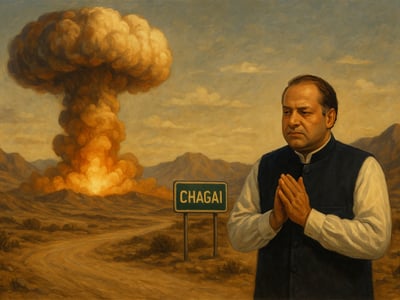
Pakistan’s 28 May 1998 nuclear tests at Chagai in Balochistan
On May 28, 1998, Pakistan announced that it had carried out underground nuclear tests in the Ras Koh Hills of Chagai District, in Balochistan. The declaration, delivered by Prime Minister Nawaz Sharif, came just over two weeks after India’s Pokhran-II tests on May 11 and 13. Although Pakistan’s nuclear program had long been suspected abroad, the events at Chagai marked the moment when that capability was presented publicly and unmistakably to the world.
The timing mattered as much as the detonations themselves. India’s tests had altered the regional atmosphere in a matter of days, creating pressure on Pakistan’s political and military leadership to decide whether to respond, and how quickly. A delayed answer risked being read as hesitation or incapacity. But a rushed one carried its own dangers: technical failure, diplomatic isolation, and economic penalties were all plausible outcomes.
Pakistan’s decision was made under unusually compressed conditions. The state had to move from longstanding ambiguity to a public act that could not be withdrawn. That required more than political resolve. Preparations at a remote test site in southwestern Pakistan had to be completed under secrecy, in difficult terrain, and in the presence of intense international scrutiny. The challenge was both logistical and symbolic. The tests had to work, and they had to be understood to have worked.
Public discussion of Pakistan’s nuclear effort often centers on figures such as Abdul Qadeer Khan and Samar Mubarakmand, both closely associated in different ways with the country’s strategic and scientific establishment. Yet on May 28 itself, the decisive public role belonged to the head of government. Sharif’s announcement transformed the event from a hidden military-scientific undertaking into a formal act of state policy. Once declared, the tests became not only a technical achievement but also a diplomatic fact.
That distinction is important. Before Chagai, Pakistan’s capability was debated, inferred, and assessed through intelligence estimates, procurement patterns, and years of strategic suspicion. After Chagai, the ambiguity narrowed sharply. Pakistan had chosen to present itself as a nuclear-armed state in explicit response to a changing regional balance. In that sense, the tests were not simply explosions underground; they were a signal aimed at multiple audiences at once: India, domestic opinion, major powers, and international institutions concerned with nuclear proliferation.
The immediate regional context was clear. India’s May 1998 tests had already drawn international concern and set off a round of diplomatic reactions. Pakistan now faced a decision window in which inaction would also send a message. For its leaders, the issue was not only whether the country possessed a capability, but whether leaving it undeclared after Pokhran-II would weaken deterrence at a critical moment. The tests at Chagai were therefore interpreted, both inside and outside Pakistan, as an attempt to establish strategic parity in overt form.
The announcement did not end the story. It began a new phase. International criticism followed quickly, as did sanctions. The United States imposed sanctions on Pakistan in 1998 under the Glenn Amendment, mirroring the punitive framework that had also been applied after India’s tests. The broader international response included renewed debate over nonproliferation, regional security, and the limits of sanctions as a tool of pressure. The tests also fed directly into discussions at the United Nations, where concern centered on the risk of a more dangerous South Asian arms competition.
Two days later, on May 30, Pakistan conducted another nuclear test in Kharan District. Sources often distinguish this later event from the May 28 Chagai tests, and careful accounts keep the dates and locations separate. The distinction matters because public memory can compress the sequence, but contemporaneous reporting and official timelines treated them as related yet distinct events within the same tense week.
In Pakistan, May 28 later acquired lasting symbolic significance and came to be commemorated as Youm-e-Takbir. Internationally, however, the meaning of the date has remained tied less to celebration than to strategic consequence. Chagai fixed Pakistan’s place in the overt nuclear order of South Asia. It also narrowed the space for regional ambiguity. From that point onward, crises between India and Pakistan unfolded against the background of declared nuclear capability on both sides.
Why it still matters
The tests of May 28, 1998, remain important because they formalized an overt nuclear deterrence relationship in South Asia. Before 1998, ambiguity left room for inference and uncertainty. After India’s and Pakistan’s tests, military planning and crisis management had to account for publicly demonstrated nuclear status. That altered the structure of regional security in ways that continue to shape policy.
The episode also remains a reference point in debates over nonproliferation and sanctions. Pakistan’s tests, like India’s earlier that month, raised difficult questions about how the international system responds when a state converts a long-suspected capability into an open declaration. The sanctions that followed showed one kind of response, but they also illustrated the limits of external pressure once a government decides that strategic signaling outweighs expected costs.
Finally, May 28 endures because it demonstrated how quickly a regional rivalry can move from ambiguity to irreversible public escalation. The event is still studied not only for what happened underground in the Ras Koh Hills, but for the political decision surrounding it: in a narrow span of days, a covertly understood capability became an openly claimed deterrent, with consequences that have lasted far beyond 1998.
Timeline
- India Pokhran-II nuclear test
- India Pokhran-II nuclear test
- Pakistan nuclear tests
- Pakistan announcement of nuclear tests
- Pakistan Kharan nuclear test
What you uncovered
When Secrecy Became Signal
You didn't just… complete a date puzzle; you traced the moment Pakistan turned a long-suspected capability into an explicit public signal under intense regional pressure.
What changed here was not only military capability but political visibility. Once the tests were publicly announced, ambiguity gave way to a declared deterrent relationship, and that altered how rivals, allies, and sanctions regimes responded. The timing mattered as much as the event itself: acting within days of India’s tests made speed part of the message. That is why 28 May 1998 remains important in discussions of crisis management and nonproliferation, not only in South Asia but more broadly.
The United States imposed sanctions on Pakistan in 1998 under the Glenn Amendment after the tests.
FAQ
What happened on 28 May 1998 in Pakistan?
On 28 May 1998, Pakistan carried out underground nuclear tests at the Chagai test site in the Ras Koh Hills, Chagai District, Balochistan. Prime Minister Nawaz Sharif announced the tests to the nation the same day.
Where were Pakistan’s 1998 nuclear tests conducted?
The tests were conducted at the Chagai test site in the Ras Koh Hills, in Chagai District, Balochistan. The site was a remote area in southwestern Pakistan.
Why did Pakistan conduct the tests after India’s Pokhran-II?
India conducted the Pokhran-II nuclear tests on 11 May and 13 May 1998, which created the immediate regional context for Pakistan’s decision. Pakistan then chose to respond with its own tests on 28 May 1998.
What did Nawaz Sharif do on 28 May 1998?
Nawaz Sharif addressed the nation on 28 May 1998 to announce that Pakistan had carried out the tests. His announcement made the event public domestically and internationally.
What happened after Pakistan’s May 1998 nuclear tests?
The United States imposed sanctions on Pakistan in 1998 under the Glenn Amendment following the tests. The events also became a major reference point in India-Pakistan deterrence discussions.