

About this story
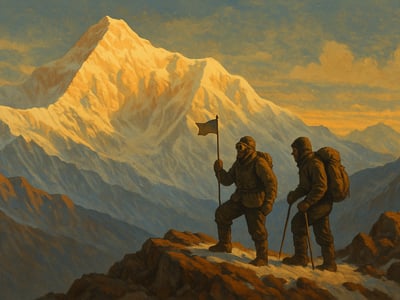
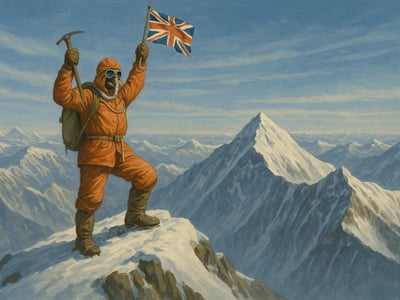
Hillary and Tenzing Norgay after the 29 May 1953 Everest summit ascent.
Video puzzle
On 29 May 1953, Edmund Hillary and Tenzing Norgay reached the summit of Mount Everest during the British expedition led by John Hunt. The mountain, on the Nepal-Tibet frontier in the Himalayas, had long stood at the center of repeated attempts, setbacks, and debate about whether its highest point could be reached at all. Their success quickly became one of the most widely recognized moments in the history of mountaineering, but it was not a sudden breakthrough. It came at the end of years of route finding, logistical planning, and earlier climbs that had shown where progress was possible and where it was not.
Everest had been approached for decades before 1953. Early British expeditions from the north, through Tibet, helped map the mountain and identify potential routes, but they also showed how difficult the final stages of the climb would be. The 1921 reconnaissance provided important geographical knowledge, and the 1924 expedition entered mountaineering history through the deaths of George Mallory and Andrew Irvine high on the mountain. Those earlier efforts did not produce a confirmed summit, but they established Everest as a problem that would demand not only strong climbers but also a large and carefully organized expedition.
By the early 1950s, the southern side of Everest had become increasingly important. A 1951 reconnaissance from Nepal gave climbers a much better sense of the route through the Khumbu Icefall and toward the South Col. The 1952 Swiss expeditions built further experience on that line and showed that a summit bid from the south was realistic. Tenzing Norgay had taken part in the Swiss climbing efforts, so when he joined the 1953 British expedition, he brought direct knowledge of the mountain's upper reaches as well as extensive Himalayan climbing experience.
John Hunt's expedition was organized in a systematic way. Camps had to be established progressively higher on the mountain. Loads of food, fuel, tents, and oxygen equipment had to be moved upward by teams of climbers and porters. At those altitudes, planning was not an administrative detail but a condition of survival. A summit attempt depended on many people doing precise work over many days: fixing route sections, ferrying equipment, preserving strength, and deciding how best to deploy limited supplies.
Oxygen strategy was especially important. Above 8,000 meters, the body is under extreme strain, and even basic movement becomes difficult. The expedition had to balance the weight of oxygen apparatus against the advantages it gave to summit climbers. It also had to decide which pairs would make the final attempts. Those choices were not simply a matter of identifying the strongest climbers; they were also shaped by timing, acclimatization, equipment, and the conditions developing on the mountain.
A key moment came on 28 May 1953, when Tom Bourdillon and Charles Evans made an earlier summit attempt. They climbed strongly and got to within reach of the top, but they turned back below the summit. Their retreat was an important reminder of how narrow the margin for success remained. The expedition had expended effort and supplies, and the weather window was limited. The route had been pushed high, but the mountain was still unconquered.
That left Hillary and Tenzing as the next summit pair. Their task was shaped by what the expedition had already learned and by what could still go wrong. A blocked route, failing oxygen equipment, sudden exhaustion, or deteriorating weather could have ended the attempt. From high camp on 29 May, they climbed upward in the so-called death zone, where altitude itself becomes a constant threat. Every decision mattered: pace, energy, footing, and the use of oxygen.
Their ascent included a steep rock step near the summit ridge that became one of the best-known features of the climb. Beyond it, the final ground led to the highest point on Earth. Hillary and Tenzing reached the summit and spent a short time there before beginning the descent. In mountaineering terms, that descent was part of the achievement. A summit only became a confirmed success if the climbers returned safely with a coherent account of what they had done.
Public attention later often focused on simple questions, especially who stepped first. Contemporary and later source-based accounts, however, present the climb as a joint ascent. That framing is important because the event emerged from a team expedition in which credit was never limited to one moment on the ridge. Hunt's leadership, the work of earlier summit teams, the labor of those moving supplies upward, and the experience accumulated from previous expeditions all formed part of the outcome. The summit photograph and later reporting made Hillary and Tenzing the public faces of the success, but the expedition itself was larger than two men.
News of the ascent traveled quickly and was received with enormous public interest in 1953. The climb was widely reported through newspapers, photographs, and later memoirs. Tenzing Norgay published his own account in 1955 in *Tiger of the Snows*, helping shape how the ascent would be remembered beyond the first burst of headlines. Over time, the story of Everest in 1953 became fixed in popular memory as a moment of endurance and achievement, yet the reality was more procedural and collective than legend sometimes suggests.
Why it still matters
The 1953 ascent remains a reference point because it showed how high-altitude success depended on far more than bravery. Expedition logistics, camp placement, oxygen planning, and summit team structure were all central to the outcome. Later Himalayan expeditions, even when they differed in style or technology, continued to engage with questions that were clearly visible on Everest in 1953.
The climb also shaped public understanding of Himalayan mountaineering. For many people around the world, Everest became knowable through the reports, images, and personal accounts that followed the expedition. Those narratives helped define what an extreme mountain expedition looked like, from the long approach and staged camps to the compressed drama of the final push.
It still matters as well because it is often discussed as an example of how credit works in team achievements. Hillary and Tenzing reached the summit together, but their success depended on a broader structure of labor, leadership, and prior knowledge. That makes the event useful not only as a mountaineering milestone, but also as a historical case in how famous achievements are built.
Seen that way, 29 May 1953 was not just the day Everest was climbed. It was the day a long chain of reconnaissance, failed attempts, technical judgment, and coordinated effort finally held together all the way to the top and back.
Timeline
What you uncovered
Beyond the Final Steps
You didn't just… complete a mountain puzzle; you traced a moment that depended on planning, judgment, and a successful return from the highest point on Earth.
The summit is often remembered as a single image: two climbers standing at the top. But the ascent was really the visible end of a longer process shaped by reconnaissance, earlier failures, route knowledge, camp organization, and decisions about oxygen and team order. That is part of why the climb still matters: it shows how exploration is often credited to a final pair even when success depends on a much larger chain of work behind them.
On 28 May 1953, Tom Bourdillon and Charles Evans turned back below the summit during an earlier attempt, leaving Hillary and Tenzing Norgay as the next summit team.
FAQ
What happened on 29 May 1953 on Mount Everest?
On 29 May 1953, Edmund Hillary and Tenzing Norgay completed the summit ascent of Mount Everest. Their climb was part of the 1953 British Mount Everest expedition led by Colonel John Hunt.
Who led the 1953 British Everest expedition?
The 1953 British Mount Everest expedition was led by Colonel John Hunt. Hillary and Tenzing were the summit pair on the successful climb.
What happened before Hillary and Tenzing reached the summit?
On 28 May 1953, Tom Bourdillon and Charles Evans made a strong summit attempt but turned back below the top. That left the expedition with limited time and pressure on the next summit team.
How did the South Col route help the 1953 ascent?
The expedition used the South Col route from Nepal. It built on reconnaissance from 1951 and climbing experience gained during the 1952 Swiss expeditions.