
About this story
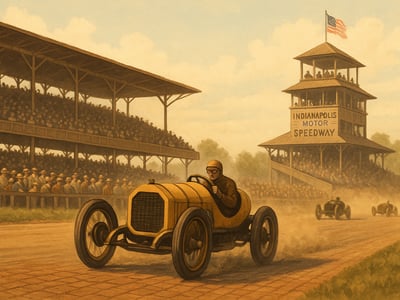
Ray Harroun won the 1911 500-mile race at Indianapolis Motor Speedway.
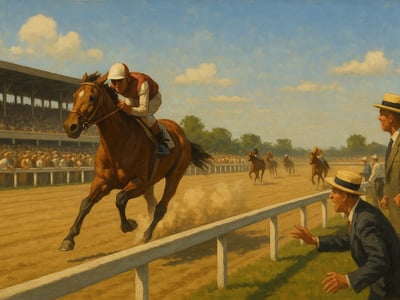
On May 30, 1911, the first Indianapolis 500 was held at Indianapolis Motor Speedway in Speedway, Indiana, near Indianapolis. Officially titled the International 500-Mile Sweepstakes, the race covered 200 laps of the speedway’s 2.5-mile oval, for a total of 500 miles. By the end of the day, Ray Harroun had driven the Marmon Wasp to victory in 6 hours, 42 minutes, and 8 seconds, averaging about 74.6 miles per hour.
That result gave the new event a clear winner, but the larger significance lay in the format itself. A 500-mile race asked more of drivers, cars, and organizers than the shorter contests that had often defined early automobile competition. Speed still mattered, but so did endurance, fuel use, tire wear, mechanical reliability, and the ability to keep a car running efficiently over many hours.
Indianapolis Motor Speedway had opened in 1909. Its founders, including Carl G. Fisher, James A. Allison, Arthur Newby, and Frank Wheeler, intended the facility to serve both as a proving ground for the growing automobile industry and as a major public sporting venue. The speedway’s early history had already shown how demanding motor racing could be. By 1911, the track’s brick-paved surface had become one of its defining features, giving rise to the nickname “the Brickyard” and providing a more durable racing surface than many roads of the time.
The 1911 race was designed as a major Memorial Day event, and it drew a large paying crowd. That public response mattered. Auto racing in the early twentieth century was not only a technical exercise but also a commercial spectacle. Promoters needed an event that was simple to describe, easy to market, and substantial enough to justify a day at the track. A 500-mile race met those needs. It was long enough to feel like a true test, but structured enough for spectators to follow its progress lap after lap.
For the competitors, the challenge was practical as much as dramatic. Early racing cars operated under severe limits by modern standards. Drivers had to manage rough conditions, heat, fatigue, and constant vibration. Teams had to decide how hard to push, when to stop, and how to avoid damaging the car before the finish. In a race of this length, outright pace could be wasted if a machine proved fragile or if pit decisions went wrong.
Harroun’s victory reflected that balance between speed and control. Driving the Marmon Wasp for the full 500 miles, he maintained the kind of sustained performance the race format demanded. The official time of 6:42:08 was not simply a record of fast laps; it was evidence that the car and driver could endure the entire distance without losing the larger contest to breakdowns, delays, or exhaustion.
The race also helped define the speedway itself. A purpose-built oval with a fixed distance per lap made the event legible in a way many earlier road races were not. Organizers could count progress precisely, record elapsed time clearly, and present the competition as a measured test rather than a loosely staged exhibition. That mattered for legitimacy. A race with a known distance, repeated laps, and a clear finishing order gave newspapers and spectators a straightforward story to follow.
Even the winning average speed, around 74.6 miles per hour, carried meaning beyond the number. In 1911, maintaining that pace over 500 miles on a brick surface required engineering consistency as well as driver judgment. It suggested that automobile competition was becoming not just faster, but more organized and more technically disciplined.
The first Indianapolis 500 therefore stood at the meeting point of several developments at once: the rise of purpose-built racing facilities, the increasing public appetite for spectator sport, and the automobile industry’s interest in performance as a public demonstration. It was not merely another race on the calendar. It established a model that could be repeated.
Why it still matters
The 1911 Indianapolis 500 still matters because it helped fix the basic logic of endurance-style automobile racing at a major venue. Distance became central to the contest. Winning was not only about who could produce the single fastest burst of speed, but who could manage time, stops, machinery, and stamina across a long, predetermined course.
It also strengthened Indianapolis Motor Speedway as a recurring center of American motorsport. Once the 500-mile format proved successful, the track was no longer just a new facility seeking attention. It became associated with a specific annual event that audiences could anticipate and recognize.
More broadly, the race showed how early motor sport joined engineering display with mass entertainment. Manufacturers and teams demonstrated what cars could do, while promoters sold the event as a full-scale public occasion. That combination would shape much of twentieth-century racing culture.
When Harroun crossed the finish line on May 30, 1911, he won more than a single competition. The day confirmed that a long-distance race at Indianapolis could work as sport, as spectacle, and as a durable tradition.
Timeline
- Indianapolis Motor Speedway opens
- First Indianapolis 500
What you uncovered
When Racing Became Endurance
You didn't just… complete a motorsport milestone; you traced the moment when racing began to depend as much on sustained judgment and machine management as on speed.
A 500-mile format changed the logic of competition by making survival, timing, and consistency central to the result. That pushed racing away from brief spectacle and toward a system built around pit decisions, mechanical limits, and the design of a venue able to host a long event. It also helped tie automobile racing to ticketed mass entertainment, where the track itself became part of the experience.
The 1911 race was 200 laps of a 2.5-mile oval, for a total distance of 500 miles.
FAQ
When was the first Indianapolis 500 held?
The first Indianapolis 500 took place on 1911-05-30. It was run at Indianapolis Motor Speedway in Speedway, Indiana.
Who won the first Indianapolis 500?
Ray Harroun won the race. He drove the Marmon Wasp to victory.
How long was the 1911 Indianapolis 500?
The race covered 200 laps of the 2.5-mile oval, for a total of 500 miles. Harroun finished in 6 hours 42 minutes 8 seconds.
Where did the first Indianapolis 500 take place?
It was held at Indianapolis Motor Speedway in Speedway, Indiana, near Indianapolis. The track had opened in 1909 and was using its brick-paved racing surface by 1911.