
About this story
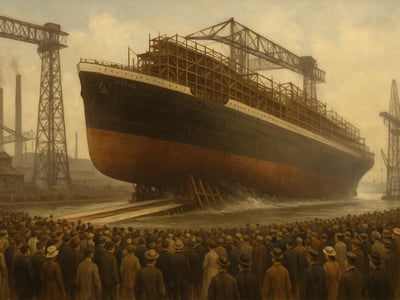
On 31 May 1911, RMS Titanic was launched in Belfast. The launch marked a major public milestone in building one of White Star Line’s Olympic-class ocean liners.
RMS Titanic at its 1911 launch period at Harland and Wolff, Belfast
Video puzzle
On 31 May 1911, thousands gathered at the Harland and Wolff shipyard in Belfast to watch RMS *Titanic* enter the water for the first time. Built for the White Star Line, the ship had been taking shape for months on slipway No. 3 at Queen's Island, beside the River Lagan. The launch was a major public and industrial event, but it did not mark the ship's completion. It was one carefully managed stage in a much longer process of construction.
By the time of the launch, *Titanic* was already known as one of the largest passenger ships under construction anywhere in the world. At the Belfast yard, it was identified as yard number 401. Its keel had been laid on 20 October 1910, and from that point the ship's steel framework and hull had steadily risen in a shipyard designed for projects of exceptional scale. Harland and Wolff was not building the vessel in isolation: *Titanic* belonged to the Olympic-class program, which reflected the intense competition among major passenger lines in the early twentieth century.
The practical challenge on launch day was straightforward in principle but demanding in execution. A massive hull had to be released from the slipway and guided into the river in a controlled way. The ship was not yet equipped with all the machinery, interiors, and fittings it would later need for service, but even as a hull it represented an enormous weight and a serious engineering risk. If the movement down the slipway was uneven, the structure could be damaged. If the ship failed to move properly, the launch could stall. And because the event drew large crowds, the yard had to combine industrial precision with public order.
Harland and Wolff had extensive experience with large ships, yet experience did not remove the need for detailed planning. The launch depended on preparation of the slipway, careful timing, and close supervision by shipyard management and workers. William James Pirrie, one of the leading figures associated with Harland and Wolff, was connected with the proceedings, as was J. Bruce Ismay of the White Star Line. Thomas Andrews, the ship's designer and a central figure in its construction, was also closely linked to the project. Their presence reflected the importance of the vessel not only as a piece of engineering, but also as a commercial statement.
When the moment came, the hull moved down the ways and into the River Lagan. Unlike some passenger-ship ceremonies, the launch was above all an industrial operation. What the public saw was dramatic in scale, but the event itself was brief. The work that mattered most still lay ahead. Once afloat, *Titanic* was transferred for fitting-out, the long phase in which a launched hull was transformed into an operating liner.
That distinction is important. Public memory often treats a launch as the moment a ship is finished, but in shipbuilding terms it is only a milestone. After 31 May 1911, engineers and workers continued installing engines, funnels, interior spaces, mechanical systems, and the many details required for passenger service. The visible shape of the ship already existed, yet much of what would make it function as an ocean liner remained incomplete.
This fitting-out period lasted for months. Belfast's shipbuilding system was built to handle exactly this kind of sequence: fabrication on the slipway, launch into the water, then continued outfitting at a fitting-out berth. The method allowed large vessels to leave the slipway once the hull was ready, freeing valuable yard space while construction continued in another form. In an era of expanding transatlantic travel, that organization mattered as much as the steel and rivets themselves.
By early 1912, *Titanic* was approaching readiness for service. On 2 April 1912, it carried out sea trials before being delivered to the White Star Line. Those trials tested the ship under operating conditions in a way that the launch did not. The launch had proved that the hull could safely leave the yard's construction supports and enter the river. The trials, by contrast, helped confirm whether the completed vessel could perform at sea.
Seen in that sequence, the launch of 31 May 1911 becomes more than a famous image attached to a famous ship. It shows how large passenger liners were actually made: in stages, by coordinated labor, within a highly organized industrial environment. The event at Belfast was both a public spectacle and a technical transition from one phase of construction to the next.
Why it still matters
The launch of *Titanic* still matters because it offers a clear view of early twentieth-century shipbuilding at full scale. Much attention has long focused on the ship's later history, but the Belfast launch highlights the industrial systems behind ocean travel: drafting offices, steel production, slipways, cranes, river access, and a workforce capable of coordinating a project of unusual size.
It also remains important to Belfast's historical identity. Queen's Island and the Harland and Wolff yard became closely associated with one of the best-known ships ever built, and museums and heritage institutions continue to use the launch to explain the city's maritime and industrial past. In that sense, the event belongs not only to the history of a single vessel, but also to the history of how modern industry organized skill, labor, and space to build machines on a monumental scale.
Remembered this way, the launch is not simply a prelude to what came later. It is a historical episode in its own right: a moment when engineering planning, industrial confidence, and public attention briefly met on the slipways of Belfast.
Timeline
What you uncovered
More Than a Launch
You didn't just…assemble a famous ship's outline; you reconstructed a moment when a massive hull entered the water even though much of the work still lay ahead.
Public launches often look like the finishing moment, but in shipbuilding they marked a transition rather than an end. For a vessel like Titanic, getting the hull into the water was only one part of a larger industrial sequence that still included fitting-out, machinery, interiors, and trials. That distinction helps explain how early twentieth-century shipyards organized labor, space, and timing around projects too large to complete in a single stage.
Titanic was built at Harland and Wolff in Belfast as yard number 401 for the White Star Line.
FAQ
What happened when RMS Titanic was launched on 31 May 1911?
On 31 May 1911, RMS Titanic was launched from slipway No. 3 at Harland and Wolff in Belfast. The hull entered the water during a public launch, while fitting-out work still remained to be done.
Where was Titanic launched in Belfast?
Titanic was launched at the Harland and Wolff shipyard on Queen's Island, Belfast, into the River Lagan. The launch took place from slipway No. 3.
Who was connected with Titanic's launch and construction?
J. Bruce Ismay and William James Pirrie were associated with the launch-day proceedings in Belfast. Titanic was built for the White Star Line.
What was the difference between Titanic's launch and its sea trials?
The launch moved the ship's hull into the water, but it did not mean the ship was finished. After launch, work continued on the engines, interiors, and other fittings before sea trials in April 1912.