
About this story
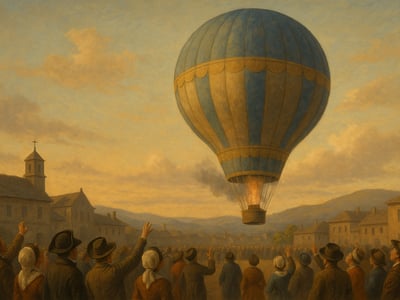
Public demonstration of the Montgolfier balloon at Annonay, France, on 4 June 1783.
On June 4, 1783, in Annonay in the Ardèche region of France, Joseph-Michel Montgolfier and Jacques-Étienne Montgolfier carried out a public demonstration that would become one of the key early moments in the history of flight. Before local officials and spectators, they launched an unmanned balloon made of linen and paper, using heated air to lift it from the ground. Reports differ on the exact figures, but contemporary and later accounts agree on the essential result: the craft rose high into the air, traveled some distance, and came down only after showing that sustained balloon flight was possible.
The demonstration mattered because it was not a private workshop trial or an anecdote passed from inventor to inventor. The brothers chose to present a full-scale experiment in public view. That decision carried a clear risk. If the balloon failed to fill properly, if the envelope tore, or if the craft simply dropped back to earth without proving useful lift, the claim would have been weakened in front of witnesses. Instead, the flight gave visible evidence that heated air could raise a large, lightweight structure into the sky.
The Montgolfier brothers came from a paper-manufacturing family, and that background helps explain both the materials and the method behind their work. Paper and fabric offered a way to build a large envelope light enough to be lifted, while practical experience with materials and production would have shaped their experiments. Their task was not only to imagine ascent, but to make a structure big enough, light enough, and durable enough to survive inflation and launch. For a public trial, the engineering challenge was inseparable from the problem of reliability.
At Annonay, the balloon was inflated by hot air and then released without a human passenger. That unmanned design was important. It reduced the immediate danger while allowing the inventors to test whether a large envelope could gain altitude and remain aloft long enough to convince observers. Accounts of the flight commonly describe the balloon rising to somewhere around 1,600 to 2,000 meters, though those estimates vary, and many sources also report a journey of about 2 kilometers before descent near Annonay. The exact measurements remain uncertain, but the broader fact is well established: the craft did not merely hop upward. It performed a visible aerial passage.
For observers in 1783, that distinction was significant. Curiosity about flight was ancient, but practical demonstrations were rare and often unreliable. Claims could easily outrun proof. What the Montgolfiers offered at Annonay was a public event in which officials and onlookers could see the machine rise and move through the air. In that sense, the demonstration was both a technical experiment and a carefully staged act of verification. Witnesses did not need to rely only on theory. They could point to an object that had ascended, traveled, and landed.
The success at Annonay helped push ballooning rapidly forward in France during the rest of 1783. Later that year, another famous balloon experiment at Versailles carried a sheep, a duck, and a rooster. Still later came early manned ascents, including those associated with Pilâtre de Rozier. The Annonay demonstration therefore stands at the beginning of a quick sequence: public proof, further trials, and then the first steps toward carrying living passengers through the air.
It also belongs to a broader story of competition and experimentation in the late eighteenth century. The Montgolfiers were not the only figures exploring flight. Other inventors, including Jacques Charles and the Robert brothers, pursued different balloon designs, especially gas balloons. But the Annonay event gave heated-air ballooning an early and memorable public success. It showed that ascent was no longer only an idea discussed in principle. It could be demonstrated before a crowd.
That combination of spectacle and method helped the event travel beyond Annonay itself. News of striking experiments could spread quickly through official networks, correspondence, and print. A successful public trial had persuasive power because it joined visual drama to practical evidence. The balloon in the sky was astonishing, but the real force of the moment lay in the fact that many people could attest that it had happened.
Why it still matters
The June 1783 demonstration still matters because it marks an early point at which aeronautics became a practical experimental field rather than a collection of hopes and isolated claims. The Montgolfier brothers did not solve all the problems of flight, and their balloon was unmanned, but they showed that controlled ascent with a purpose-built craft could be achieved in a repeatable, public way.
The event also illustrates how new technical ideas gain acceptance. A claim becomes more persuasive when it is visible, witnessed, and tested under conditions that others can examine. In that respect, Annonay was not important only because a balloon rose into the air. It was important because the ascent was turned into evidence.
Lighter-than-air flight would later find military, scientific, and observational uses, and ballooning would remain an important branch of aviation history even after heavier-than-air flight emerged. The public launch at Annonay stands near the start of that longer development. It was a modest craft by later standards, but it showed that leaving the ground in a designed aerial vehicle had moved from speculation toward practice.
Timeline
- Public hot-air balloon demonstration at Annonay
- Versailles balloon experiment
What you uncovered
Proof in the Air
You didn't just… complete an image; you revisited a moment when flight had to be demonstrated in public before it could be treated as more than an idea.
At Annonay, the balloon's importance was not only that it rose, but that it rose before officials and spectators who could describe what they saw. In early aeronautics, spectacle and evidence were closely linked: a public trial gave a technical claim credibility in a way private assertion could not. That pattern still matters in how new technologies gain trust through visible tests, shared measurements, and repeated results.
The Annonay demonstration came before the better-known Versailles balloon test of 19 September 1783, which carried a sheep, a duck, and a rooster.
FAQ
What happened at the Montgolfier brothers’ Annonay demonstration on 4 June 1783?
Joseph-Michel Montgolfier and Jacques-Étienne Montgolfier publicly demonstrated an unmanned hot-air balloon at Annonay, France, on 1783-06-04. The craft was presented before local officials and spectators.
Was the Annonay balloon unmanned?
Yes. The balloon demonstrated at Annonay was unmanned. It was a linen-and-paper craft filled with heated air.
How high and how far did the balloon travel?
Accounts of the 1783-06-04 demonstration report an ascent to roughly 1,600 to 2,000 meters. The balloon was also reported to travel about 2 kilometers before descending, though measurements vary across sources.
Why is the Annonay flight important?
The demonstration helped establish ballooning as a practical area of experimental aeronautics. It showed that a large balloon could rise in public view and encouraged further balloon experiments later in 1783.